


Article by
Dan Conneally - NMLS 339916, LO13164, BK3246524, CQ1072086
Dan Conneally has been successfully helping Florida families with thier real estate related situations for the last 21+ years, regardless of credit or past financial background.
While Dan is effective with institutional lending, he particuarly shines when matters require unique strategies involving noninstitutional resources.
Check out his legions of testimonials from real Florida families at Google, Facebook and the BBB to get a sense of the caliber and effectiveness he achieves. Dan has appeared on television speading the message of hope to good folks that need diligent, discrete, nonjudgy care.
The IRS isn't just another creditor; they're a federal agency with the power to freeze your bank accounts and place a lien on your Florida home without a second thought. It's a heavy burden to carry, especially when you're watching the 7% daily compounded interest on your tax debt climb while traditional banks slam their doors. We understand that feeling of being trapped between a mounting bill and a rigid financial system. You've worked hard for your home, and seeing equity sit idle while the government threatens your peace of mind is frustrating. The good news is that you can pay off tax debt with home equity by focusing on your property's value rather than your credit history.
In this 2026 guide, we'll show you how to secure fast funding to stop IRS penalties and clear your property title in as little as five days. You'll learn how Florida homeowners are using strategic asset-based loans to meet the March 31 property tax deadline and settle federal obligations before they escalate. We're going to break down the process of turning your home's equity into a financial bridge that leads you back to stability. It's time to stop the fear and start the recovery.
Key Takeaways
- Leverage your Florida property's value to settle IRS or local property tax obligations, even if you’ve already faced rejection from traditional banks.
- Discover how to pay off tax debt with home equity by utilizing asset-based lending that prioritizes your home’s Loan-to-Value ratio over your credit history.
- Understand why private money serves as a vital bridge to clear title liens and stop aggressive IRS collection tactics when your Debt-to-Income ratio is high.
- Navigate critical Florida tax deadlines to prevent tax certificate sales and protect your primary residence from government-initiated foreclosure.
- Learn the streamlined steps to secure funding in as little as 5 to 15 days, providing the speed needed to stop daily interest compounding.
Understanding the Strategy: Can You Pay Off Tax Debt with Home Equity?
The Florida real estate market in 2026 presents a unique challenge for many homeowners. Property values have remained robust across the Sunshine State, yet rising living costs have left many families equity-rich but cash-poor. This means you might be sitting on hundreds of thousands of dollars in property value while struggling to write a check to the IRS or your local tax collector. Leveraging your property to pay off tax debt with home equity is a process where you secure a loan against your house to satisfy government obligations in full. Understanding Home Equity is the first step toward realizing that your house is more than just a shelter; it's a financial tool that can rescue your credit and your peace of mind.
Equity-based tax resolution is a strategic move to stop compounding penalties. The IRS actually prefers that you borrow the money from a private source. They want their funds immediately and in one lump sum rather than waiting years for a risky installment plan. When you use Taxes / IRS Hard Money Loans, the lender coordinates directly with the tax agency during the closing process. This ensures the lien is satisfied and released as part of the escrow, clearing your title and stopping the aggressive collection cycle that often leads to bank levies or wage garnishments.
The High Cost of Waiting: IRS Penalties vs. Loan Interest
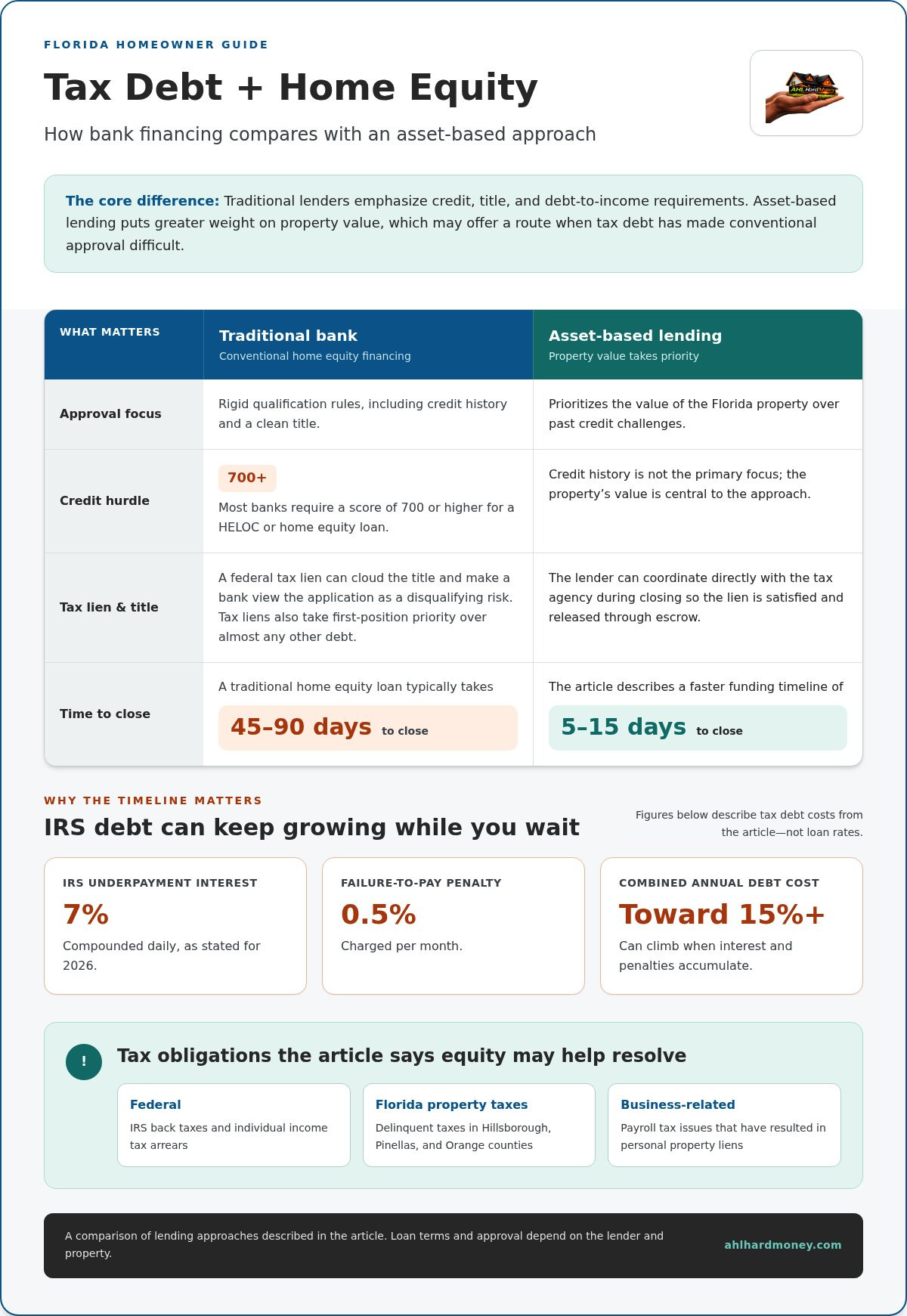
Waiting for a miracle while the IRS watches is a recipe for financial disaster. In 2026, the IRS underpayment interest rate reached 7% compounded daily, but that's only part of the story. When you add the failure-to-pay penalty of 0.5% per month, your total annual cost of debt can quickly climb toward 15% or more. This financial drain is accompanied by a heavy psychological burden. Constant letters and the fear of a tax foreclosure can tear at a family's sense of security. Clearing the debt now prevents a future tax deed sale of your Florida home, ensuring you stay in control of your most valuable asset.
Types of Tax Debt You Can Resolve with Equity
Our local expertise covers various liabilities that Florida homeowners face. You can use your property's value to resolve several types of debt:
- Federal IRS back taxes and individual income tax arrears.
- Delinquent Florida property taxes in counties like Hillsborough, Pinellas, and Orange.
- Business-related tax liabilities, such as payroll tax issues, that have resulted in personal property liens.
Whether it's a local collector or the federal government, the goal remains the same. You use your equity to buy back your financial freedom and protect your home from seizure.
Why Traditional Banks Often Reject Tax-Related Equity Loans
Traditional banks operate on a rigid set of rules that often create a frustrating "Catch-22" for Florida homeowners. To get a standard loan, you need a high credit score and a clean title. However, if you have significant tax arrears, your credit score has likely plummeted, and a federal tax lien is probably clouding your title. This paradox makes it nearly impossible to pay off tax debt with home equity through a conventional lender. While the government provides several IRS tax debt options, most traditional institutions aren't interested in helping you navigate them. They see a tax lien not as a solvable problem, but as a disqualifying risk.
Institutional lenders are obsessed with Debt-to-Income (DTI) ratios. When an IRS or property tax liability appears on your record, banks view it as a massive, high-priority debt that must be factored into your monthly obligations. Because tax liens take "first position" priority over almost any other debt, banks fear they'll lose their collateral if the government decides to seize the property. This fear leads to immediate rejection, leaving you stuck without the funds needed to clear the very debt that’s causing the rejection. For those in this position, seeking home equity loans for bad credit becomes a tactical necessity rather than just an option.
The Credit Score Hurdle
Your FICO score is often the first casualty of a tax dispute. Once a Notice of Federal Tax Lien is filed, it signals to every lender that you're a high-risk borrower. Most banks require a score of 700 or higher for a HELOC or home equity loan, a benchmark that's out of reach for many struggling with back taxes. We take a different approach. At AHL HardMoney, we prioritize the value of your Florida property over your past credit challenges. We believe your equity should work for you, even if your credit report isn't perfect.
The Timeline Problem
Speed is your greatest ally when dealing with the IRS, yet it’s the one thing big banks lack. A traditional home equity loan typically takes 45 to 90 days to close. When you're facing a March 31 property tax deadline or an impending IRS levy, you don't have three months to wait for an underwriter's approval. You need a solution that moves at the speed of the real world. We specialize in closing loans in just 5 to 15 days, providing the rapid liquidity required to meet urgent tax deadlines and stop penalties in their tracks. If you're ready to move forward, you can learn more about our fast-track process and how we support Florida homeowners across the state.
The Hard Money Solution: Tapping Equity with Bad Credit
When traditional banks turn you away, it's often because they're looking at your past rather than your property's potential. Hard money lending offers a different path. It's an asset-based approach where your Florida property serves as the primary collateral for the loan. This shift in focus allows you to pay off tax debt with home equity regardless of your FICO score or employment history. Even the government recognizes this strategy, listing private loans among the official IRS tax payment options because it's often more cost-effective than letting federal penalties compound daily.
Think of hard money as a strategic financial bridge. It's a tactical tool used to clear a title so you can eventually refinance into a traditional bank loan once your credit score has time to recover. By using a cash-out refinance, you can access the liquidity needed to satisfy the IRS in full, stopping their aggressive collection tactics immediately. This proactive relief is designed to handle the "Catch-22" of tax debt by providing the funds first and letting the credit repair follow.
Asset-Based Lending Explained
Your Florida home’s location is a key factor in our approval process. Whether you're located in the bustling neighborhoods of Tampa, the growing suburbs of Orlando, or the high-value coastal areas of Boca Raton, your property's market value is what matters most. We typically look at the Loan-to-Value (LTV) ratio, using a 60% to 70% rule of thumb to determine how much you can borrow. In counties like Hillsborough, Pasco, and Pinellas, we evaluate the local market trends to ensure we're providing a loan that's both helpful for your situation and secure for the long term.
The Closing Process for Tax Debt Loans
The mechanics of closing a tax-related loan are handled with professional urgency. Escrow plays a vital role here, as they ensure the IRS or the local County Tax Collector is paid directly from the loan proceeds. To facilitate this, we'll help you obtain a "Payoff Letter" from the IRS, which provides a verified total of your liability. This allows the title company to release the tax lien simultaneously with the recording of your new loan. This streamlined process means you can go from an active lien to a clear title in as little as 5 to 15 days, providing the speed you need to meet a looming tax deadline.
Navigating the Florida Tax Landscape: Local Deadlines and Rules
Florida homeowners face a strict calendar that rewards early action and penalizes delay. While you can enjoy discounts for early property tax payments starting in November (4%), the mood shifts once spring arrives. March 31, 2026, is the final deadline to pay your 2025 property taxes. On April 1, those taxes become delinquent. This isn't just a late fee; it’s the start of a legal process that can lead to a tax deed sale. Deciding to pay off tax debt with home equity before these deadlines pass is a critical move to preserve your ownership and stop the clock on rising costs.
In Florida, tax collectors don't wait long to recover funds. By June 1st of the delinquent year, local offices begin selling tax certificates for unpaid bills. Investors buy these certificates to earn interest on your debt. While you still own the home at this stage, you've essentially allowed a third party to take a financial interest in your property. If the certificate remains unpaid for two years, the investor can file a Tax Deed Application. This triggers a public auction where your property could be sold to the highest bidder for a fraction of its actual market value.
Homeowners in Tampa, Saint Petersburg, and Clearwater need to stay in close contact with their respective Hillsborough and Pinellas county tax collectors. These offices move quickly, and once the auction process starts, your options for traditional refinancing disappear. We focus on the local reality of these markets, providing rapid solutions that outpace the bureaucratic timeline of the tax office.
Florida Property Tax Foreclosure Timeline
The delinquency cycle begins the moment you miss the March 31 cutoff. Once the tax certificate is sold in June, the two-year redemption period starts. If you're already in the danger zone or facing an impending auction, foreclosure refinance loans can provide the emergency capital needed to halt the process. Waiting until the final month is risky, as the legal fees associated with tax deed applications can add thousands to your total bill.
Local Market Resilience
Taking Action: How to Secure a Tax Debt Loan in 15 Days
Securing the funds to pay off tax debt with home equity shouldn't be a months-long ordeal. When the IRS is knocking or a Florida tax deed sale is looming, every day counts. We've streamlined our process to move at the speed of your deadline, focusing on the value of your property rather than the credit hurdles that stopped you at the bank. By following a clear, four-step path, you can transition from financial crisis to total relief in about two weeks.
- Step 1: Prepare Your Paperwork. Gather your current tax payoff documents and your most recent mortgage statement. These documents tell us exactly what's owed and how much equity is available to solve the problem.
- Step 2: Fast-Track Approval. Apply for a 30-minute approval via a private money refinance. This initial step gives you the green light to move forward without waiting weeks for a traditional credit committee.
- Step 3: Verification. We'll conduct a property valuation and a title search. This confirms your equity levels and identifies any other liens that need to be addressed to ensure you have a clear title post-closing.
- Step 4: Funding. Once you sign the loan documents, we wire the funds directly to the IRS or the County Tax Collector. This ensures the debt is satisfied immediately and the official lien release process begins.
Why Speed is Your Best Defense
Time is the one luxury you don't have when facing tax delinquency. Our ability to close in 5 to 15 days is often the difference between keeping your home and losing it at a public auction. Seeking a fast hard money loan approval Florida is a tactical choice to protect your asset. It stops the clock on the 7% daily compounded IRS interest and prevents the local tax collector from moving forward with a certificate sale. By shrinking the closing window, you minimize the accrual of additional penalties that would otherwise eat into your home’s remaining equity. For comprehensive support during this process, consulting with a tax specialist like Apex Income Tax & Multiservice LLC can help you navigate complex IRS requirements and plan for a more stable financial future.
Satisfying your tax debt is the first step toward a full financial recovery. Once the lien is gone and your title is clear, you finally have the breathing room to rebuild your credit over the next 12 to 24 months. This loan serves as a strategic bridge. It protects your Florida property today so you can qualify for a traditional bank refinance tomorrow. Don't let a temporary tax setback become a permanent loss of your home. You can Contact AHL HardMoney today for a fast equity-based solution and take the first step toward reclaiming your financial future.
Reclaim Your Financial Freedom Today
Your Florida home is more than just a place to live; it's the key to resolving your most pressing financial challenges. We've explored how your property's value can stop aggressive IRS collection tactics and prevent the devastating loss of your home at a local tax deed auction. You don't have to let a low credit score or a rigid bank's rejection letter dictate your future. By choosing to pay off tax debt with home equity, you're taking a decisive step toward proactive relief and a clear property title.
Our team has served as resourceful local champions for Florida homeowners since 2004. We understand the urgency of tax deadlines, which is why we guarantee a closing within 5 to 15 days. Because our approvals are asset-based, no credit check is required to move forward. You have the equity, and we have the expertise to help you leverage it effectively.
The weight of tax debt doesn't have to be permanent. Take control of your situation today and secure the peace of mind that comes with a fresh start and a protected home. For small business owners seeking additional resources on long-term financial health, you can learn more about ASAP Solutions for their comprehensive guide on small business accounting.
Frequently Asked Questions
Can I get a home equity loan if I have an active IRS tax lien?
Yes, you can. While traditional banks usually reject applications with active liens, we specialize in asset-based lending that looks past your credit report. We use the equity in your Florida home to satisfy the lien at closing, which clears your title and stops further penalties. It's a strategic way to pay off tax debt with home equity when institutional lenders turn you down due to aggressive IRS collection tactics.
How fast can I get a loan to pay off my Florida property taxes?
You can receive funding in as little as 5 to 15 days. We understand that Florida property tax deadlines, like the critical March 31 cutoff, require immediate action. Our team provides approvals within 30 minutes to ensure you can stop the delinquency process before tax certificates are sold in June. This speed is essential for homeowners in Tampa, Orlando, and Clearwater facing aggressive collection timelines from the county tax collector.
Do I need a 700 credit score to use my equity for tax debt?
No, your FICO score is not a factor for approval with our equity-based programs. We focus on the value of your Florida property and the available equity rather than your past credit history. This allows homeowners in markets like Brandon or Sarasota to access funds even if their credit has been damaged by tax liens. We look at the equity you've built to find a path forward for your financial recovery.
What is the maximum Loan-to-Value (LTV) for a tax debt hard money loan?
We generally look for a Loan-to-Value ratio between 60% and 70% for these types of loans. This means you need a healthy amount of equity built up in your primary residence or Florida investment property. By maintaining these LTV levels, we can provide the necessary capital to clear your tax obligations while ensuring the loan remains a sustainable financial bridge. This equity-first approach is why credit history is not a factor.
Will the lender pay the IRS directly or do I get the cash?
To ensure the debt is fully resolved, the lender typically pays the IRS or the local county tax collector directly during the closing process. Any remaining funds from your cash out refinance can then be disbursed to you. This direct payment method is the most efficient way to pay off tax debt with home equity. It guarantees the lien is satisfied and released, providing you with a clear title and immediate peace of mind.
What happens if my home is already in the tax deed sale process?
We can still help if there is sufficient equity in the property. Our foreclosure refinance loans are specifically designed to stop the auction process by paying the delinquent taxes and fees in full. Because we close in 5 to 15 days, we can often intervene even when a tax deed application has already been filed. This rapid response is vital for protecting your home from being sold for a fraction of its value.
Can I use equity from a rental property to pay my personal tax debt?
Yes, you can leverage the equity in a Florida rental property to satisfy personal IRS or property tax liabilities. As an asset-based lender, we look at your entire real estate portfolio to find the best collateral for your specific needs. This flexibility is ideal for landlords in Saint Petersburg or Lakeland who need to protect their primary residence. We focus on the equity available across your properties to secure a fast solution.
Is a hard money loan cheaper than IRS interest and penalties?
In many cases, yes. With the IRS charging 7% daily compounded interest in 2026 plus failure-to-pay penalties, the total cost of government debt can be staggering. A hard money loan serves as a short-term tool to stop these compounding costs immediately. It clears the lien and stops the penalties from growing, allowing you to eventually transition back to traditional financing once your title is clear and your credit score has time to recover.
Disclaimer:
While Dan is not a real estate attorney, he is a Full Time, Licensed Florida Mortgage and Real Estate Broker Professional coupled with 21+ years of successful strategies, methodologies and techniques that have proven effective to the benefit of Florida families.
While not every conversation is a deal, we promise to leave you better off then before you called. We serve everyone we come in contact, with the highest levels of integrity and dignity.
We invite you to make the call 📲


