


Article by
Dan Conneally - NMLS 339916, LO13164, BK3246524, CQ1072086
Dan Conneally has been successfully helping Florida families with thier real estate related situations for the last 21+ years, regardless of credit or past financial background.
While Dan is effective with institutional lending, he particuarly shines when matters require unique strategies involving noninstitutional resources.
Check out his legions of testimonials from real Florida families at Google, Facebook and the BBB to get a sense of the caliber and effectiveness he achieves. Dan has appeared on television speading the message of hope to good folks that need diligent, discrete, nonjudgy care.
Did you know that Florida currently holds the highest foreclosure rate in the nation, with Pinellas County filings surging by 35 percent in the first half of 2026? If you are facing a looming sale date in Clearwater or St. Pete, it's easy to feel like the clock has already run out. You've likely dealt with aggressive bank attorneys and the sting of being rejected by traditional lenders who only care about your credit score. However, your home's value is often more powerful than your FICO rating. You can still refinance to stop foreclosure Pinellas County by leveraging the equity you've built, even if the auction is just days away.
We understand the weight of this uncertainty and the fear of losing your primary residence. This 2026 guide reveals how to secure a fast bridge loan to halt the legal process, pay off delinquent taxes, and regain your financial footing. You'll discover the exact steps to transition from a 30 minute approval to a closed loan in as little as five days. By the end of this article, you'll have a clear roadmap to protect your home, stabilize your equity, and silence the bank for good.
Key Takeaways
- Understand the Florida judicial process and the Pinellas Clerk's role to identify exactly how much time remains before a scheduled auction.
- Learn how to use a private money refinance to stop foreclosure Pinellas County by paying off delinquent balances, back taxes, and legal fees in full.
- Compare the speed of asset-based lending with traditional banks to see why a 30-minute approval is vital for time-sensitive emergency situations.
- Follow a 5-step roadmap to accurately assess your Clearwater or St. Pete home equity and secure a formal payoff letter from your current servicer.
- Discover how direct access to local decision-makers allows for property-based funding in as little as 5 days without the friction of institutional red tape.
Understanding the Foreclosure Timeline in Pinellas County
Florida is a judicial foreclosure state. This means your lender must sue you in court to take your home. For residents in St. Petersburg and Clearwater, this process provides a vital buffer. Understanding the Foreclosure Process helps you see that the bank doesn't own your home the moment you miss a payment. However, once the Pinellas County Clerk of the Circuit Court schedules an auction, the timeline shrinks rapidly. The Clerk manages the public auction, usually held online, and is responsible for issuing the final title transfer documents.
You have a legal window to act. It starts with the Lis Pendens and ends at the foreclosure sale. Identifying this window of opportunity, specifically the time between the initial lawsuit filing and the Final Judgment, is critical for a smooth transition. During this time, you can still refinance to stop foreclosure Pinellas County if you have enough equity. Waiting until the last minute is risky, but it's rarely too late until the gavel falls. Private lenders can often move faster than the court's calendar, providing the capital needed to halt the legal machinery in as little as five days.
To better understand this concept, watch this helpful video:
The Legal Steps: From Missed Payment to Auction
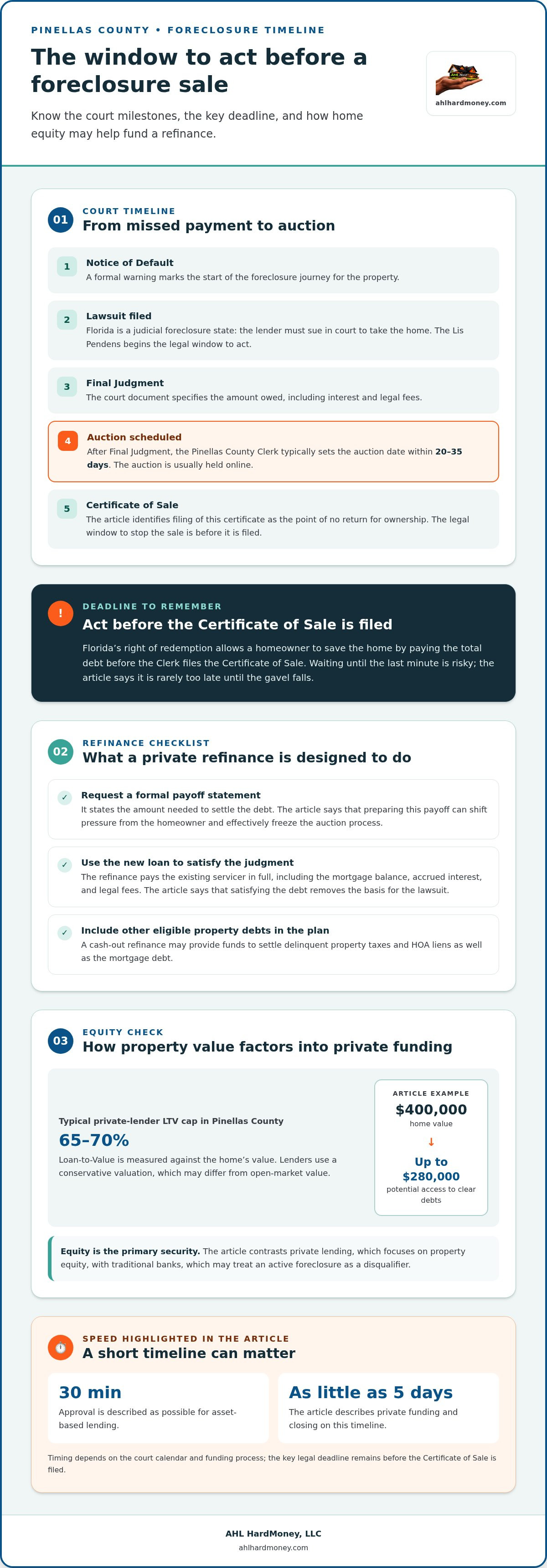
Your journey usually begins with a Notice of Default. This document is a formal warning for your Clearwater or St. Pete property. After the bank files its lawsuit, the court eventually issues a Final Judgment. This document specifies exactly how much you owe, including interest and legal fees. Once this happens, the Pinellas Clerk typically sets the auction date within 20 to 35 days. By choosing to refinance to stop foreclosure Pinellas County, you can satisfy the judgment before the auction date arrives. Traditional lenders usually stop talking to you at this point. Their systems are locked, and their attorneys are focused solely on the sale.
Why Refinancing Must Happen Before the Gavel Falls
The state of Florida grants you the right of redemption. This means you can save your home by paying the total debt before the Clerk files the Certificate of Sale. A private home equity loan can provide these funds quickly. This new loan pays off the entire Final Judgment, effectively dismissing the court case and stopping the auction. You must act before the Certificate of Sale is filed, as that document represents the point of no return for your ownership. The Redemption Period in Pinellas County is the final chance to save equity.
How Refinancing to Stop Foreclosure Actually Works
A foreclosure bailout loan isn't a simple mortgage modification or a temporary repayment plan. It's a complete financial reset. When you refinance to stop foreclosure Pinellas County, a private lender provides the capital necessary to pay your existing mortgage servicer in full. This payment covers the entire principal balance, years of accrued interest, and the aggressive legal fees added by the bank's attorneys. By satisfying the debt entirely, the underlying lawsuit loses its legal basis. The court case is dismissed because there is no longer a balance for the bank to collect.
Private money is often the only viable path once litigation begins. Traditional banks view an active foreclosure as an absolute disqualifier, often labeling the borrower as uncollectible. A private lender, however, looks at your property's equity as the primary security. They see a homeowner who needs a bridge to financial stability rather than a credit score on a page. This transition allows you to move from being a defendant in a courtroom to a stabilized homeowner with a fresh start.
The Role of Home Equity in Private Funding
Your equity is the engine that drives this entire process. To calculate your usable equity, lenders look at the Loan-to-Value (LTV) ratio. In Pinellas County, private lenders typically cap this at 65 to 70 percent of the home's value. For example, if your home in St. Pete is worth $400,000, you might access up to $280,000 to clear your debts. A cash-out refinance can provide the liquidity needed to settle not just the mortgage, but also delinquent property taxes and HOA liens. It's vital to understand the difference between market value and quick-sale value. While your home might sell for a premium on the open market, lenders use a conservative valuation to ensure the loan can be funded in days. Following Pinellas County Foreclosure Procedures requires absolute precision, so having a clear equity picture is the essential first step.
Stopping the Sale: The Immediate Impact
The moment a private lender requests a formal payoff statement from your current bank, the pressure begins to shift. This document tells the court and the bank's attorneys that the funds to settle the debt are being prepared. It effectively freezes the auction process. The psychological relief is often the most significant part of the journey. You stop being a target for aggressive mailers and process servers. Instead, you regain control of your primary residence. These foreclosure bailout loans in Florida are specifically built for speed, ensuring the gavel never falls on your hard-earned equity. If you're ready to see how your property's value can work for you, it's time to learn more about our local approach.
Hard Money vs. Traditional Refinance: Why Speed Wins
Traditional banking operates on a timeline that simply doesn't exist for someone facing a court-ordered auction. While a standard bank might take 45 days to process a file, a private lender can offer a 30-minute approval. When you need to refinance to stop foreclosure Pinellas County, every hour counts. Traditional institutions require piles of paperwork and months of waiting, but asset-based lending focuses on the property itself. This allows for a closing window of 5 to 15 days, which is often the only way to beat a judicial sale date.
Why Traditional Banks Say "No" During Foreclosure
Once a Lis Pendens is filed against your property, most traditional mortgage departments will immediately freeze your application. Conventional lenders are bound by rigid federal guidelines that ignore the reality of a financial crisis. They see the legal action as a massive risk, regardless of how much equity you have tucked away in your St. Pete home. Additionally, missed payments during the legal process cause credit scores to plummet, often falling well below the 620 minimum required by big banks. This creates a "catch-22" where you can't get the loan you need because your credit is damaged by the very situation you're trying to fix. High debt-to-income (DTI) ratios further complicate things, as banks prioritize your monthly earnings over the actual value of your home.
The Hard Money Advantage for Pinellas Homeowners
By choosing a local partner, you gain access to a different, more human philosophy to refinance to stop foreclosure Pinellas County. By utilizing home equity loans, you bypass the invasive credit checks and income verifications that stall traditional deals. Local expertise in St. Petersburg and Clearwater real estate markets allows private lenders to value your property accurately and quickly, often without a full appraisal. Hard money lenders prioritize the property asset over the borrower’s past financial mistakes. This financing acts as a "bridge," providing a 12 to 24-month temporary fix that stops the immediate crisis. It gives you the breathing room to either sell the home for a full market price or repair your credit enough to eventually transition back into a traditional mortgage.
The 5-Step Pinellas Refinance Roadmap
Stopping a foreclosure requires a strategic, high-speed plan. When you choose to refinance to stop foreclosure Pinellas County, you're engaging in a race against the court's calendar. This roadmap simplifies the path from legal crisis to financial resolution. It's designed to move you through the process in days, not months. By following these specific steps, you can transition from the stress of a lawsuit to the security of a settled debt.
- Step 1: Immediate Equity Assessment. We determine exactly what your St. Pete or Clearwater home is worth. Since equity is the primary qualification, this step happens almost instantly to establish your borrowing power.
- Step 2: Securing a Payoff Letter. You must request a formal payoff statement from your current mortgage servicer. This document lists the total amount needed to satisfy the debt completely, including all legal fees and interest.
- Step 3: Fast-Track Approval. Leveraging a 30-minute approval window, you get a clear answer without the typical institutional delays that cause traditional bank loans to fail.
- Step 4: Property Verification and Title Search. A title company investigates the property to identify the Lis Pendens and any other outstanding liens that need clearing.
- Step 5: Closing and Settlement. Once the new loan funds, the existing mortgage is paid off in full, and the foreclosure case is legally dismissed.
Gathering Your Critical Documents
Speed depends on preparation. You should have your most recent mortgage statement and property tax bill ready for review. It's vital to distinguish between a reinstatement amount, which only brings the loan current, and a payoff amount, which retires the debt entirely. Many homeowners also use a private money refinance to clear IRS or property tax liens simultaneously. This holistic approach ensures your title is clean and your financial future is stable, preventing future legal headaches from secondary creditors.
Navigating the Pinellas Court System
Communication is your best defense once the legal process starts. After your new funding is secured, it's crucial to notify the bank’s attorney that a refinance is in progress. A formal Motion to Cancel Sale can be filed with the court to stop the auction while the title company prepares the final settlement documents. The title company plays a pivotal role here. They ensure that once the settlement occurs, the foreclosure is legally dismissed in the public records. This process effectively removes the legal cloud over your property, allowing you to breathe again. You aren't just paying a bill; you're reclaiming your home's title.
Why Pinellas Homeowners Trust AHL HardMoney
Institutional red tape is the enemy of a homeowner in crisis. When you're facing a court-ordered sale, you don't have time for committee reviews or distant underwriters who don't understand the St. Petersburg market. AHL HardMoney (NMLS ID 380601) provides direct access to decision-makers who live and work right here in Florida. We focus on an "Equity First" philosophy, which means we look at the potential of your property rather than the temporary financial problems you're facing. Our team has a proven track record in hard money lending across Florida, specifically helping families stabilize their finances when traditional banks turn them away.
Local Expertise in St. Petersburg and Beyond
Our deep knowledge of Pinellas County neighborhood values is a significant advantage for our clients. Whether your home is a historic bungalow in Old Northeast or a coastal property near the Beaches, we understand what your equity is actually worth in 2026. This isn't just about numbers; it's about community. We've built a dedicated network of local appraisers and title agents in Clearwater, Largo, and St. Pete who understand the extreme urgency of a pending auction. This local infrastructure allows us to refinance to stop foreclosure Pinellas County with a level of precision that national lenders simply can't match. We act as a resourceful local champion, standing between you and the bank's attorneys to ensure your primary residence remains yours.
Getting Started: Your 30-Minute Approval
The path to proactive relief starts with a simple conversation. Our equity-based application process is designed to be inclusive and incredibly fast. We don't need a perfect credit score or a massive stack of tax returns to get started. Once you reach out, you can expect a clear answer within our signature 30-minute approval window. In the first 24 hours after contacting us, we'll review your equity position and begin the property verification process. This high-speed momentum is designed to replace your anxiety with a concrete plan of action. We move with purpose because we know that in the foreclosure world, time is your most valuable asset. You don't have to wait for the gavel to fall to take back control of your home.
Stop your foreclosure today with a fast Pinellas County refinance
Reclaiming Your Home and Your Future
The Pinellas County foreclosure timeline is demanding, but it isn't an immediate dead end for your ownership. You've learned that your home equity is a powerful financial shield that can halt the auction process, regardless of past credit challenges. By acting before the Certificate of Sale is filed, you can secure a vital bridge to stability and protect the hard-earned value in your St. Pete or Clearwater property. It's entirely possible to refinance to stop foreclosure Pinellas County even when traditional banks have closed their doors and stopped communicating with you.
Our approach focuses on speed and simplicity to provide the proactive relief you need. With a 5 to 15 day closing speed and approvals based strictly on equity rather than FICO scores, you have a viable path forward that traditional lenders simply cannot offer. Our team of local Pinellas County experts understands the urgency of the court's calendar and is ready to move at the speed your specific situation requires.
You don't have to face this difficult transition alone. Reclaiming your peace of mind starts with a single step toward a customized solution that puts your home and your family's future first.
Frequently Asked Questions
Can I really stop a foreclosure in Pinellas County if the sale is next week?
Yes, you can stop a sale scheduled for next week by moving with extreme urgency. Because AHL HardMoney can close in as little as 5 to 15 days, it's possible to satisfy the court's judgment before the Pinellas County Clerk of Court completes the auction. You must provide your current payoff letter immediately to ensure our local team can fund the deal and help your attorney file a motion to cancel the sale in time.
How much equity do I need to qualify for a hard money refinance?
Most private lenders in the St. Petersburg and Clearwater area require you to have at least 30 to 35 percent equity in your primary residence. This means your total loan-to-value ratio should generally stay at or below 70 percent. This cushion protects the investment while allowing you to refinance to stop foreclosure Pinellas County. We use a local assessment to determine your home's current market value rather than relying on automated estimates.
Will a low credit score prevent me from refinancing to stop foreclosure?
A low credit score won't prevent you from qualifying for an equity-based loan. We prioritize the value of your property and the amount of equity you've built over your FICO score or past financial challenges. Traditional banks often walk away when they see a foreclosure filing, but our "Equity First" philosophy allows us to provide approvals in as little as 30 minutes. We look beyond your credit report to find a viable path forward.
What are the typical interest rates for a foreclosure bailout loan in Florida?
Interest rates for foreclosure bailout loans in Florida are typically higher than traditional bank mortgages because they represent a higher risk and provide much faster access to capital. These are short-term bridge solutions designed for speed and flexibility rather than 30-year stability. While specific rates vary based on the equity position and property type, most borrowers find the cost manageable compared to the total loss of their home's built-up value and primary residence.
What happens to the Lis Pendens once I refinance?
The Lis Pendens is a public notice that a lawsuit is pending against your property. Once you complete your refinance and the existing lender is paid in full, their attorney must file a voluntary dismissal of the lawsuit. The title company then ensures the Lis Pendens is cleared from the public records. This process removes the legal cloud over your Clearwater or Largo home, restoring your title to a clean and marketable status.
Can I refinance if I have an IRS tax lien on my Pinellas property?
Yes, you can still refinance even if you are facing an IRS tax lien or delinquent property taxes. We offer specific programs like our Taxes / IRS Hard Money Loans designed to consolidate these debts into one manageable payment. By using your home's equity to pay off the government liens at closing, you can stop the foreclosure process and prevent the IRS from taking further collection actions against your personal assets or property.
How long does the hard money loan last?
Hard money loans are intended to be temporary bridge financing and usually last between 12 and 24 months. This window provides you with enough time to stabilize your finances, improve your credit score, or list the property for a traditional sale without the pressure of a looming auction. It's a strategic tool used to stop the immediate crisis in Pinellas County while you prepare for a long-term financial solution or a conventional bank refinance.
Do I need to be employed to qualify for an equity-based loan?
You don't necessarily need traditional employment or a standard W-2 to qualify for our equity-based programs. Since we focus on the property's value and your equity position, we can often work with self-employed individuals, retirees, or those currently between jobs. Our goal is to see that the loan is well-secured by the real estate asset itself. This flexibility is why so many residents in St. Pete and Clearwater choose to refinance to stop foreclosure Pinellas County.
Disclaimer:
While Dan is not a real estate attorney, he is a Full Time, Licensed Florida Mortgage and Real Estate Broker Professional coupled with 21+ years of successful strategies, methodologies and techniques that have proven effective to the benefit of Florida families.
While not every conversation is a deal, we promise to leave you better off then before you called. We serve everyone we come in contact, with the highest levels of integrity and dignity.
We invite you to make the call 📲


