

Article by
Dan Conneally - NMLS 339916, LO13164, BK3246524, CQ1072086
Dan Conneally has been successfully helping Florida families with thier real estate related situations for the last 21+ years, regardless of credit or past financial background.
While Dan is effective with institutional lending, he particuarly shines when matters require unique strategies involving noninstitutional resources.
Check out his legions of testimonials from real Florida families at Google, Facebook and the BBB to get a sense of the caliber and effectiveness he achieves. Dan has appeared on television speading the message of hope to good folks that need diligent, discrete, nonjudgy care.
What if a low credit score isn’t the only thing a Florida lender considers? If you’re exploring property equity loans bad credit, it’s understandable to worry that past credit problems will end the conversation before it starts. They may limit your options, but some property-secured lenders also assess the home’s value, available equity, existing debt, and how you plan to repay.
This guide explains how those factors can shape a loan application, what information a lender may ask you to provide, and how asset-based financing compares with other possible routes. You’ll also learn why a loan secured by your home deserves careful consideration: if you can’t meet the repayment terms, you could lose the property.
We’ll compare traditional home equity financing with hard-money options and cover questions to ask about costs, terms, and repayment. Use the checklists to prepare for a lender conversation and compare the written terms, rather than assuming your credit score or available equity tells the whole story.
Key Takeaways
- Property equity loans for borrowers with bad credit may be worth exploring, but lenders can weigh the property, existing debt, loan purpose, and repayment plan alongside credit.
- Compare traditional borrowing with hard-money options by asking how each lender reviews an application and reviewing the confirmed terms.
- Before speaking with a lender, gather details about ownership, the property, mortgage balances, liens, income, debts, and how you plan to use the funds.
- Review repayment obligations carefully: because the property secures the loan, falling behind could put your home at risk.
- When exploring AHL HardMoney, LLC’s Florida home equity loan options, ask whether your property and situation fit a current program.
Can You Get a Property Equity Loan With Bad Credit in Florida?
Yes, bad credit doesn’t automatically decide every property-secured loan application in Florida. Some lenders may consider a borrower’s property and available equity alongside credit history, but an asset-based review isn’t a promise of approval or a credit-free process. A property equity loan is borrowing secured by real estate you own. Because the property acts as collateral, failing to meet the repayment terms could put it at risk.
For borrowers researching property equity loans bad credit, the key is to understand what a lender may assess, not assume that a certain amount of equity guarantees a loan. Ask how the lender evaluates available equity, the property, existing claims against it, and your plan to repay.
What does property equity mean to a lender?
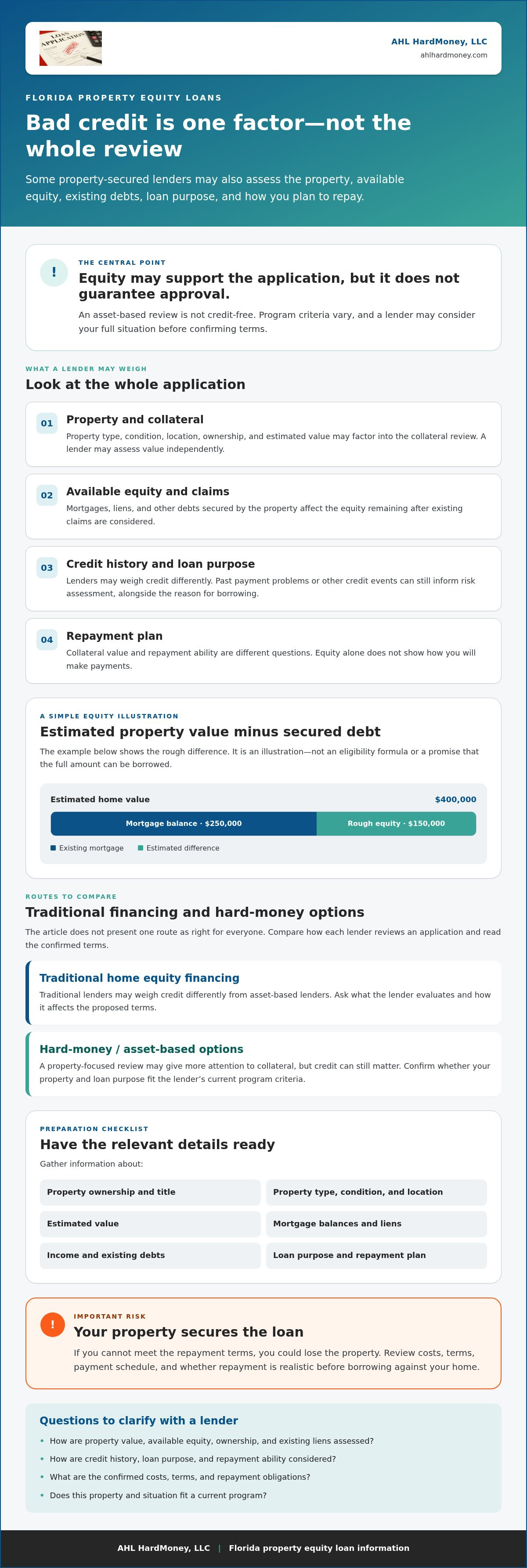
Equity is the property’s estimated value minus the debts secured against it. For example, if a home is estimated to be worth $400,000 and the mortgage balance is $250,000, the rough difference is $150,000 in equity. That’s an illustration, not an eligibility formula or a promise that the full amount can be borrowed.
A lender may use its own valuation and review the mortgage and other liens to understand the property’s position. The amount of equity considered acceptable depends on the specific program and its underwriting. For a neutral introduction to the concept, see this overview of home equity.
Does bad credit automatically disqualify a Florida borrower?
Not necessarily. Traditional lenders and asset-based lenders may weigh credit differently, and a property-focused review may give more attention to collateral. Still, credit history can inform risk assessment. A lender may consider past payment problems or other credit events alongside the details of the proposed loan. Asset-based doesn’t mean credit-free, and no lender can be assumed to approve every applicant.
Expect the full situation to matter. A lender may review where the property is located, who owns it, its condition and estimated value, existing mortgages or liens, the requested loan purpose, and how you expect to repay. Ownership details or outstanding claims against the property can affect the review. A clear repayment strategy helps explain how you plan to manage the borrowing.
AHL HardMoney, LLC is a Florida-based, non-institutional lender that offers hard-money home equity loans. Florida borrowers can review its home equity loan options, then confirm whether a particular property and loan purpose fit current program criteria. Whatever route you explore, compare the actual terms and consider whether repayment is realistic before using your home as collateral.
How Florida Property Equity Loans Assess Credit, Equity, and Repayment
A lender’s review usually involves more than estimating how much equity a property holds. For borrowers considering property equity loans bad credit, understanding the full picture can help you prepare useful questions and avoid treating one favorable factor as a guarantee. Program criteria vary, so ask what the lender will assess and how each factor affects the proposed terms.
Collateral value and repayment ability are different questions: a property may support a loan as security, but it doesn’t show by itself how you’ll make the payments. A lender may look at the property, ownership, existing debts, credit history, loan purpose, and repayment plan together. Equity is one part of the review, not a substitute for understanding the loan’s costs, schedule, and your ability to repay.
How property value and existing liens affect the review
Property type, condition, location, and estimated value can all matter to a lender’s collateral review. The lender may assess value independently, so an online estimate or tax record shouldn’t be treated as a final valuation. Ownership matters too: be ready to explain who holds title and whether anyone else has an interest in the property.
Make a complete list of mortgages, liens, and other debts secured by the real estate. These obligations affect the equity available after existing claims are considered. If there’s no mortgage on the property, AHL’s information about Florida property with no mortgage offers context for that scenario. Debt-free ownership still doesn’t determine approval or loan terms on its own.
Why a clear repayment or exit plan matters
An exit plan is your realistic method for repaying the loan or refinancing it, if refinancing is part of your plan. Depending on the situation, a borrower might discuss documented income or a planned refinance, but neither approach is automatically suitable or assured. Be ready to explain the steps, timing, and assumptions behind your plan.
Stress-test those assumptions. What if income changes, an expected refinance isn’t available, or another part of the plan takes longer than anticipated? Consider whether you could still meet payments and what other resources might be available. Since the property secures the borrowing, missed payments can put it at risk.
Also confirm what type of financing is being discussed. The Consumer Financial Protection Bureau explains the difference between a home equity loan and a home equity line of credit. Ask the lender to clarify the specific structure, repayment schedule, and all applicable terms before deciding whether it fits your needs.
Hard-Money Equity Loans vs. Other Options for Bad-Credit Borrowers
Traditional bank borrowing and hard-money equity financing can evaluate an application differently. A bank may place substantial weight on credit history, income documentation, and existing obligations. An asset-based lender may focus more heavily on the property and its equity, while still reviewing the borrower’s circumstances and repayment plan. Neither approach guarantees approval, and a property-secured loan puts the property at risk if you can’t repay.
Compare the actual terms, not just the review process. Hard-money financing isn’t automatically cheaper, safer, or the right fit. Use the table to identify questions to ask, then verify each lender’s requirements and proposed terms.
| Option | Collateral | Likely review focus | Repayment questions | Details to verify |
|---|---|---|---|---|
| Traditional bank borrowing | May be secured by the home, depending on the product | Credit, income, debts, and property | Can your budget support the payment? | Eligibility, rate, fees, timeline, and loan structure |
| Hard-money home equity loan | Real estate | Property value and equity, plus borrower and repayment details | What’s your practical plan to repay? | All costs, term, payment schedule, and program criteria |
| Cash-out refinance | Property securing the refinanced mortgage | Existing mortgage, property, and borrower details | How will the new mortgage payment compare? | New loan terms, costs, and effect on existing financing |
| Debt consolidation | Depends on the financing used; property-secured options put the home at risk | Total debts and proposed repayment structure | Will the new plan be manageable over time? | Which debts are included, total costs, and collateral risk |
When might a hard-money home equity loan be worth exploring?
It may be worth discussing if traditional qualification is difficult and you believe your property has usable equity. That doesn’t establish eligibility: the lender still needs to review the application, property, and repayment plan. AHL HardMoney offers hard-money home equity loans in Florida. Its Florida home equity loan information is a place to check for program-specific details and questions to raise.
When should you compare cash-out refinance or debt consolidation?
A home equity loan adds borrowing secured by the property, while a cash-out refinance replaces an existing mortgage with a new one that may provide funds from available equity. Compare how each would affect your total obligations and payment structure. If debt consolidation is the goal, list every balance you’d address and compare the new repayment plan with your current debts. Consolidating debt against a home can increase the stakes if payments become difficult. You can also research a cash-out refinance as a separate option.
How to Prepare for a Bad-Credit Property Equity Loan in Florida
Good preparation makes a lender conversation more useful, but a checklist is not a guarantee of approval. For property equity loans bad credit, bring a clear picture of the property, your existing obligations, why you need the funds, and how you expect to repay. Ask the lender which documents are required for its review.
What information should you gather before speaking with a lender?
Use this checklist to organize your information before discussing options. Not every item will necessarily be an eligibility requirement, so confirm the lender’s document list.
- Ownership and property: Note who owns the property, its address, type, condition, and any records or information you have about its value.
- Mortgage and liens: Gather recent mortgage statements and details of other loans, liens, or debts secured against the property.
- Credit and obligations: Prepare a straightforward summary of credit issues, current monthly obligations, and any changes that may affect your finances.
- Income and repayment: Organize information that helps explain your income and how you plan to meet payments or repay the balance.
- Loan purpose: Write down how much you’re seeking and what you intend to use the funds for. Be ready to explain how the borrowing fits your broader financial plan.
What questions should you ask before using your home as collateral?
Ask how the lender will value and review your specific property, and request the proposed terms in writing. Compare the full cost, any fees, payment schedule, loan term, and any prepayment provisions. Clarify what happens if a payment is late, your finances change, or a planned refinance or other exit strategy isn’t available.
Understand the full repayment obligation, including what could happen if you can’t pay, before pledging your property. A property-secured loan puts the real estate at risk if you don’t meet your obligations. Take time to read every document, ask for explanations of unfamiliar terms, and consider having a qualified professional review the paperwork when needed. Don’t rely on verbal estimates when making a commitment. Confirm the final terms that apply to your application.
Bring your questions, too. A focused discussion about ownership, property details, existing debt, loan purpose, and repayment can help clarify whether an option is worth considering, without treating an initial conversation as an approval.
For background on the company, visit AHL HardMoney’s about page.
Explore AHL HardMoney’s Florida Property Equity Loan Options
AHL HardMoney, LLC is a Florida-based, non-institutional lender offering hard-money home equity loans and cash-out refinance. The company is headquartered in Tampa and serves Florida borrowers. Its listed locations include Tampa, Clearwater, Saint Petersburg, Palmetto, Largo, Newport Richey, Port Richey, Brooksville, Brandon, Orlando, Daytona, Naples, Ocala, Deltona, DeLand, Jupiter, Palm Beach, Lakeland, and Boca Raton. Confirm current availability and whether a particular property and loan purpose fit a program.
For people exploring property equity loans bad credit, a conversation with a lender can help clarify whether a property-secured option is worth considering. AHL reports that approvals can often happen within 30 minutes and that some loans close in 5 to 15 days. These are company-reported timeframes, not promises. Confirm that they’re current, and remember that timing depends on verification and individual circumstances.
What to clarify in an initial conversation
Start with the property and the purpose of the borrowing. Ask whether the property’s location and type fit a currently available program, then share relevant details about ownership and any mortgages or liens. Be candid about credit circumstances and explain how you intend to use the funds.
Discuss your repayment plan, too. Ask what information the lender needs to assess the property, your application, and the proposed repayment strategy. Before making a decision, request the complete terms that apply to your specific application, including the payment schedule, costs, loan duration, and consequences of missed payments. Review the documents carefully. An initial discussion isn’t an approval or an obligation to borrow.
How to take the next step without rushing
Use the conversation to get answers, not to make a decision under pressure. Compare the option with other paths that may fit your needs, and assess whether the repayment plan remains realistic if circumstances change. Because the property secures the debt, failing to meet the loan obligations could put it at risk.
AHL describes its approach as individualized, with property, equity, purpose, and repayment considerations forming part of the discussion. If you’re still weighing your options, ask questions and take time to review any proposed terms before deciding whether to proceed.
Learn about AHL HardMoney’s background and lending approach as you consider your next step.
Take Your Next Step With a Clearer Plan
A low credit score doesn’t automatically rule out every property-secured option. For property equity loans bad credit, lenders may weigh available equity, property details, existing obligations, credit history, and your repayment plan together. Compare the full written terms carefully, and remember that borrowing against real estate puts the property at risk if you can’t repay.
AHL HardMoney is a Florida-focused, non-institutional lender headquartered in Tampa. The company reports that approvals can often happen within 30 minutes and that some loans close in 5 to 15 days. These are not guarantees; verify current timeframes, program availability, and terms for your situation.
A thoughtful conversation can help you clarify your property, intended use, and repayment approach without rushing into a decision. Take the time you need to compare your options and understand the obligations.
With clear information and a realistic plan, you can move forward with greater confidence.
Frequently Asked Questions
Can I get a property equity loan in Florida with bad credit?
Possibly. Bad credit doesn’t automatically rule out every property-secured loan, but it can affect the review and terms. Some hard-money lenders may give significant attention to the property’s value and available equity while also considering credit history, ownership, existing liens, loan purpose, and your repayment plan. AHL HardMoney offers hard-money home equity loans in Florida, but each application and property requires review. Approval isn’t guaranteed.
Does a home equity loan require a minimum credit score?
There isn’t one minimum score that applies to every home equity loan. Traditional lenders often set credit requirements; research cited for this guide says many Florida HELOC lenders require at least 640, though criteria vary by lender and product. Hard-money lenders may focus more on property equity, but they can still review credit and other application details. Ask the specific lender which criteria apply to the program you’re considering.
How does a hard-money lender evaluate property equity?
A hard-money lender may assess the property’s estimated value alongside mortgages, liens, or other debts secured against it to understand available equity. Property type, condition, location, ownership, intended loan use, and repayment plans may also factor into the review. Equity alone doesn’t establish approval or show that repayment is affordable. Ask how the property will be valued and request the complete terms for your specific application.
Can I use a Florida property with no mortgage as collateral?
A property with no mortgage may be considered, but debt-free ownership doesn’t guarantee that a lender will approve a loan or offer particular terms. The lender may still review ownership, property value and condition, location, any other liens, loan purpose, and repayment ability. Be prepared to confirm whether the property fits a currently available program. AHL HardMoney is based in Tampa and lends in Florida, subject to program and property review.
What documents should I prepare for a property equity loan application?
Gather recent mortgage statements, ownership and property details, and information about any liens or other debts secured by the property. Prepare a summary of your income, current obligations, credit circumstances, intended use of funds, and repayment plan. This helps make an initial discussion more focused, but it isn’t a guaranteed approval checklist. Document requirements vary, so ask the lender which records it needs for your specific application.
How quickly can a Florida hard-money equity loan close?
Timing varies with the application, property, verification, and individual circumstances. AHL HardMoney reports that some loans close in 5 to 15 days, but this is not a promised timeframe; confirm current reported timing and program availability directly. The company is headquartered in Tampa and serves locations that include Tampa, Clearwater, Saint Petersburg, Palmetto, Largo, Newport Richey, Port Richey, Brooksville, Brandon, Orlando, Daytona, Naples, Ocala, Deltona, DeLand, Jupiter, Palm Beach, Lakeland, and Boca Raton. Check whether your property location and type fit the program before relying on any estimate.
What happens if I cannot repay a loan secured by my home?
If you can’t meet the repayment obligations, you could lose the property securing the loan. Before signing, review the payment schedule, costs, default consequences, and any prepayment provisions in the written terms. Consider what you would do if your income changed or an expected refinance became unavailable. If any document or consequence is unclear, ask for an explanation and consider having a qualified professional review the terms before you commit.
Disclaimer:
While Dan is not a real estate attorney, he is a Full Time, Licensed Florida Mortgage and Real Estate Broker Professional coupled with 21+ years of successful strategies, methodologies and techniques that have proven effective to the benefit of Florida families.
While not every conversation is a deal, we promise to leave you better off then before you called. We serve everyone we come in contact, with the highest levels of integrity and dignity.
We invite you to make the call 📲


