

Article by
Dan Conneally - NMLS 339916, LO13164, BK3246524, CQ1072086
Dan Conneally has been successfully helping Florida families with thier real estate related situations for the last 21+ years, regardless of credit or past financial background.
While Dan is effective with institutional lending, he particuarly shines when matters require unique strategies involving noninstitutional resources.
Check out his legions of testimonials from real Florida families at Google, Facebook and the BBB to get a sense of the caliber and effectiveness he achieves. Dan has appeared on television speading the message of hope to good folks that need diligent, discrete, nonjudgy care.
The quickest path to funding isn’t always the right fit for an investment property. If you’re comparing private lenders for real estate investors Tampa, a fast response may be appealing, but the property securing the loan, the written terms, and the repayment plan matter just as much.
A purchase or refinance deadline can make it tempting to focus on speed. Before you choose a lender, confirm that it considers the property’s location and intended use, understand how it evaluates the deal, and identify the costs and risks that could affect your exit. Comparing these points can help you make a decision based on the financing, not just the timeline.
This 2026 guide explains how to evaluate Tampa-area private lenders by deal fit, collateral, underwriting, written terms, and exit strategy. You’ll find practical steps for preparing property information, questions to ask before applying, and ways to assess whether a lender’s program may suit your request. The goal is to understand how you’ll repay the loan before you commit.
Key Takeaways
- Choose private lenders for real estate investors Tampa based on the property, loan purpose, timeline, and realistic repayment plan, not speed alone.
- Compare written offers side by side, including collateral requirements, payment schedule, maturity date, fees, and extension terms.
- Confirm the property’s details, ownership structure, intended use, and relevant public records before approaching lenders.
- Prepare property and ownership information, existing debt details, project scope, and an exit plan to make lender conversations more productive.
- Ask whether AHL HardMoney’s hard-money home purchase or cash-out refinance may fit your request, and confirm current eligibility and intended-use rules directly.
How to find private lenders for real estate investors in Tampa
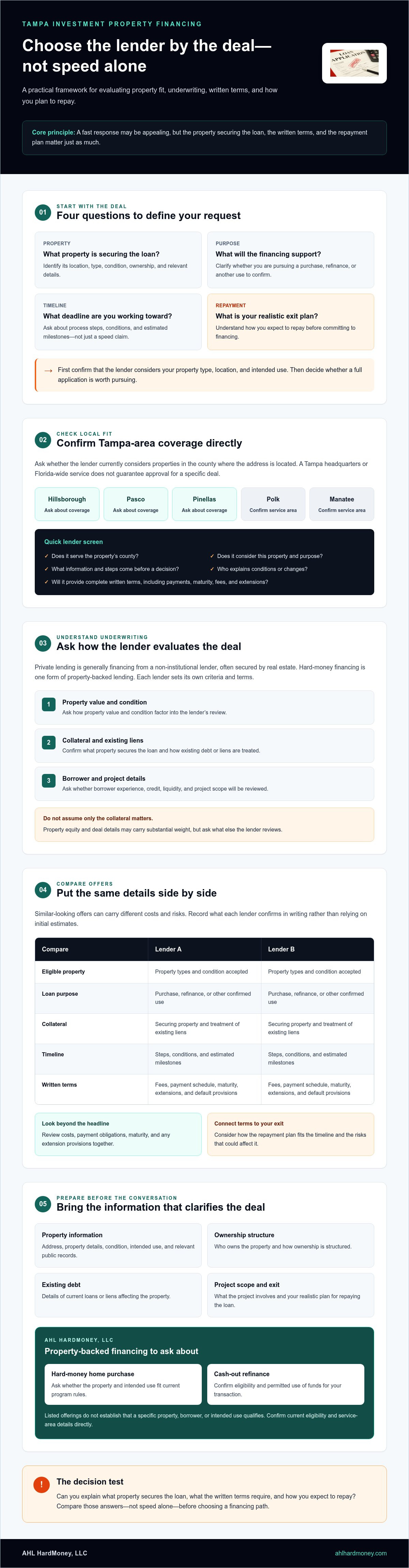
Start with the deal, not a lender’s speed claim. Define the property, intended use, purchase or refinance timeline, and a realistic repayment plan. Then ask whether the lender considers that property type and purpose before spending time on a full application.
Private lending generally means financing from a non-institutional lender, often secured by real estate. Hard-money financing is one form of property-backed lending. A lender may focus on the collateral and deal, but each lender sets its own underwriting criteria and terms. This Hard money loan overview introduces the category; it doesn’t explain the terms of any particular lender’s offer.
For a quick introduction to finding private money lenders for real estate deals, watch this video:
What private real estate lenders may finance
Private financing may cover property purchases, refinancing, or borrowing against equity in real estate. These are broad categories, not a promise that every lender offers each option. Ask about current programs, eligible property types, permitted use of funds, and borrower requirements. A Florida hard money lender guide can provide state-level context, but verify program details directly with the lender.
AHL HardMoney lists hard-money home purchase and cash-out refinance among its offerings. A listing doesn’t establish that a particular property or intended use qualifies, so ask about the address and transaction you have in mind.
Why Tampa-area coverage matters
Confirm that the lender considers properties in the county where your address is located. Ask directly about Hillsborough, Pasco, and Pinellas, and whether properties in Polk or Manatee fall within its current service area. A Tampa headquarters or Florida-wide service may make a lender worth contacting, but neither guarantees approval for a specific property, borrower, or deal.
Use this quick screen before sharing a full application:
- Florida coverage: Does the lender currently serve the property’s county?
- Property and purpose: Will it consider this property type and intended use?
- Process: What information is needed, and what steps happen before a decision?
- Communication: Who can answer questions and explain conditions or changes?
- Written terms: Will the lender provide a complete offer, including the payment schedule, maturity, fees, and any extension provisions?
This focused approach helps investors compare private lenders for real estate investors Tampa on fit and clarity, rather than a headline promise. For broader Florida context, consult a Florida hard money lender guide, then verify each lender’s current coverage and terms.
Compare Tampa private lenders by underwriting, terms, and exit plan
Two offers may look similar at first but carry different costs and risks. Compare the same details for each lender, and record what is confirmed in writing rather than relying on estimates from an initial conversation.
| Compare | Lender A | Lender B |
|---|---|---|
| Eligible property | Property types and condition accepted | Property types and condition accepted |
| Loan purpose | Purchase, refinance, or other confirmed use | Purchase, refinance, or other confirmed use |
| Collateral | Property securing the loan; treatment of existing liens | Property securing the loan; treatment of existing liens |
| Timeline | Steps, conditions, and estimated milestones | Steps, conditions, and estimated milestones |
| Documented terms | Fees, payment schedule, maturity, extensions, default provisions | Fees, payment schedule, maturity, extensions, default provisions |
Property equity and deal details may carry substantial weight in private-lending underwriting, but don’t assume your credit, liquidity, or experience will not be reviewed. Ask how the lender evaluates property value, existing liens, borrower experience, and project scope. Also ask whether it needs credit or financial records. Specific answers make it easier to compare private lenders for real estate investors Tampa on actual criteria rather than broad claims.
Questions to ask before accepting a private loan
Request the complete written offer. Ask the lender to explain each fee, payment obligation, maturity date, extension provision, and default term. Clarify how it will determine property value and what could change the proposed terms. Ask which documents or issues could delay approval, closing, or funding. If an important answer is verbal, request written confirmation before committing.
Test the exit strategy before comparing speed
Identify the specific source of repayment, such as a property sale, refinance, or other documented funds. Then test the plan against possible setbacks. What happens if renovations take longer, a sale closes later than expected, the sale price is lower than planned, or refinancing is unavailable on the terms you anticipated? Use assumptions tied to the deal, and consider whether you could manage payments and other obligations during a delay. Short-term financing can create added pressure if the planned exit slips.
Closing paperwork and rules can depend on the transaction. The Consumer Financial Protection Bureau’s Real Estate Settlement Procedures Act (RESPA) FAQs provide general information; ask a qualified closing professional whether particular requirements apply to your loan. For borrower-specific decisions, consult legal, tax, and financial professionals. To learn about AHL HardMoney before discussing a property-backed request, review the company’s background.
Evaluate a Tampa investment property and local lending fit
A lender’s review starts with a particular asset and a clearly defined request. Confirm the full property address, intended use, ownership structure, and whether you’re seeking purchase financing, a cash-out refinance, or a home equity loan. Describe your plan plainly. The same property may be assessed differently depending on how you’ll use it and how you intend to repay the loan.
Keep property details consistent across your purchase contract, ownership records, and lender discussions. If an entity will own the property, confirm the proposed borrower and ownership structure with the lender early. The CFPB home buying guide offers general information about loan choices and closing. Use it as background, then confirm the terms and requirements that apply to your financing.
Check property records and physical risks
First, verify which jurisdiction covers the address. For a Tampa property in Hillsborough County, consult the appropriate county property and recorded-document sources for available tax details, ownership information, liens, and other records. Check the relevant city or county source for land-use and zoning details. Tampa city rules may not apply to every property in the county.
Review FEMA map information for the exact address, then ask an insurance professional and the lender what coverage may be needed. A location alone doesn’t establish a property’s flood risk or insurance requirements. Document the property’s condition, access, occupancy, and repair needs as well. For uncertain building or repair issues, consult qualified local professionals and describe the scope clearly enough for a lender to assess.
Match the property purpose to an available program
An investment purchase differs from borrowing against equity in a property you already own. AHL HardMoney lists hard-money home purchase and cash-out refinance among its offerings, but confirm eligibility, property type, and permitted use for the individual deal. For an acquisition, review its hard-money home purchase financing information and ask whether the property and intended use fit. For an equity-based request, ask directly about cash-out refinance options and current requirements.
Don’t rely on broad neighborhood descriptions or old listing estimates to support a financing decision. Gather current, address-specific comparable sales and property details, then ask how the lender will determine value. Tampa-area conditions vary by property and submarket, so a valuation or market trend that suits one address may not reflect another. This property-level review helps you assess whether the request, collateral, and repayment plan fit together.
Prepare your Tampa private-lending application and compare next steps
Make the first conversation useful by preparing a clear picture of the property, your request, and how you expect to repay the loan. This makes it easier to compare private lenders for real estate investors Tampa on the same basis and gives each lender a chance to explain its process and requirements.
Information to organize before contacting lenders
Gather what you have, then ask each lender which documents it actually needs. Requirements vary by program and deal, so use this as a preparation checklist, not a universal application package.
- Identify the property: Note the full address, property type, occupancy, condition, and known access or repair concerns.
- Support the value: Collect available valuation information or relevant comparable sales. The lender may use its own valuation process.
- Clarify ownership and debt: Have ownership records and current lien or mortgage information available. Explain the role of any entity that will own or borrow against the property.
- Define the request: State whether you’re pursuing a purchase, refinance, or another property-backed purpose. Summarize the requested timeline and project scope.
- Show the repayment plan: Identify the anticipated source of repayment, such as a sale, refinance, or other documented funds. Note the assumptions behind the plan and what could affect it.
- Organize supporting records: Keep relevant project, income, and insurance documents accessible if available. Confirm whether the lender needs them before sending sensitive information.
How to assess the lender conversation
Look for clear explanations, not just confidence. A helpful lender should explain what happens next, how it reviews the property and request, which eligibility questions remain open, and what conditions could affect the proposed financing. Ask what documents are needed, who reviews them, and what might delay the process.
Ask when an early indication becomes a formal commitment, which conditions must be met, and when final written terms will be provided. Read those terms carefully before deciding. Compare written offers, processes, and communication consistently. A preliminary answer or appealing timeline is not a substitute for confirmed terms and a workable repayment plan.
After each conversation, keep a simple comparison sheet with documents requested, open questions, next steps, written terms received, and unresolved conditions. It will help you spot differences and follow up without relying on memory. If anything is unclear, request an explanation in writing before moving ahead.
Consider AHL HardMoney for property-backed financing in Tampa
AHL HardMoney, LLC is a privately owned, Tampa-headquartered non-institutional lender serving borrowers throughout Florida. Investors comparing private lenders for real estate investors Tampa may want to include AHL in their research because it offers property-backed financing programs. The right fit depends on the property, intended use, eligibility, and repayment plan.
Keep the distinction clear: general market categories don’t confirm that a particular lender offers or approves them. AHL’s offerings relevant to property-backed requests include hard-money home purchase, cash-out refinance, home equity loans, and private money refinance. Ask whether the program is currently available for your property type and investment purpose before relying on it in your plan.
Which AHL program may fit your situation
If you’re purchasing a property, ask AHL whether its hard-money home purchase program considers the address, ownership structure, and intended investment use. A program listing alone doesn’t establish eligibility. If you already own the property and want to access equity, ask whether cash-out refinance or a home equity loan may suit your circumstances, and clarify how the loan would be secured and repaid.
For background on equity-based borrowing in Florida, consult a Florida cash-out refinance equity guide, then confirm the details that apply directly with the lender. Before comparing offers, make sure you understand the proposed use of funds, collateral, repayment source, and loan structure.
What to confirm directly with AHL
Bring the property address, request purpose, ownership details, existing liens, project scope if relevant, and intended exit plan. Ask AHL to clarify:
- Whether the requested program is currently available for your intended use and property type.
- Which documents it needs and how property value, borrower information, and deal details factor into underwriting.
- All fees, payment obligations, maturity dates, extension provisions, collateral requirements, and default terms in the written offer.
- What conditions affect approval, closing expectations, or funding, and which steps must be completed first.
AHL reports that approvals often occur within 30 minutes and closings may take 5 to 15 days. These are company-reported possibilities, not guarantees; timing depends on verification and deal circumstances. Confirm current expectations directly, and don’t treat an initial conversation or preliminary indication as approval or a commitment to fund. Review the final written terms alongside your exit plan before proceeding.
Make your next financing decision with confidence
The right lender is the one whose program fits your property, intended use, timeline, and repayment plan. Compare written terms, verify property details using current, address-specific information, and test your exit strategy against delays before committing. A quick preliminary response can help you plan next steps, but it cannot replace confirmed terms or a realistic repayment plan.
AHL HardMoney, LLC is headquartered in Tampa and serves borrowers throughout Florida. Its NMLS ID is 380601. The company reports that approvals often occur within 30 minutes and closings in 5 to 15 days. These are possibilities, not guarantees. Verify current timelines, program availability, and eligibility directly with AHL, and review all terms before deciding. Comparing private lenders for real estate investors Tampa this way can help you move forward with clearer expectations.
Prepare your questions, confirm the details, and contact AHL HardMoney to discuss whether its property-backed financing may fit your investment request.
Frequently Asked Questions
How do I find a private lender for a real estate investment in Tampa?
Start with the property address, financing purpose, timeline, and repayment plan. Confirm that the lender serves the property’s county and considers that transaction type. Compare written terms, collateral requirements, fees, and maturity provisions, and ask how delays are handled. AHL serves borrowers throughout Florida, including Tampa, Clearwater, Saint Petersburg, Palmetto, Largo, Newport Richey, Port Richey, Brooksville, Brandon, Orlando, Daytona, Naples, Ocala, Deltona, DeLand, Jupiter, Palm Beach, Lakeland, and Boca Raton. Verify credentials before sharing sensitive documents.
Do private lenders in Tampa finance investment properties?
Some private lenders finance property-related transactions, but eligibility depends on the lender, property, and intended use. A purchase, refinance, or equity-based request may be assessed differently. Investor-focused marketing doesn’t confirm that your strategy qualifies. Give the lender the property address and transaction details, then request written confirmation of eligibility, collateral requirements, and repayment terms. AHL lists hard-money home purchase and property-secured refinance options, but confirm current availability and fit directly.
Can I get a private real estate loan with poor credit?
Possibly, but a private lender may consider property equity and deal details alongside your credit history, and approval isn’t assured. Credit isn’t automatically irrelevant. Ask which factors apply to your request, what documents are needed, and how the lender will assess your repayment plan. Compare complete written terms, including payment obligations and maturity provisions. Treat claims about flexible credit review as something to verify, not a promise that you’ll qualify or receive particular terms.
How quickly can a Tampa private lender close a real estate loan?
Closing time varies with the property, documentation, title work, underwriting, and other transaction details. AHL reports that approvals often occur within 30 minutes and closings may take 5 to 15 days, but these are company-reported possibilities, not guaranteed timelines. Confirm current expectations directly and ask which milestones remain, what could cause delays, and when a preliminary review becomes a formal commitment. Don’t rely on an estimated timeline until you understand its conditions.
What should I compare when choosing a private lender?
Compare eligible property types and loan purposes, collateral, required documents, fees, payment schedule, maturity, and extension provisions. Ask how the lender evaluates the property and your planned exit, and whether it serves the property’s county. Request written terms from each lender so you can review offers consistently. Communication and clarity matter, too. A fast response alone doesn’t show whether the financing fits your investment or whether you can manage repayment if plans change.
Are hard-money loans risky for real estate investors?
They can carry meaningful risks, especially if repayment depends on a sale, refinance, or project completion that gets delayed. Before signing, review the full written terms, payment obligations, collateral provisions, maturity date, extension options, and default terms. Test your exit plan against realistic delays and weaker-than-expected outcomes using assumptions tied to the deal. If the repayment path becomes uncertain, consider the potential consequences and seek independent legal, tax, or financial advice before making a borrower-specific decision.
Disclaimer:
While Dan is not a real estate attorney, he is a Full Time, Licensed Florida Mortgage and Real Estate Broker Professional coupled with 21+ years of successful strategies, methodologies and techniques that have proven effective to the benefit of Florida families.
While not every conversation is a deal, we promise to leave you better off then before you called. We serve everyone we come in contact, with the highest levels of integrity and dignity.
We invite you to make the call 📲


