

Article by
Dan Conneally - NMLS 339916, LO13164, BK3246524, CQ1072086
Dan Conneally has been successfully helping Florida families with thier real estate related situations for the last 21+ years, regardless of credit or past financial background.
While Dan is effective with institutional lending, he particuarly shines when matters require unique strategies involving noninstitutional resources.
Check out his legions of testimonials from real Florida families at Google, Facebook and the BBB to get a sense of the caliber and effectiveness he achieves. Dan has appeared on television speading the message of hope to good folks that need diligent, discrete, nonjudgy care.
When comparing Polk County hard money lenders, the fastest financing offer is not automatically the right fit. Start with three questions: how much equity is available, what will the funds be used for, and how will you repay the loan? Asset-based financing gives substantial weight to the property and its equity, which may make it worth exploring when conventional financing does not fit your timeline or circumstances.
Hard money is often associated with investment purchases and renovations, but property-secured financing can also address other goals. You may be considering a cash-out refinance, a home equity loan, debt consolidation, home improvements, or another property-related need. A clear purpose helps narrow down the options.
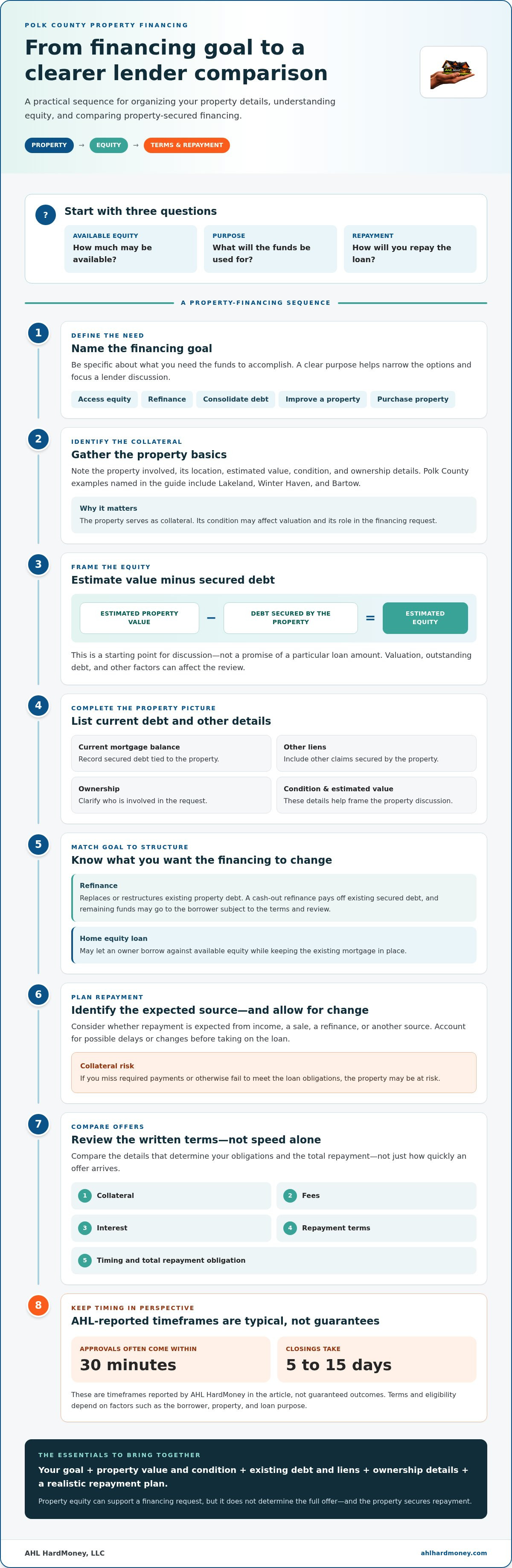
This guide explains how equity-based lending differs from conventional financing and what to compare as you explore Polk County options. You’ll learn which property details to gather, how AHL HardMoney’s programs relate to common financing goals, and what to expect from its process. AHL reports that approvals often come within 30 minutes and closings take 5 to 15 days. These are typical timeframes, not guarantees. Begin with your goal, then compare the terms and risks of financing that may fit.
Key Takeaways
- Polk County hard money lenders may consider property equity and your financing purpose when reviewing a property-secured loan.
- Property value is only part of the picture. Condition, existing liens, and your repayment plan can also matter.
- Compare written terms for collateral, fees, interest, repayment, and timing. Consider the total repayment obligation before proceeding.
- Prepare for a lender discussion by defining your goal, gathering property details, listing liens, and outlining how you plan to repay.
- Explore options that align with your plans, including cash-out refinance, home equity, debt consolidation, and home improvement loans.
Searching for Polk County hard money lenders? Start with your financing goal
Traditional mortgage financing does not fit every borrower’s circumstances or timeline. You may want to purchase a property, use equity in one you own, refinance existing debt, or address a pressing financial need. Start by defining the goal rather than assuming hard money is only for investors buying or renovating property.
Whether your property is in Lakeland, Winter Haven, Bartow, or elsewhere in Polk County, its location helps identify the collateral. Your financing purpose gives the lender important context. The Polk County, Florida Wikipedia page provides background on the county’s communities and geography.
What does a hard money lender do?
Hard money lending is private, asset-based financing secured by real estate. The property acts as collateral for the loan. A lender considers its value and equity alongside the borrower’s circumstances and intended use of the funds. If you do not meet the loan obligations, the property may be at risk.
Conventional underwriting often gives substantial attention to income, credit, and other financial details. An asset-based review places more weight on the property, but credit and repayment ability may still matter. Terms and eligibility depend on factors such as the borrower, property, and loan purpose.
Hard money is property-secured financing that considers real estate equity and the borrower’s reason for seeking funds.
Which Polk County financing need are you trying to solve?
Be specific about what you need the funds to accomplish. A defined goal makes it easier to compare loan structures and focus on options that fit your situation.
- Access equity: A home equity loan or cash-out refinance may help you use available property equity. Explore home equity loan options as one possible route.
- Refinance: A refinance replaces or restructures existing property debt. Identify what you want to change and why.
- Consolidate debt: Debt consolidation financing uses property as collateral to address multiple obligations. Consider how you will repay the new loan and the risk to the property.
- Improve a property: Home improvement financing can support planned work. Be ready to describe the project and the property involved.
- Purchase property: A purchase loan helps finance the acquisition of real estate. Explain which property you’re considering and how you plan to use it.
If the need is urgent, state the purpose plainly and identify the property involved. Among Polk County hard money lenders, comparing programs against your actual goal helps keep the discussion focused on relevant terms, costs, and next steps.
How Polk County hard money loans use property equity
Equity is a starting point for understanding a property-secured loan, not a promise of a particular loan amount. It generally means the property’s estimated value minus the debt secured by it. The estimate depends on the valuation, and the amount of equity can change as the property value or outstanding debt changes.
For example, knowing an estimated property value and the balance on an existing mortgage can help frame a financing discussion. Those figures alone do not determine how much financing may be available. A lender may also consider the property’s condition, other liens, the intended use of the funds, and your repayment plan. Rocket Mortgage’s explanation of hard money loans offers additional background on this type of financing.
How equity can support a refinance or home equity loan
A refinance replaces existing property debt with a new loan. A home equity loan may let an owner borrow against available equity while keeping the existing mortgage in place. These are different structures, so identify whether your goal is to replace existing debt or borrow against equity separately.
A cash-out refinance is one way to access property equity. The new loan pays off existing secured debt, and the borrower may receive remaining funds, subject to the loan terms and review. Learn about home equity loan options and cash-out refinance options to understand how these goals can fit different financing paths.
Why property and repayment details matter
Equity is only one part of the picture. A useful discussion covers the property’s estimated value and condition, current mortgage balances and other liens, ownership, and how you intend to use the funds. Ownership details clarify who is involved in the request. The property’s condition may affect its valuation and its role as collateral.
Collateral is the property pledged to secure repayment. If you miss required payments or otherwise fail to meet the loan obligations, the property may be at risk. Build a realistic repayment plan before taking on the loan. Consider whether repayment is expected from income, a sale, a refinance, or another source, and account for possible delays or changes.
Property equity can support a financing request, but collateral secures repayment and you remain responsible for meeting the loan terms.
For borrowers comparing Polk County hard money lenders, these details help move the discussion beyond a rough equity estimate. Gather what you know about value, debt, ownership, and repayment, then use it to discuss which financing structure aligns with your circumstances.
How to compare hard money lenders serving Lakeland and Polk County
A responsive process can matter when financing is time-sensitive, but speed alone does not establish whether a loan fits. Compare the full structure: what the loan is for, which property secures it, how repayment works, and what you’ll owe. A low credit score does not necessarily determine every property-secured lending decision. Credit may be considered alongside equity, property details, purpose, and repayment plans.
Use this checklist to compare written terms side by side. Details vary by lender, borrower, property, and loan purpose, so review each offer on its own terms.
| What to compare | Questions to answer |
|---|---|
| Loan purpose | Does the loan address your intended need, such as a purchase, refinance, or property-related expense? |
| Collateral | Which property secures the loan, and how are its value, condition, and existing liens considered? |
| Fees and interest | What interest rate and origination or other fees are written into the offer? How do they affect the total amount you’ll repay? |
| Repayment | What payment schedule applies, when is the balance due, and what repayment source are you relying on? |
| Timeline | Is the stated timing an estimate, or does the written agreement make a specific commitment? What conditions could affect the schedule? |
Compare the full loan structure, not just speed
Look beyond the initial rate or estimated closing date. Review the stated interest, origination fees, payment schedule, maturity date, and any terms for requesting an extension. Use the written terms to understand the total repayment obligation, including applicable fees. If a term is unclear, get its meaning in writing before proceeding. A fast process does not replace understanding the cost, conditions, and risks.
Pay close attention to timing language. An estimated timeline is not necessarily a contractual commitment or guaranteed closing date. Review what must happen before funding and whether timing depends on specific conditions. Approval and closing are not assured by a quoted estimate.
Understand collateral risk and credit considerations
The property secures the loan, so missed payments or failure to meet the agreement can have serious consequences, including risk to the property. Make sure your repayment plan is realistic, not simply hopeful. Credit may be one factor in a lender’s review, but it does not by itself promise approval or rule out every property-based option. For broader state context, see this Florida hard money lending guide.
As you compare Polk County hard money lenders, line up each written offer against the same questions. This makes differences easier to spot and helps you weigh speed against repayment obligations and collateral risk.
What to prepare before discussing a hard money loan in Polk County
A focused request makes it easier to discuss a possible program fit and next steps. Before speaking with Polk County hard money lenders, organize four essentials: your financing purpose, property details, debts secured by the property, and a realistic repayment plan. This preparation helps keep the conversation clear, whether the property is in Lakeland, Winter Haven, Bartow, or another part of the county.
Gather property and existing loan information
Start with the property. Collect its address, ownership information, estimated value, and current mortgage details. Add what you know about its condition and any other liens or obligations tied to it. Be precise about which figures are estimates. Property valuation and documentation needs depend on the financing request.
Clarify the amount, purpose, and repayment plan
Connect the amount you’re seeking to a defined goal. Describe what the funds would cover and what outcome you need. A request tied to a specific use is easier to assess than a broad estimate without context. Then explain how you expect to repay the loan, using anticipated income or another defined source rather than an untested assumption.
Use this four-step checklist to prepare a concise overview:
- Define the purpose. State whether you’re seeking funds for a refinance, equity access, debt consolidation, property improvements, a purchase, or another specific need. Explain what the funds are intended to accomplish.
- Gather property details. Provide the address, ownership details, estimated value, and an honest description of the property’s condition. Remember that an estimate is a starting point, not a final valuation.
- List existing liens. Write down current mortgage balances and other debts secured by the property. Include the creditor and any available account or payoff information so the obligations are clear.
- Outline repayment. Identify the expected repayment source and the steps behind it. If your plan depends on income, a sale, or refinancing, explain the basis for that expectation and any relevant timing.
The requested loan size should make sense alongside the property’s estimated equity, the purpose of the funds, and the obligations already secured by the property. For example, if you’re seeking funds for improvements, be ready to explain the work and how the request relates to the property and repayment plan. If you’re refinancing, identify the existing loan and the change you hope to achieve. These details frame the discussion but do not guarantee a particular outcome.
Keep your notes and supporting records together, and flag details you’re still estimating. Clear, consistent information gives a lender a useful starting point for reviewing your request and explaining possible next steps.
Explore AHL HardMoney options for Polk County property financing
Once you’ve clarified your goal and gathered the property details, match your request to a relevant financing path. AHL HardMoney, LLC provides hard-money financing to borrowers throughout Florida, including Polk County. As a privately owned, non-institutional lender, AHL offers programs that consider property equity and the purpose behind the request.
Property-based financing can address more than purchases and renovations. It can also relate to equity access, refinancing, debt consolidation, or improvements to a property you already own. A clear purpose helps distinguish among these options and gives the lender a useful starting point.
Match the financing goal to an AHL loan option
Different goals call for different loan structures. These AHL options provide a starting point for considering which direction fits your property and plans:
- Exploring equity through refinancing? A cash-out refinance may suit a request to replace existing property debt while accessing available equity.
- Looking to borrow against home equity? A home equity loan is a separate path for accessing equity without framing the request as a refinance.
- Managing several obligations? Debt consolidation financing may help address multiple debts using property-secured funds. Consider the obligations involved and your repayment plan.
- Planning work on a property? Home improvement financing may fit a request tied to a specific property-related project. Be ready to explain the work and the outcome you’re seeking.
These categories are not interchangeable. A borrower seeking funds for improvements may have a different purpose and repayment plan from someone looking to refinance existing debt. AHL considers the financing purpose alongside property equity, so describing both makes the discussion more specific.
Take the next step with clear expectations
Before beginning a discussion, summarize the property, its ownership and condition, existing secured obligations, your intended use of the funds, and your repayment plan. Keep the requested amount connected to your goal and the information you have about the property. This gives the conversation a practical foundation without assuming a particular loan structure or outcome.
AHL reports that approvals often occur within 30 minutes and closings take 5 to 15 days. These are typical timeframes, not guarantees. Individual applications and closings can vary. A responsive process can provide timely clarity, but it does not replace reviewing the written terms, understanding repayment responsibilities, or considering the risk to the collateral.
For borrowers comparing Polk County hard money lenders, bring a specific goal and organized property details to the conversation. You do not need every answer in advance. Start with what you know, identify what remains uncertain, and discuss possible next steps.
Move forward with a clearer financing conversation
Your next step does not have to be a commitment. Start a focused conversation about whether property-based financing aligns with your plans, what terms would apply, and what responsibilities come with the loan. Clear questions can help turn an uncertain search into a more informed decision.
AHL HardMoney, LLC serves Polk County and other Florida counties and holds NMLS ID 380601. Its service locations include Tampa, Clearwater, Saint Petersburg, Palmetto, Largo, Newport Richey, Port Richey, Brooksville, Brandon, Orlando, Daytona, Napels, Ocala, Deltona, Deland, Jupiter, Palm Beach, Lakeland, and Boca Raton. If you’re comparing Polk County hard money lenders, prepare to discuss your property and financing goal with a lender that offers options for different needs. Review the terms and weigh both the opportunity and the obligations.
A thoughtful financing decision starts with understanding your options. Take the next step by sharing your property details and financing goal with AHL HardMoney.
Frequently Asked Questions
Are hard money loans available for properties in Polk County, Florida?
Yes. AHL HardMoney provides hard-money financing to borrowers in Polk County, including property owners in Lakeland and other county communities. AHL offers programs for different financing purposes, including cash-out refinance, home equity, debt consolidation, and home improvements. Have the property address and your goal ready to focus the discussion on relevant next steps.
Can I qualify for a hard money loan with bad credit?
Bad credit does not automatically rule out a property-secured loan. AHL’s programs serve borrowers regardless of credit history, with the property and purpose of the request considered as part of the review. Approval is not assured: the property, existing obligations, repayment plan, and other application details still matter. Describe your circumstances accurately and explain how you plan to meet the loan terms.
How quickly can a Polk County hard money loan close?
AHL reports that closings typically take 5 to 15 days, but this timeframe is not guaranteed. The actual schedule can vary with the application and closing process. If your plans depend on funding, account for the steps that must be completed and do not treat an estimate as a firm commitment. AHL also reports that approvals often come within 30 minutes, which is not a promise of approval or closing.
How much can I borrow against my Polk County property?
There is no single amount that applies to every property. Potential loan size depends on the property’s valuation, debt already secured by it, the financing purpose, and the program review. Gather the current mortgage balance, information about other liens, and a reasonable property-value estimate. These details help frame your request, but the applicable terms depend on the lender’s review.
What is the difference between a hard money loan and a traditional mortgage?
A hard money loan is private financing secured by real estate, with the property and financing purpose playing a central role in the review. A conventional mortgage typically follows institutional underwriting that places substantial weight on borrower financial details such as income and credit. Neither description guarantees approval. Compare the written terms, repayment schedule, and consequences of missed payments before deciding which approach fits your circumstances.
Can a hard money loan help with debt consolidation or home improvements?
Yes. AHL offers debt consolidation hard money loans for borrowers seeking to address eligible obligations, along with home improvement hard money loans for property-related projects. Identify the debts or planned work, the property involved, and the outcome you’re seeking. Because the property secures the financing, consider how the new payment fits your budget and how you’ll repay the loan.
Is a hard money loan secured by my property?
Yes. Real estate serves as collateral for a hard money loan, securing the borrower’s repayment obligation under the loan agreement. If payments are missed or you fail to meet the agreement’s terms, the property may be at risk. Read the collateral and default provisions carefully and make sure your repayment plan is practical, not dependent on an uncertain future outcome.
Disclaimer:
While Dan is not a real estate attorney, he is a Full Time, Licensed Florida Mortgage and Real Estate Broker Professional coupled with 21+ years of successful strategies, methodologies and techniques that have proven effective to the benefit of Florida families.
While not every conversation is a deal, we promise to leave you better off then before you called. We serve everyone we come in contact, with the highest levels of integrity and dignity.
We invite you to make the call 📲


