


Article by
Dan Conneally - NMLS 339916, LO13164, BK3246524, CQ1072086
Dan Conneally has been successfully helping Florida families with thier real estate related situations for the last 21+ years, regardless of credit or past financial background.
While Dan is effective with institutional lending, he particuarly shines when matters require unique strategies involving noninstitutional resources.
Check out his legions of testimonials from real Florida families at Google, Facebook and the BBB to get a sense of the caliber and effectiveness he achieves. Dan has appeared on television speading the message of hope to good folks that need diligent, discrete, nonjudgy care.
What if a foreclosure deadline leaves little time for a conventional solution, but your home still has equity? For some homeowners, a hard money foreclosure refinance Tampa may be one option to compare. It isn’t a guaranteed rescue, and refinancing doesn’t automatically stop a foreclosure. Timing, usable equity, and a realistic repayment plan all matter.
It’s understandable to feel unsure about how much time remains, which organization to contact, or whether credit problems rule out every financing path. They don’t necessarily rule out an equity-based review: asset-based lenders may consider the property’s equity alongside credit history, though approval is never guaranteed. Acting promptly can help you understand your choices while protecting your legal options.
This guide compares lender options with Tampa-area public and nonprofit assistance, explains how foreclosure refinancing is evaluated, and outlines practical first steps, including checking case deadlines and gathering key loan and property details. You’ll get a clearer picture of which paths may fit your circumstances and what to consider before making time-sensitive decisions.
Key Takeaways
- Compare servicer loss mitigation, housing counseling, legal guidance, and refinancing by their purpose and who makes each decision.
- A hard money foreclosure refinance Tampa may be worth exploring when property equity and a realistic repayment plan support the next financing step.
- Review court dates and servicer notices first, then gather mortgage statements, payoff details, property records, income information, and lien documents.
- Property value, existing liens, and the total payoff amount can affect whether an equity-based refinance is feasible.
- AHL HardMoney, llc reports that approvals often take place within 30 minutes and closings may take 5 to 15 days. Timing and outcomes vary by file and transaction.
Tampa Foreclosure Assistance Programs: What Options Can Homeowners Compare?
Facing foreclosure can make every choice feel urgent. Assistance isn’t one guaranteed program. It may mean asking your mortgage servicer to review available options, getting guidance from a housing counselor, speaking with a Florida legal professional, or exploring a refinance based on your property’s equity. Which route may fit depends on your finances, property, court status, and the rules that apply.
These options work differently. A servicer review considers possible changes to your existing loan, while a refinance involves new financing and underwriting. Counseling and legal guidance can help you understand choices and deadlines, but neither replaces a lender’s decision or the court’s process.
For a brief overview of how this type of asset-based financing works, see Hard money loan.
As you compare paths, keep this distinction in mind: Foreclosure assistance may help you pursue a solution, but it isn’t a guaranteed way to stop foreclosure. Don’t assume that submitting a request or exploring a refinance changes a court date. Confirm deadlines and seek legal guidance when court papers are involved.
Which foreclosure assistance routes may be available in Tampa?
Start by contacting your mortgage servicer and asking about its loss-mitigation review process and any documents it needs. A HUD-approved housing counselor can explain options and help you prepare for conversations with the servicer. If you’ve received court papers, a Florida attorney or legal aid organization can help you understand the case and your response options. Each route serves a different purpose, and timing can matter.
Here’s a quick comparison:
| Route | Purpose | Likely decision-maker | Timing sensitivity | Key limitation |
|---|---|---|---|---|
| Servicer loss mitigation | Review possible changes to the current loan | Mortgage servicer or loan owner | Respond promptly to notices and requests | Terms depend on review and eligibility |
| Housing counseling | Understand options and prepare questions | You choose how to proceed | Useful early, especially before deadlines | Counseling does not decide loan terms |
| Legal guidance | Understand court papers, deadlines, and rights | You and your legal representative | Urgent when court dates or response deadlines apply | Doesn’t provide financing |
| Equity-based refinance | Use new financing to address existing property debt | Lender, subject to underwriting | Available time and court status matter | Requires a feasible transaction and repayment plan |
When might a foreclosure refinance belong in the comparison?
A hard money foreclosure refinance Tampa may be an option to explore when the property has usable equity and the owner can support a workable repayment plan. Unlike a servicer loss-mitigation review, refinancing creates a new financing arrangement that may be used to address existing property debt. Equity, liens, payoff figures, property value, and underwriting all affect feasibility. Credit history alone may not tell the whole story.
Explore a Florida foreclosure refinance loan as one path to compare. A refinance doesn’t automatically pause a foreclosure or replace legal advice, so keep tracking court and servicer deadlines while evaluating whether the numbers and timing work.
How Tampa Foreclosure Refinance Works: Equity, Timing, and Court Status
A foreclosure refinance is a new financing arrangement that may be used to address existing debt secured by a property. It’s separate from negotiating a loss-mitigation plan with your mortgage servicer. For homeowners considering a hard money foreclosure refinance Tampa, the central questions are whether the property supports a feasible loan and whether the transaction fits the homeowner’s financial and legal circumstances.
How does home equity affect a foreclosure refinance?
Equity is generally estimated by subtracting secured debts from the property’s estimated value. That estimate is only a starting point: a lender’s valuation, recorded liens, payoff amounts, and other transaction obligations can affect how much equity may be usable. For example, a home may appear to have substantial equity, but additional liens or a larger-than-expected payoff can reduce what remains to address the debt.
Underwriting also considers whether the proposed repayment plan is workable. Credit history may be considered alongside the property, but equity alone doesn’t establish approval. No single figure determines eligibility; the property and full transaction details matter.
What does foreclosure status mean for timing in Hillsborough County?
Lender review and court proceedings follow different timelines. An application, discussion, or preliminary decision from a lender does not itself pause a foreclosure case or change a court deadline. Keep those tracks separate, and don’t rely on a possible closing date as a substitute for confirming what the court requires.
Gather servicer notices and court papers, then identify the case number, hearing dates, and any orders. Hillsborough County Clerk of Court records can help you research case status. Records research is not legal interpretation, though, and it can’t replace advice from a Florida attorney about your case or response deadlines. Verify Florida foreclosure procedures and legal timelines with a qualified professional using current information.
The Consumer Financial Protection Bureau’s overview of options to avoid foreclosure also explains why contacting your servicer and understanding available paths are important steps.
For additional background, read this Florida foreclosure bailout guide. If an equity-based option seems relevant, AHL’s Florida foreclosure refinance loan page describes that financing path. Compare any potential transaction timeline with your verified court dates, and seek legal guidance about deadlines.
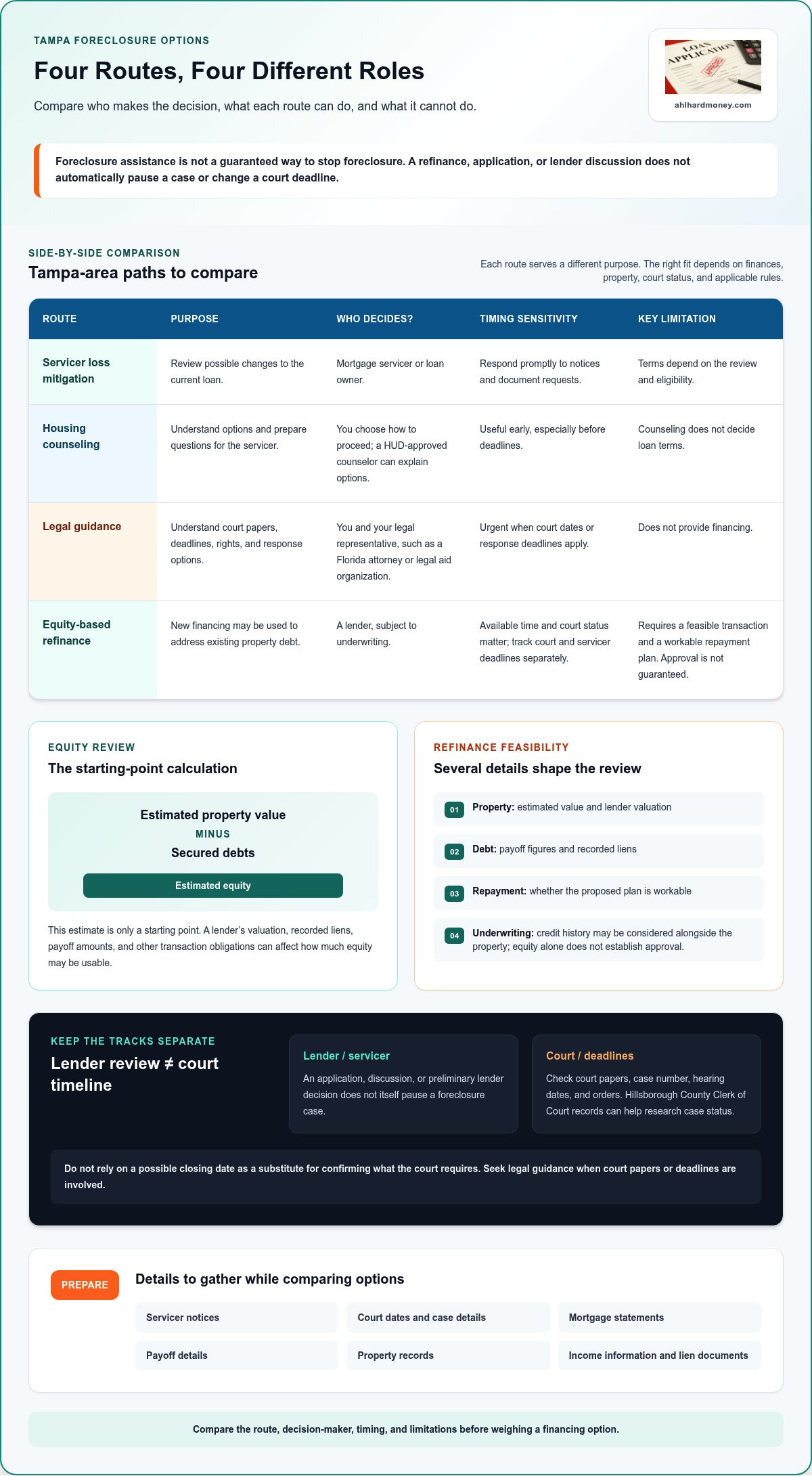
Compare Tampa Foreclosure Assistance Programs: Refinance, Servicer Review, or Counseling?
These routes address different parts of a foreclosure challenge. A servicer review may explore changes to the existing loan. Counseling can help you understand options and organize financial information. A refinance addresses property debt through a new loan, adding a new repayment obligation secured by the home. Start by identifying what you need and what you can realistically repay.
| Option | Purpose | Effect on debt | Who decides | Timing and main risk |
|---|---|---|---|---|
| Servicer loss mitigation | Review possible ways to address mortgage difficulty | May change the existing loan arrangement | Mortgage servicer or loan owner | Submit requested information promptly; approval and terms depend on review |
| Equity-based refinance | Use new financing to address existing property debt | Creates a new repayment obligation secured by the property | Lender through underwriting | Deadlines matter; repayment may be unsustainable without a credible plan |
| Housing counseling | Help organize finances and understand possible paths | Doesn’t provide a loan or change debt by itself | You decide how to proceed | Useful for planning, but not legal representation or a lender decision |
| Legal guidance | Interpret notices, filings, and legal rights | Doesn’t provide financing | You and your legal representative | Seek guidance promptly when court papers or deadlines are involved |
When could a private-money refinance be worth evaluating?
A hard money foreclosure refinance Tampa may merit consideration when property equity, a time-sensitive payoff need, and a workable repayment plan align. Asset-based lending can weigh the property alongside credit history, so credit concerns may not be the only factor. But equity doesn’t guarantee approval, and a new loan isn’t a sound solution if the payments don’t fit the household’s finances. If accessing property equity is part of the plan, review the cash-out refinance overview.
When might another assistance route fit better?
If keeping or modifying the current financing is the goal, begin with the servicer’s loss-mitigation review. A counselor can help you map income, expenses, and available choices. The Consumer Financial Protection Bureau also explains how a HUD-approved housing counseling agency may support homeowners exploring foreclosure-avoidance paths. For court notices, filings, or questions about rights, seek Florida legal guidance.
Before taking on new debt, compare the proposed payment plan with reliable income and essential expenses. If there isn’t a credible way to repay, refinancing may add risk rather than resolve it. Each route has its own review process, and none should be assumed to pause court proceedings.
Tampa Homeowner Action Plan: Documents, Deadlines, and Equity Review
Get the timeline clear before comparing financing. Keep court obligations and loan questions moving on parallel tracks: a refinance discussion doesn’t replace a required response or change a scheduled court event. If a notice or order is unclear, seek Florida legal guidance rather than guessing what it means.
- Start with dates and notices. Gather servicer letters and court papers. Note the case number, hearing dates, response dates, and instructions shown in the documents. Confirm case information through Hillsborough County Clerk of Court records, and ask a qualified legal professional to interpret deadlines or court requirements.
- Collect mortgage and payoff records. Pull recent mortgage statements and request current payoff information from the servicer. The amount owed can differ from the balance shown on a statement, so use current figures when assessing a possible transaction.
- Organize property and lien information. Record the property address, gather available support for its estimated value, and collect property records and documents about recorded liens or other secured obligations.
- Summarize household finances. List reliable income, recurring expenses, existing obligations, and expected financial changes. Use this information to test whether a proposed payment plan is realistic, not just possible on paper.
What information helps assess a Tampa refinance scenario?
A well-organized file makes it easier to discuss the property and debt without missing key details. Bring together the notices, statements, payoff information, property records, lien documents, and income details above. For a hard money foreclosure refinance Tampa review, equity is only one part of the picture; the amount needed to address existing debt and the ability to manage future payments also matter. See this Florida foreclosure refinance guide for related considerations.
How can homeowners evaluate a proposed path responsibly?
Compare the full repayment obligation with dependable household income and likely changes, such as shifts in work or regular expenses. Read written financing terms carefully, including how the property secures the obligation and what could happen after a default. For background on asset-based lending, consult this Florida hard-money financing guide.
Keep court dates and response obligations active while financing conversations proceed. Separate questions about legal rights and deadlines from questions about loan structure and repayment. A financing timeline cannot be treated as an extension of a court deadline.
AHL HardMoney, llc Foreclosure Refinance in Tampa: What to Expect Next
AHL HardMoney, llc is a Tampa-headquartered private lender offering foreclosure refinance and cash-out refinance to borrowers across Florida. Its asset-based approach considers the property and its equity alongside the borrower’s broader financial circumstances. A refinance may be worth exploring when the numbers support a feasible transaction, but speed alone doesn’t make it the right solution. AHL serves borrowers in Tampa, Clearwater, Saint Petersburg, Palmetto, Largo, New Port Richey, Port Richey, Brooksville, Brandon, Orlando, Daytona, Naples, Ocala, Deltona, DeLand, Jupiter, Palm Beach, Lakeland, and Boca Raton.
How does AHL HardMoney, llc evaluate a foreclosure refinance inquiry?
The review looks at the property as collateral and the details that shape the proposed transaction. Property value, existing mortgage and lien obligations, payoff information, foreclosure status, and the borrower’s repayment plan can all inform the assessment. Credit history is considered in context, and no factor guarantees approval.
AHL HardMoney, llc reports that approvals often take place within 30 minutes and closings may take 5 to 15 days. These are typical reported timeframes, not promises. Timing can vary with the file and transaction, and an approval timeline is different from a completed closing. Neither an application nor a potential refinance automatically pauses a court case or prevents foreclosure. Keep legal deadlines active and get guidance about court requirements.
What should a homeowner do next?
Prepare a clear picture of the situation before weighing a new loan: organize mortgage statements, current payoff information, property details, lien records, court papers, and a realistic summary of income and recurring obligations. Compare the potential repayment obligation with household cash flow, including expected changes. If the plan depends on unreliable income, pause and reassess before taking on debt secured by the home.
For readers comparing different forms of private financing, AHL HardMoney, llc’s private money refinance solutions provide related context. Keep communication with the servicer and attention to court notices moving alongside any financing review. A lender’s process addresses the financing question; it doesn’t replace legal advice or decide what happens in court.
If property equity and a sustainable repayment plan make a refinance worth evaluating, take the next step with your information organized and deadlines in view. Learn about AHL HardMoney, llc and its Florida lending focus.
Take Your Next Step With Clearer Options
Foreclosure assistance can mean several different paths, from a servicer review or counseling to an equity-based refinance. The best fit depends on your deadlines, property equity, existing obligations, and whether the repayment plan is sustainable. A hard money foreclosure refinance Tampa may be worth evaluating, but it doesn’t automatically pause court proceedings or guarantee a particular outcome.
AHL HardMoney, llc is headquartered in Tampa and serves borrowers across Florida, with foreclosure refinance and cash-out refinance among its offerings. AHL reports that approvals often take place within 30 minutes and closings may take 5 to 15 days. These are typical reported ranges, not guarantees; timing and outcomes depend on the file and transaction. Keep legal deadlines in view while you compare options.
Start by gathering your documents and clarifying the dates that matter. If a refinance may fit your equity and repayment plan, learn about AHL HardMoney and take the next informed step.
Frequently Asked Questions
Can refinancing stop foreclosure in Tampa?
A refinance may help address property debt, but applying or discussing a loan doesn’t automatically stop a foreclosure or pause court proceedings. The financing must be approved and completed, and its effect depends on the transaction and the debt being addressed. Keep following servicer notices and court dates while exploring options. For questions about legal deadlines or your case, seek guidance from a Florida attorney.
What foreclosure assistance programs are available in Tampa, Florida?
Tampa homeowners can compare several routes: ask their mortgage servicer about loss-mitigation review, seek help understanding finances and options from a HUD-approved housing counselor, and get legal guidance if court papers or deadlines are involved. Equity-based refinancing is another possibility for some owners, subject to underwriting and a workable repayment plan. These options have different purposes, decision-makers, and eligibility factors, so no single route fits every situation.
Can I refinance my home if foreclosure has already started?
Possibly. A foreclosure filing doesn’t by itself answer whether refinancing is feasible, but the property’s equity, liens, payoff amounts, underwriting, and time available all matter. Identify your case number, notices, and upcoming dates, then discuss the financing scenario promptly. Don’t assume a loan inquiry changes the court schedule. A Florida legal professional can help interpret court papers and explain which deadlines apply to your circumstances.
Can I get a hard-money foreclosure refinance in Tampa with bad credit?
Credit problems don’t necessarily end the conversation. AHL HardMoney considers borrowers regardless of credit history while evaluating the property and overall transaction. Equity, existing obligations, foreclosure status, and a realistic repayment plan can all be relevant. That doesn’t mean approval is guaranteed or credit is disregarded. For a hard money foreclosure refinance Tampa review, organize property and debt details so the circumstances can be considered together.
How quickly can a Tampa foreclosure refinance close?
AHL reports that approvals often take place within 30 minutes and closings may take 5 to 15 days. These are typical reported timeframes, not promises; timing depends on the file and transaction. An approval is not the same as a completed closing, and neither should be treated as changing a court deadline. Keep responding to notices and confirm legal dates while any refinance is being evaluated.
What documents should I gather for a foreclosure refinance review?
Gather recent mortgage statements and current payoff information, plus the property address, available value information, property records, and documents showing recorded liens or other secured obligations. Include servicer notices, court papers, the case number, and known hearing or response dates. A clear summary of income, regular expenses, and expected changes can help you assess whether a proposed repayment plan is realistic, not just whether the property has equity.
Does a foreclosure refinance require home equity?
Equity is an important part of an asset-based refinance review because the property secures the financing. A basic estimate subtracts secured debt from estimated property value, but liens, payoff amounts, and the lender’s valuation can change the usable-equity picture. There’s no minimum threshold stated here, and equity alone doesn’t guarantee approval. Consider both the transaction’s feasibility and whether the resulting repayment obligation fits your finances.
Disclaimer:
While Dan is not a real estate attorney, he is a Full Time, Licensed Florida Mortgage and Real Estate Broker Professional coupled with 21+ years of successful strategies, methodologies and techniques that have proven effective to the benefit of Florida families.
While not every conversation is a deal, we promise to leave you better off then before you called. We serve everyone we come in contact, with the highest levels of integrity and dignity.
We invite you to make the call 📲


