


Article by
Dan Conneally - NMLS 339916, LO13164, BK3246524, CQ1072086
Dan Conneally has been successfully helping Florida families with thier real estate related situations for the last 21+ years, regardless of credit or past financial background.
While Dan is effective with institutional lending, he particuarly shines when matters require unique strategies involving noninstitutional resources.
Check out his legions of testimonials from real Florida families at Google, Facebook and the BBB to get a sense of the caliber and effectiveness he achieves. Dan has appeared on television speading the message of hope to good folks that need diligent, discrete, nonjudgy care.
An emergency bridge loan to preserve a 1031 exchange deadline in Orlando can help fund a replacement-property purchase, but it doesn’t extend the exchange timeline. The 45-day identification period and 180-day exchange period run concurrently from the closing of the relinquished property. Timing matters, and exchange proceeds generally must remain under the qualified intermediary’s control.
If you’re facing a financing gap, it’s understandable to look for a way to keep the transaction moving without disrupting the exchange. An emergency bridge loan may provide purchase funds, but how it fits with the exchange depends on the transaction structure, the lender’s collateral requirements, and the qualified intermediary’s handling of funds.
This article explains how bridge financing can work alongside exchange proceeds, what happens at closing with a qualified intermediary, and why buying the replacement property first doesn’t automatically solve a deadline problem. It also covers limited disaster-related postponements, so you can understand which deadlines may shift and what a loan can and can’t do.
Key Takeaways
- A bridge loan may help address a replacement-property funding gap, but it doesn’t change the exchange deadlines.
- Understand how exchange proceeds, collateral, and the qualified intermediary’s role can affect a bridge loan closing.
- Buying a replacement property first may involve a different exchange structure, with its own timing and financing considerations.
- Limited disaster-related relief may postpone certain deadlines; the rules depend on the circumstances and applicable IRS relief.
- See how private money refinancing and other real-estate financing options may fit when a transaction needs additional funding.
Can a lender use my 1031 sale proceeds as collateral for the bridge loan?
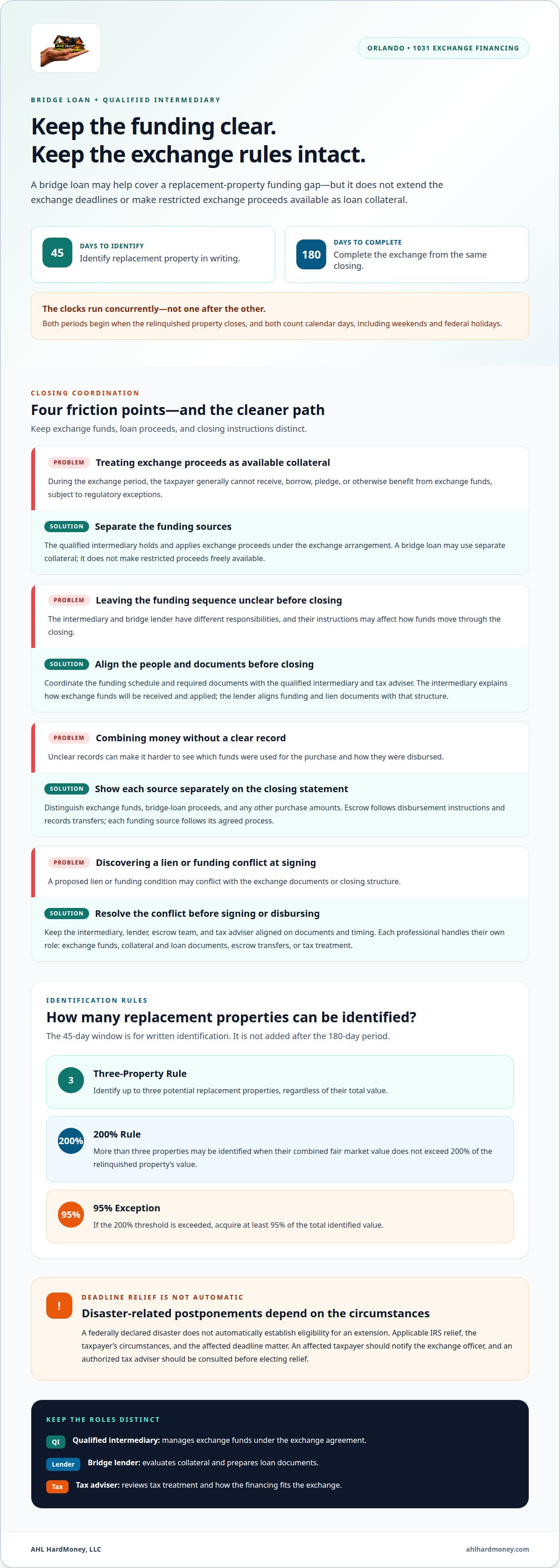
In a forward 1031 exchange, the 45-day identification deadline and 180-day exchange deadline begin when the relinquished property closes. They run concurrently, and both periods count calendar days, including weekends and federal holidays. An emergency bridge loan to preserve a 1031 exchange deadline in Orlando may address a purchase-funding gap, but it doesn’t change either deadline.
Exchange proceeds generally can’t serve as funds the taxpayer controls or pledges for personal use before the exchange ends. Deferred-exchange agreements generally prevent the taxpayer from receiving, borrowing, pledging, or otherwise benefiting from those funds during the exchange period, subject to exceptions under 26 CFR 1.1031(k)-1(g)(6). A bridge loan secured by separate collateral may help fund a purchase, but it doesn’t make restricted proceeds freely available as loan collateral.
The distinction matters at closing. The qualified intermediary holds the exchange proceeds and applies them to the replacement-property purchase under the exchange arrangement. A lender assessing collateral needs to distinguish those funds from other assets or property securing the loan. If the proposed structure gives the taxpayer control of exchange proceeds, it can put the intended tax treatment at risk.
The 45-day window is for identifying replacement property in writing under the exchange rules. It isn’t added after the 180-day clock; both start from the relinquished-property closing. Under the Three-Property Rule, a taxpayer may identify up to three potential replacement properties, regardless of their total value. The 200% Rule allows more than three when their combined fair market value doesn’t exceed 200% of the relinquished property’s value. If that threshold is exceeded, the 95% Exception requires acquiring at least 95% of the total identified value.
What are the 1031 exchange identification and closing deadlines? A taxpayer generally has 45 days after the sale closing to identify replacement property and 180 days from that same closing to complete the exchange. The periods operate together, not one after the other.
Orlando bridge-loan rates, fees, terms, and loan-to-value limits depend on the collateral, property value, lien position, and repayment plan. Those factors shape the lender’s assessment; no single figure applies to every transaction. For an Orlando investor weighing an emergency bridge loan to preserve a 1031 exchange deadline, the proposed collateral and exit strategy are central. A property facing foreclosure involves a different financing concern, addressed through Florida foreclosure refinance loans.
How does the qualified intermediary interact with the bridge lender at closing?
The qualified intermediary and bridge lender handle different parts of the same closing. The intermediary holds and transfers exchange funds under the exchange agreement. The lender supplies loan proceeds according to its closing instructions. Clear coordination helps keep those funding sources separate in the transaction records.
Before closing, the lender’s team can coordinate the funding schedule and required documents with the taxpayer’s qualified intermediary and tax adviser. The intermediary can provide instructions for receiving exchange proceeds and identify how those funds will be applied to the replacement property. The lender can align its funding and lien documents with that closing structure. The tax adviser can review how the proposed financing fits the taxpayer’s section 1031 exchange transaction.
This coordination doesn’t change the professionals’ roles. The qualified intermediary manages exchange funds and follows the exchange agreement; the lender evaluates collateral and prepares loan documents. The tax adviser addresses tax treatment. The intermediary isn’t the lender’s underwriter, and the lender isn’t the taxpayer’s tax adviser. A permanent financing plan also matters: the bridge loan’s repayment path should fit the investor’s overall transaction, rather than assume exchange funds can be borrowed or pledged freely.
At escrow, the closing statement should distinguish exchange funds, bridge-loan proceeds, and any other amounts used in the purchase. Escrow follows the disbursement instructions and records the transfers. The intermediary sends exchange funds through the agreed process, while the lender sends its funds according to its closing requirements. If a proposed lien or funding condition conflicts with the exchange documents, resolve the issue before signing or disbursing funds. This keeps the closing sequence transparent and gives each professional the information needed for their role.
Disaster-related deadline relief calls for additional coordination. A federally declared disaster doesn’t automatically establish that a taxpayer qualifies for an extension. The applicable IRS relief, the taxpayer’s circumstances, and the affected exchange deadline matter. If the taxpayer is affected, they should notify the exchange officer because the exchange company may not know. An authorized tax adviser should be consulted before electing relief. A lender’s disaster-related refusal to fund can also be relevant to a non-affected taxpayer’s Section 17 relief analysis.
For a transaction that combines exchange funds and bridge financing, keep the intermediary, lender, escrow team, and tax adviser aligned on documents and timing. Learn about the team’s approach to real-estate financing as you consider the financing side of that coordination.
Why can't you just buy the replacement property first with a bridge loan?
A bridge loan can fund a replacement-property purchase before other financing or sale proceeds arrive. Buying first, however, may require a reverse-exchange structure rather than a standard forward exchange.
Bridge Financing for Replacement-Property Purchases
Bridge financing is short-term funding that can support a replacement-property purchase while the investor arranges a longer-term repayment plan. It can help when the seller’s closing schedule doesn’t match the investor’s available cash or expected sale proceeds. A lender may focus its review on property value and the borrower’s exit strategy, helping address a tight purchase timeline without changing the exchange rules.
In a forward exchange, the taxpayer sells the relinquished property first, then identifies and acquires replacement property through the exchange. A bridge loan may help fund the purchase, but it doesn’t make an otherwise ineligible property eligible or change the exchange deadlines. The loan also doesn’t itself establish that a purchase qualifies for Section 1031 treatment.
Buying the replacement property first raises a different timing issue. A reverse exchange typically uses an exchange accommodation titleholder to hold title to one property while the other property is sold. Under the described reverse-exchange rules, the relinquished property must be identified within 45 days after the replacement property is parked, and the transfer must be completed within 180 days. The financing and title arrangement therefore need to fit that structure.
Documents and Steps a Lender Uses to Arrange an Emergency Bridge Loan
The lender’s review centers on the property’s value and the borrower’s exit strategy, meaning the plan for repaying or replacing the short-term financing. These details connect the requested loan to the purchase and its expected repayment. The lender then evaluates the collateral and prepares funding and lien documents for closing.
For an Orlando purchase, make the financing path clear: which property secures the loan, how the purchase will close, and what event is expected to repay the bridge financing. The lender’s review of property value and exit strategy helps frame those decisions. The qualified intermediary and tax adviser handle their separate exchange and tax roles.
Multiple property sales can complicate the plan. If an investor expects proceeds from more than one relinquished property, each sale has its own closing sequence and exchange transaction. The lender’s repayment analysis needs to account for which sale supports the exit plan and what happens if that sale closes later than expected. The exchange structure also needs to reflect the properties involved.
A bridge loan doesn’t replace the taxpayer’s exchange obligations or tax-return timing. In an illustrative scenario, a $3,000,000 replacement-property purchase financed at 70% of its price produces a $2,100,000 bridge loan. That example shows how financing size relates to purchase value, not how every lender sets terms. The investor’s repayment plan and exchange structure remain central.
180-Day exchange period
The 180-day exchange period gives a taxpayer time to acquire qualifying replacement property after transferring the relinquished property. It starts on the relinquished-property transfer date, not when the replacement purchase begins. The 45-day identification period runs within that same window. A bridge loan can support the purchase, but it doesn’t pause or restart either clock.
The 180-day deadline may not be the only date that matters. The exchange generally must conclude before the taxpayer’s tax return due date for the year of the transfer, unless a filing extension is in place. If that due date comes sooner, it can limit the time available. A filing extension may affect that tax-return constraint, but it doesn’t by itself extend the 180-day exchange period.
For a forward exchange, completion means acquiring identified replacement property within the applicable exchange period. The transaction timeline needs to account for purchase terms, title work, lender underwriting, and closing coordination. A delay at any stage can affect the time remaining, even if financing is arranged. Record key dates in writing with the exchange documents, so the taxpayer and transaction professionals share the same timeline.
A reverse exchange has its own 180-day limit. Under Revenue Procedure 2000-37, the transfer must be completed within 180 days, and the combined period of parking cannot exceed 180 days. Parking refers to an exchange accommodation titleholder holding title to one property while the other property is sold. This structure can allow the replacement property to be acquired first, but it doesn’t remove the need to complete the exchange within the applicable period.
Standard 1031 deadlines generally aren’t extendable, except for limited relief involving presidentially declared disasters affecting the exchange area. According to the Internal Revenue Service, qualifying deadlines may be postponed by 120 days or until the end of the authorized disaster extension period, whichever is later. This is not automatic relief for every disaster. A FEMA notice or presidential declaration alone does not postpone an exchange deadline; IRS disaster relief must apply.
Even when disaster relief applies, its outer limits matter. The postponement cannot extend beyond one year or the taxpayer’s tax return due date, including extensions, for the transfer year. A deadline that falls before the disaster date may also be treated differently from one falling on or after it. For a reverse exchange, the taxpayer must still account for the parking period and any applicable relief. These limits make the 180-day calendar an essential part of planning the purchase, financing, and final transfer.
Exchange funds and postponed deadlines
A bridge loan can address a funding gap, but it doesn’t itself postpone a 1031 exchange deadline or release exchange funds. The taxpayer generally can’t receive or control those proceeds directly without disqualifying the exchange. Disaster relief is a separate possibility, governed by the applicable IRS notice and the taxpayer’s circumstances.
According to the Internal Revenue Service, a taxpayer may qualify for an extension of the 45-day identification deadline after a qualifying federally declared disaster. Relief isn’t automatic for every disaster. A FEMA notice or presidential declaration alone doesn’t postpone an exchange deadline; the IRS must issue relief identifying eligible areas. The taxpayer’s connection to a covered area and the deadline date affect whether relief applies.
For general relief, according to the Internal Revenue Service, .02 (1) is amended so that the last day of the 45-day identification period, the 180-day exchange period, and specified reverse-exchange periods falling on or after a federally declared disaster date are postponed by 120 days or until the last day of the authorized general disaster extension period, whichever is later. The applicable IRS News Release or other guidance identifies that period and covered disaster.
Section 6 of Revenue Procedure 2018-58 addresses deadlines falling between a disaster date and the end of the postponement period. If an affected taxpayer’s qualifying 45- or 180-day deadline falls on or after the applicable disaster date, that deadline may be postponed to the final day specified in the relief. The particular IRS notice controls the date. A deadline that passed before the disaster date may be treated differently.
Section 17 may also apply when disaster-related difficulty prevents a taxpayer from meeting an exchange deadline, including some taxpayers not designated as affected. A lender’s refusal to fund because of a federally declared disaster can support eligibility under the described rules. Section 17 relief is limited: it can’t extend beyond one year or the taxpayer’s income tax return due date, including extensions, for the transfer year. An authorized tax adviser can assess how the relief applies.
For a reverse exchange, according to the Internal Revenue Service, the relinquished property must be identified no later than 45 days after the replacement property is parked with the accommodation titleholder. If an investor can’t close on time, alternatives include separate purchase financing, a reverse-exchange structure, or qualifying disaster relief. A bridge loan alone doesn’t extend the exchange period, and the exchange may not receive Section 1031 treatment if required deadlines are missed.
Postponed deadlines may also delay access to unspent exchange funds until the new deadlines pass, unless the exchange ends earlier under applicable rules. That can affect purchase and cash-flow planning even when a loan funds the transaction. Aligning the exchange schedule, lender funding, and tax advice helps clarify which option fits the real-estate transaction.
AHL HardMoney, llc
AHL HardMoney, llc can help Orlando property owners consider real-estate financing when an exchange purchase creates a funding gap. Options include Cash Out Refinance, Home Equity Loans, Private Money Refinance, and Foreclosure Refinance Loans. These may address financing needs tied to property, but they don’t extend a 1031 deadline or change how a qualified intermediary handles exchange proceeds.
The right direction depends on the property, existing financing, and transaction repayment plan. For example, a Home Equity Loan may be relevant when available equity is part of the financing picture. Exchange timing and tax treatment remain separate matters for the qualified intermediary and tax adviser.
Contact AHL HardMoney, llc to discuss your property and financing needs.
Plan the Financing Around the Transaction
An emergency bridge loan to preserve a 1031 exchange deadline in Orlando should be considered as one part of a coordinated transaction plan, not as a substitute for exchange compliance. The next step is to bring the financing structure, property purchase, and repayment plan into the same discussion. That gives each professional a clearer view of how their part connects to the larger transaction.
The right financing route depends on the property, available equity, existing obligations, and intended exit strategy. A focused review can clarify which questions belong with a lender and which require input from the qualified intermediary or tax adviser. Clear roles and timely communication make a complex decision easier to manage.
Take the next step with a clear picture of your property and goals. A thoughtful financing plan can help you move forward with greater confidence.
Frequently Asked Questions
What Is a 1031 Exchange?
A 1031 exchange is a transaction involving real property held for investment or productive use in a trade or business. It allows qualifying taxpayers to defer tax on gain when they exchange qualifying real estate under the applicable rules. The property’s use and the exchange structure matter; calling a transaction an exchange doesn’t, by itself, make the property or sale eligible.
Does using a bridge loan affect whether my exchange qualifies for tax deferral?
A bridge loan doesn’t automatically determine whether an exchange qualifies, but its structure and the use of exchange proceeds matter. For example, the IRS Form 8824 example describes Taylor exchanging a building with an $80,000 mortgage for one with a $150,000 mortgage plus $40,000 cash. The replacement property’s liabilities exceed the liabilities relieved by $70,000, illustrating why a tax adviser should consider debt and cash together.
Can a bridge loan help an Orlando investor close a replacement property before the 1031 deadline?
Yes. Bridge financing can supply purchase funds when the investor’s other financing or cash isn’t ready for closing. It doesn’t extend the exchange deadline. If the replacement property is purchased first, the transaction may need a reverse-exchange structure, with title and timing arranged accordingly. The lender’s collateral and repayment plan also need to fit the closing and exchange arrangements.
What are the IRS rules for borrowing money during a 1031 exchange?
Under 26 CFR 1.1031(k)-1(g)(6), a deferred-exchange agreement generally must prevent the taxpayer from receiving, pledging, borrowing, or otherwise benefiting from exchange funds before the exchange period ends, subject to exceptions. A separate loan is distinct from taking exchange proceeds, but its collateral and disbursement terms still matter. Loan documents should clearly identify the collateral and how the borrowed funds will be used.
How do exchange funds, bridge financing, and replacement-property closing work together?
At closing, escrow coordinates the sources and uses of purchase funds. For example, the qualified intermediary may transfer exchange proceeds under the exchange agreement, while the lender sends bridge-loan proceeds under its funding instructions. The closing statement records how the funds are applied. Keeping them distinct helps the professionals track the transaction and identify any mismatch between the lender’s lien documents and the exchange arrangement.
How quickly can an Orlando bridge loan be approved and funded?
AHL HardMoney, llc reports approvals often within 30 minutes and loan closings in 5 to 15 days, regardless of credit history. Those figures describe approval and possible closing timing, not a guaranteed date when funds will reach escrow. AHL HardMoney, llc serves Orlando and the surrounding Florida markets. The purchase contract, property details, lender documents, and closing coordination all affect the transaction schedule.
What are the risks of using bridge financing to meet a 1031 exchange deadline?
Bridge financing creates a repayment obligation and may place a lien on the collateral property. If the expected sale, refinance, or other exit plan is delayed, the borrower still needs to meet the loan terms. The loan also doesn’t pause exchange deadlines. Before relying on it, map the closing schedule, collateral, repayment source, and exchange timeline together.
When should an Orlando investor consult a qualified intermediary, tax adviser, or real estate attorney?
Bring the qualified intermediary and tax adviser into the discussion before signing exchange or loan documents, especially if the replacement purchase comes first, exchange proceeds could be pledged, or a disaster affects timing. The qualified intermediary handles exchange funds and transaction procedures; the tax adviser considers tax treatment and possible relief. A real estate attorney can address property, title, and loan-document issues. For disaster relief, consult an authorized tax adviser before electing an extension.
Disclaimer:
While Dan is not a real estate attorney, he is a Full Time, Licensed Florida Mortgage and Real Estate Broker Professional coupled with 21+ years of successful strategies, methodologies and techniques that have proven effective to the benefit of Florida families.
While not every conversation is a deal, we promise to leave you better off then before you called. We serve everyone we come in contact, with the highest levels of integrity and dignity.
We invite you to make the call 📲


