


Article by
Dan Conneally - NMLS 339916, LO13164, BK3246524, CQ1072086
Dan Conneally has been successfully helping Florida families with thier real estate related situations for the last 21+ years, regardless of credit or past financial background.
While Dan is effective with institutional lending, he particuarly shines when matters require unique strategies involving noninstitutional resources.
Check out his legions of testimonials from real Florida families at Google, Facebook and the BBB to get a sense of the caliber and effectiveness he achieves. Dan has appeared on television speading the message of hope to good folks that need diligent, discrete, nonjudgy care.
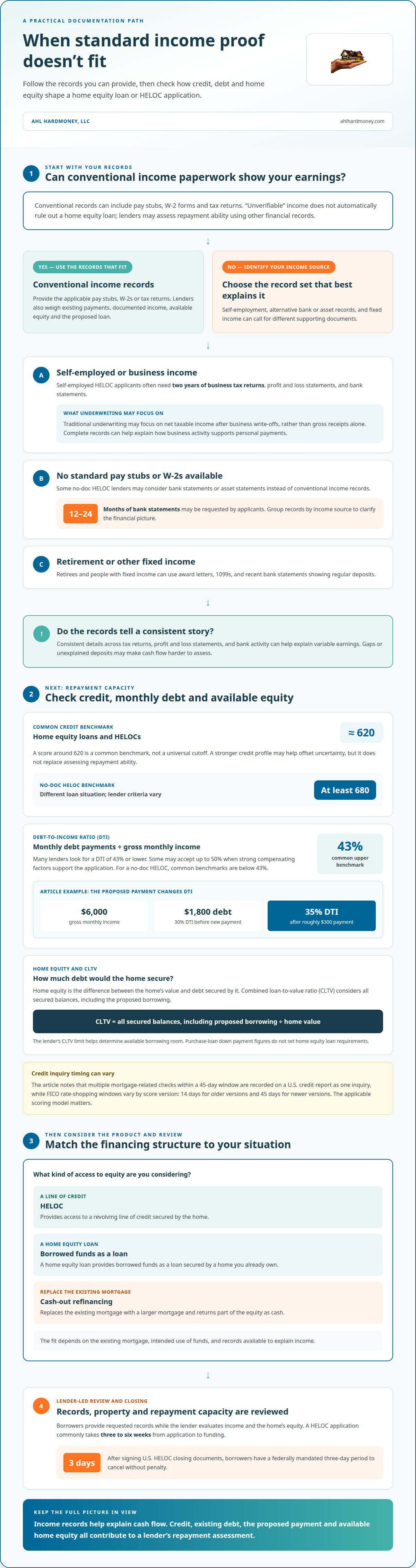
Unverifiable income doesn’t automatically rule out a home equity loan. Understanding how to get a home equity loan with unverifiable income starts with showing a lender a reliable way to assess your ability to repay; some no-doc HELOC lenders, for example, may consider bank or asset statements instead of standard pay stubs, W-2s, or tax returns. Credit and debt also matter: common benchmarks are a credit score around 620 and a debt-to-income ratio of 43% or lower, though lenders’ requirements vary.
It’s understandable to feel stuck when your income comes from self-employment, contract work, or another source that doesn’t fit conventional paperwork. “Unverifiable” income may still be documented in other ways, and lenders may also consider your home equity and overall financial picture.
This article explains how income records, debt, available equity, and repayment capacity can affect your options, including what self-employed borrowers may need to document. It also covers how alternative records can clarify your financial picture when conventional income documents are unavailable.
Key Takeaways
- Unverifiable income doesn’t automatically end your application; lenders may consider alternative records when assessing repayment ability.
- Self-employed borrowers can strengthen their application with organized business and personal income documentation.
- Your available borrowing room depends on the home’s value, existing mortgage balance, and the lender’s combined loan-to-value limit.
- Unstable income can raise concerns when it’s difficult to document or doesn’t support the proposed payment, so the full financial picture matters.
- Understand which records apply to your income type, since pay stubs, tax returns, bank statements, and asset statements may serve different purposes.
Credit score requirements
A credit score around 620 is a common benchmark for U.S. home equity loans and HELOCs, but it isn’t a universal cutoff. A lender also weighs existing payments, documented income, available equity, and the proposed loan. For borrowers with unverifiable income, a stronger credit profile can help offset uncertainty, but it doesn’t replace the need to assess repayment ability.
Debt-to-income ratio, or DTI, compares monthly debt payments with gross monthly income. Many lenders look for a DTI of 43% or lower; some may accept up to 50% when strong compensating factors support the application. For a no-doc HELOC, common benchmarks are a credit score of at least 680 and a DTI below 43%. These benchmarks describe different loan situations, so compare each lender’s criteria against your own records and proposed payment.
Equity matters alongside credit. A home equity loan is secured by a home you already own, so purchase-loan down payment figures don’t set its requirements. For context, comparison data lists 3% down for conventional loans, 3.5% for FHA loans, and 30% for no-doc mortgages. Those are purchase-loan comparisons, not down payment rules for a home equity loan. In Florida, credit concerns may also overlap with foreclosure; the Florida foreclosure refinance loan information covers that separate financing situation.
Credit checks deserve attention while applying. Multiple mortgage-related credit checks made within a 45-day window are recorded on a U.S. credit report as a single inquiry. Inquiries less than 30 days old are ignored for scoring purposes when they occur. That does not mean every credit check follows the same timing rule; the applicable scoring model matters.
FICO’s rate-shopping window also varies by score version: older versions use 14 days for mortgage-related inquiries, while newer versions use 45 days. If you compare HELOC options, keep applications within a focused period and track when each lender makes a credit inquiry. This helps you understand how checks may appear on statements and keeps your credit review organized.
Before applying, review your credit report for errors and calculate DTI using the proposed payment as well as existing debts. A hypothetical borrower with $6,000 in gross monthly income and $1,800 in monthly debt has a 30% DTI before a new HELOC payment. Adding a roughly $300 payment raises that example to 35%. The calculation shows why lenders assess the payment alongside credit and equity, rather than looking at a score alone.
Can self-employed borrowers qualify for a HELOC?
Self-employed borrowers may qualify when available records help assess their finances. AHLHardMoney offers Home Equity Loans and accepts any credit profile, with “No Hard Credit Inquiry.” The process and documents differ from conventional underwriting, so gather records that show your financial picture and consider how a home equity loan compares with refinancing.
Income Documentation for Self-Employed Borrowers
Income documentation is the financial record that helps a business owner show earnings and cash flow. Self-employed HELOC applicants often need two years of business tax returns, profit and loss statements, and bank statements. Traditional underwriting may focus on net taxable income after business write-offs, rather than gross receipts alone. This distinction matters because complete records help explain how business activity supports personal payments.
Alternative and Fixed-Income Documentation
Alternative documentation uses financial records beyond standard pay stubs or W-2 forms to show income or assets. No-doc HELOC lenders may consider bank statements or asset statements instead of conventional records, and applicants may need 12 to 24 months of bank statements. Retirees and people with fixed income can use award letters, 1099s, and recent bank statements showing regular deposits. For older homeowners assessing their options, guides from dhuggamortgages.ca detail how different equity release pathways compare in retirement. Grouping records by income source helps clarify the financial picture.
The Lender-Led Application, Documentation, and Closing Process
The lender-led process reviews the application, supporting documents, property, and repayment capacity before a secured line of credit closes. Borrowers provide requested records while the lender evaluates income and the home’s equity. A HELOC application commonly takes three to six weeks from application to funding. After signing U.S. HELOC closing documents, borrowers have a federally mandated three-day period to cancel without penalty.
Consistent details across tax returns, profit and loss statements, and bank activity can help explain variable earnings. Gaps or unexplained deposits may make cash flow harder to assess. A focused conversation about the records supporting your application can clarify the next steps. Discuss your situation.
Comparing Home Equity Products for Unverifiable Income
A home equity loan provides borrowed funds as a loan, while a HELOC provides access to a revolving line of credit secured by the home. Cash-out refinancing replaces the existing mortgage with a larger mortgage and returns part of the equity as cash. Lenders may consider repayment ability and ask for supporting records. The fit depends on the existing mortgage, intended use of funds, and records available to explain income.
Home equity and combined loan-to-value limits
Home equity is the difference between a home’s value and the debt secured by it. Lenders use combined loan-to-value ratio, or CLTV, to determine how much debt the property would secure after a new loan or line of credit. The calculation divides all secured balances, including the proposed borrowing, by the home’s appraised value. A lower CLTV leaves more equity in the property.
For example, a $400,000 home with a $200,000 mortgage balance reaches $320,000 in total debt at an 80% CLTV. That leaves room for a $120,000 HELOC before reaching that illustrative ceiling. The figure is a calculation, not a promise of approval or an individual borrowing limit. The lender also evaluates the application and supporting documentation.
Limits vary by loan type and lender. Most U.S. HELOC lenders cap CLTV at 80% to 85%, while some allow up to 90%. For no-doc HELOCs, some lenders may allow total secured debt to reach 80% or 90% of appraised value. These are separate lending practices, not a single universal cap. A lender’s limit determines how much existing mortgage balance can be combined with new borrowing.
Consider another example: a $400,000 home has a $260,000 first mortgage and a proposed $40,000 home equity loan. That calculation helps show how both the mortgage balance and requested amount affect borrowing room. You can learn about home equity loans as one way to borrow against available equity.
Equity requirements affect the result in reverse. Home equity loans and HELOCs typically require homeowners to retain 15% to 20% equity. If a lender caps CLTV at 85%, the borrower generally needs to retain at least 15% equity after borrowing. A lower appraisal or additional lien can reduce the available amount, even when the first mortgage balance is modest.
A lender can use property valuation and current debt balances to assess the home’s equity. Updated mortgage statements help establish the remaining balance, while a valuation supports an estimate of the home’s worth. Changes to either figure can affect the assessment. For borrowers with hard-to-document income, equity is one part of the financing picture, alongside repayment capacity.
Unstable or unverifiable income as a reason for denial
A borrower may have options even when conventional documents don’t capture their income. The financial picture still needs to show repayment capacity, so available records, existing obligations, and the proposed payment matter. Home equity alone doesn’t show whether payments fit your finances. A clear application connects income evidence with the requested loan and your overall situation.
The Consumer Financial Protection Bureau’s Ability to Repay Rule generally requires U.S. mortgage lenders to verify financial information and reasonably determine that borrowers can repay. Income that changes often or records that don’t clearly support it can complicate that assessment. For example, a self-employed borrower’s tax returns may show low net taxable income after business write-offs, while other financial records show recurring deposits. Those documents present different pieces of the income picture.
Common denial concerns include income that cannot be substantiated, debt obligations that strain the budget, and an appraisal that doesn’t support the requested borrowing. Payment history can matter too. Each factor can affect the application differently, so a concern about income doesn’t automatically explain every denial.
For irregular earnings, records should make the pattern understandable. Bank statements can show when deposits arrive, while profit and loss statements can explain business revenue and expenses. If income comes from several sources, organize records for each one to distinguish recurring funds from one-time deposits. For seasonal or commission-based pay, records that show how earnings vary can help explain changes between pay periods.
Credit and property details also shape a financing application. A property valuation supports the collateral assessment, but doesn’t establish monthly cash flow. Likewise, substantial equity doesn’t answer whether income can support payments. These factors form parts of the overall financial picture, rather than replacing one another.
The key risk of borrowing against home equity is that the loan is secured by your home. If payments become unaffordable, the property may be at risk. Consider whether the payment fits a realistic cash-flow plan, especially if your earnings depend on seasonal work, business activity, or changing contracts.
A denial can reflect gaps in income documentation, debt, payment history, or property value. Understanding the issue helps identify what a future application may need to explain. Alternative records can offer a fuller view of income, but the application still needs to present a clear financial picture and the proposed payment.
Pay stubs and tax returns for income verification
For W-2 employees, pay stubs and tax returns help establish monthly income and employment history. Home equity applicants may document earnings with one to two months of pay stubs. W-2 employees typically provide two years of tax returns for a HELOC. These records help a lender compare reported income with recurring payments and assess the proposed loan.
Florida applicants who are W-2 employees are asked for 30 days of recent pay stubs and W-2 forms for the preceding two tax years. The documents show current earnings alongside reported income from earlier tax years. If pay varies, the difference between recent stubs and annual records can affect how a lender understands monthly income and evaluates approval.
Tax returns can also reveal why self-employed borrowers have income that differs from business deposits. Traditional home equity underwriting uses net taxable income after business write-offs. A return showing lower taxable income than gross receipts may therefore shape the lender’s calculation. For a HELOC, big-bank retail lenders require two years of tax returns for income verification.
Not every income source produces a pay stub. No-doc HELOC lenders may use bank statements or asset statements instead of standard W-2s, tax returns, or pay stubs. For example, a borrower with deposits from contract work can use bank records to show incoming funds. Consulting an experienced mortgage brokerage such as Integrity Estates Realty can also help homeowners navigate loan options tailored to non-traditional documentation. The lender’s review still needs to establish a reasonable picture of income and repayment ability.
Retirees and homeowners receiving fixed income can use award letters, 1099s, and recent bank statements showing regular deposits. Together, these records connect an income source with the amount received and the deposits reaching an account. A consistent paper trail can help explain funds that don’t appear on an employer’s pay stub. Match each record to the relevant income source before submitting the application.
Income verification can influence more than the approval decision. A lender’s assessment of income and repayment capacity forms part of its review of the application, alongside credit and property factors. The interest rate and available terms depend on the loan and underwriting decision; documentation alone doesn’t determine them. A credit report also shows credit history, while income records address cash flow, so the two serve different purposes.
For an application with irregular earnings, organize available pay stubs, tax returns, award letters, and bank statements by income source. This makes it easier to explain differences between monthly income and annual totals. Clear records can show what each deposit represents and how it relates to future payments.
AHL HardMoney: Home Equity Loans
AHL HardMoney, llc offers Home Equity Loans for homeowners exploring borrowing against their property. If income records don’t fit conventional pay stub or tax return patterns, equity, the existing mortgage, credit profile, and available documentation remain important parts of the financing picture. A Cash Out Refinance or Private Money Refinance may also suit homeowners whose needs point toward refinancing instead.
The right option depends on your existing mortgage, borrowing goals, and ability to manage the repayment commitment. Compare how the proposed payments fit your financial situation before moving forward.
Contact AHL HardMoney, llc about home equity loan options
Choose a financing path that fits your next move
Understanding how to get a home equity loan with unverifiable income starts with a clear view of your financial picture and what you need the funds to accomplish. The next step is to discuss how your income records, property, and financing goals fit together. A careful conversation can help you identify the questions and documents that matter for your situation.
AHL HardMoney, llc offers Home Equity Loans, Cash-Out Refinance, and Refinance Loans. Each offers a different way to finance property, so the right direction depends on your existing mortgage and goals. Consider the repayment commitment alongside the funds you hope to access.
You don’t have to sort through every option alone. Bring your priorities and available income records to AHL HardMoney, llc, and discuss the next step with a clearer view of your financing goals.
Move forward at a pace that feels informed and right for you.
Frequently Asked Questions
So, how hard is it to get a home equity loan?
It depends on the available equity and whether your finances support the proposed payments. For someone figuring out how to get a home equity loan with unverifiable income, the challenge is presenting a clear financial picture without standard employment records. Consistent deposits, manageable debt, and sufficient equity can help explain an application, while unclear income or obligations may make it harder to assess.
Is it possible to get a home loan without ITR (Income Tax Returns)?
Some financial records can help explain your situation when tax returns don’t capture the full picture. Bank statements or asset statements may provide additional context, but “without ITR” doesn’t mean without a financial review. For example, statements showing recurring deposits may help explain how business income relates to the proposed payments.
How Difficult Is Approval in Common Situations?
Approval can be more challenging when income fluctuates, records conflict, or recent payment history raises concerns. A self-employed borrower with organized business records may offer a clearer picture than one whose deposits and reported income differ without explanation. Retirees may document regular fixed-income deposits through award letters and bank statements. For any profile, lenders assess the property and financial picture together, not one circumstance in isolation.
What income documentation do home equity loan lenders accept?
Accepted documentation depends on employment and income type. W-2 employees commonly provide recent pay stubs, W-2 forms, and tax returns; self-employed applicants may use business returns, profit and loss statements, and bank statements. Retirees can use award letters or 1099s alongside bank statements showing deposits. Keep records tied to each income source, so deposits, reported earnings, and recurring payments can be understood together.
Can bank statements or asset-based underwriting qualify for a home equity loan?
Bank and asset statements can help explain finances, but they don’t guarantee qualification. Bank statements show the timing of deposits, while asset statements document funds or holdings. Consider these records alongside existing obligations, the property, and your ability to manage the proposed payments. A one-time deposit, for example, is different from a pattern of recurring deposits.
What credit score and debt-to-income ratio are required for a home equity loan?
A credit score around 620 is a common benchmark, while many lenders look for a debt-to-income ratio of 43% or lower. These aren’t universal requirements. Some lenders may accept a DTI as high as 50% when compensating factors support the application. Credit history and monthly obligations help lenders assess risk, so a score alone doesn’t determine approval or the terms offered.
What loan-to-value and combined loan-to-value limits apply to home equity loans?
Lenders commonly assess all property-secured debt against the home’s appraised value. Many HELOC lenders cap combined loan-to-value at 80% to 85%, while some permit up to 90%. The applicable limit depends on the loan and lender. Existing mortgages or other liens use part of that borrowing capacity, so the available amount depends on both the valuation and total secured balances.
How can borrowers choose a lender that offers alternative income verification?
Look for a lender whose application process considers records suited to your income, such as bank or asset statements, and ask how those records factor into repayment review. Check that the loan structure fits your needs and that you understand the payment obligation. For Florida homeowners, AHLHardMoney states “No Hard Credit Inquiry” and serves the entire state of Florida. Match the financing conversation to your income and property situation.
Disclaimer:
While Dan is not a real estate attorney, he is a Full Time, Licensed Florida Mortgage and Real Estate Broker Professional coupled with 21+ years of successful strategies, methodologies and techniques that have proven effective to the benefit of Florida families.
While not every conversation is a deal, we promise to leave you better off then before you called. We serve everyone we come in contact, with the highest levels of integrity and dignity.
We invite you to make the call 📲


