


Article by
Dan Conneally - NMLS 339916, LO13164, BK3246524, CQ1072086
Dan Conneally has been successfully helping Florida families with thier real estate related situations for the last 21+ years, regardless of credit or past financial background.
While Dan is effective with institutional lending, he particuarly shines when matters require unique strategies involving noninstitutional resources.
Check out his legions of testimonials from real Florida families at Google, Facebook and the BBB to get a sense of the caliber and effectiveness he achieves. Dan has appeared on television speading the message of hope to good folks that need diligent, discrete, nonjudgy care.
A federal tax lien doesn’t automatically rule out refinancing. A cash-out refinance to settle an IRS Form 941 payroll tax lien in Tampa may be possible when the IRS subordinates its lien to the new mortgage and the available home equity can support the payoff. Subordination changes lien priority; it doesn’t erase the tax debt or the lien.
If you’re weighing this option, the key issue is whether the new loan can close with the required lien priority and enough proceeds to cover the mortgage payoff, closing costs, and IRS balance. This article explains how subordination affects a refinance, how lien payoff can be handled through closing proceeds, and what can make the numbers work or fall short. You’ll get a clearer view of the process before deciding whether refinancing is a practical route for your Tampa property.
Key Takeaways
- A federal tax lien doesn’t automatically prevent refinancing; lien priority and available home equity shape whether a deal can work.
- Subordination can let a new mortgage move ahead of the IRS lien, but it doesn’t remove the lien or erase the tax debt.
- Review how the mortgage payoff, closing costs, and IRS payoff affect the cash remaining from the refinance.
- Form 941 payroll tax debt requires careful coordination between the refinance closing and the IRS lien payoff process.
- AHL HardMoney’s Cash Out Refinance may be a relevant option when you’re assessing whether home equity can help address an IRS lien.
Can You Refinance With a Tax Lien on Your Home?
Refinancing may be possible with a recorded federal tax lien, but lien priority and available equity matter. A cash-out refinance must account for both the existing mortgage payoff and IRS debt, not just the cash you hope to receive.
Federal Tax Liens and Levies
A federal tax lien secures the government’s claim against a taxpayer’s property; a levy is an action to take property to pay a tax debt. The distinction matters because a recorded Notice of Federal Tax Lien can affect the property and refinancing, while a levy involves collection action against assets.
For a Tampa homeowner, a lien does not mean the IRS has taken the home. However, it can affect closing because the new mortgage and IRS claim have competing priority. Whether a lender can proceed depends on how those claims are addressed.
Refinancing With a Recorded Lien
A cash-out refinance replaces an existing mortgage with a new loan and may use remaining home equity to pay debts. With a recorded federal tax lien, the transaction may require IRS subordination. This allows the new mortgage to take priority without removing the IRS lien.
The IRS application for a Certificate of Subordination of Federal Tax Lien is Form 14134, according to the Internal Revenue Service. A cash-out refinance in Tampa must also leave enough proceeds after the existing mortgage payoff and closing costs to address the IRS balance.
Florida has no single cash-out refinance loan-to-value limit that applies to every lender and borrower. The amount available depends on the property value, existing mortgage balance, lien priority, and the lender’s underwriting requirements.
Paying Off the Tax Lien
Paying the federal tax debt in full resolves the balance tied to the lien. The Internal Revenue Service releases a federal tax lien within 30 days after the taxpayer pays the tax debt in full.
A withdrawal is different: it removes the public Notice of Federal Tax Lien, but does not erase the tax debt. The IRS may consider withdrawal through a direct debit installment agreement; Form 12277 is used to request withdrawal of a filed lien notice.
Payoff Compared With Other Resolution Options
A refinance payoff directs closing proceeds toward the IRS balance, while an installment agreement spreads payment over time. For the direct debit withdrawal option, the taxpayer must owe $25,000 or less, or reduce the balance to that amount, and make three consecutive direct debit payments.
An offer in compromise is another way to resolve IRS debt, but it does not provide the same immediate payoff at closing as refinancing. Using home equity to pay business payroll taxes also adds a mortgage obligation secured by the home. Missed payments can put the property at risk. Consider the available proceeds, your ability to repay, and the IRS lien’s place in the closing.
Cash-out refinance and IRS lien priority
IRS lien priority can determine whether a cash-out refinance closes, even when the property has equity. The application, payoff plan, and timing all need to align.
IRS Lien Priority in a Refinance
Lien priority determines which creditor has the stronger claim against property if a borrower defaults. A recorded federal tax lien can stand ahead of a new mortgage, creating a barrier for a lender that expects its mortgage to hold the required position.
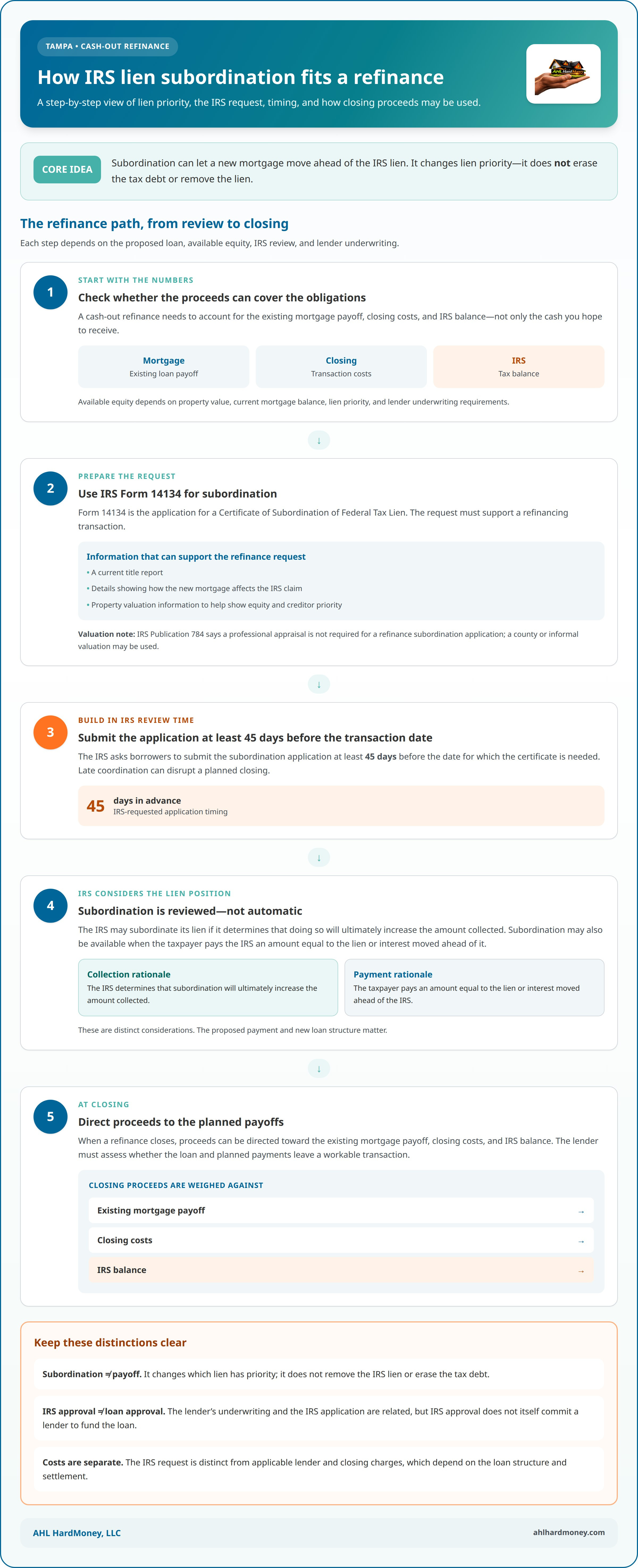
Subordination changes that order without removing the IRS lien or erasing the tax debt. According to the Internal Revenue Service, IRS Form 14134 is the application used to request a Certificate of Subordination of Federal Tax Lien. The request must support a refinancing transaction, not simply ask the IRS to step aside.
The IRS may subordinate its lien if it determines that doing so will ultimately increase the amount collected. Subordination may also be available when the taxpayer pays the IRS an amount equal to the lien or interest moved ahead of it. These are distinct considerations, so the proposed payment and new loan structure matter.
A lender coordinating the application generally needs a current title report and details showing the new mortgage’s effect on the IRS claim. IRS Publication 784 says a professional appraisal is not required for a refinance subordination application; a county or informal valuation may be used instead. That valuation helps show how equity and creditor priority change after refinancing.
Subordination Timing and Fees
Subordination is the IRS’s process for allowing another creditor to move ahead of its lien, and it can affect whether a Florida cash-out refinance proceeds. The IRS asks borrowers to submit the application at least 45 days before the transaction date for which the certificate is needed. Late coordination can disrupt a planned closing.
For a Tampa property, the lender must assess whether the proposed loan, existing mortgage payoff, and IRS payment leave a workable transaction. A Form 14134 package should present the property’s title and valuation information alongside the refinance details. The application and underwriting are related, but IRS approval does not itself commit a lender to fund the loan.
There is no supported flat fee amount to quote for this process. Separate the IRS request from the loan’s applicable lender and closing charges; those transaction costs depend on the loan structure and settlement. The central timing requirement remains the IRS’s 45-day advance application request.
Before choosing a closing date, the lender can coordinate the application timeline with the refinance review and expected IRS payment. Borrowers considering how refinance options are assessed can weigh lien priority, available equity, and transaction costs together rather than treating subordination as automatic approval.
IRS tax lien help in Tampa
For a Tampa homeowner, addressing an IRS lien during refinancing involves more than estimating the tax balance. The lien record, current payoff amount, mortgage position, and chosen IRS resolution route all affect the transaction. A tax professional or closing team can coordinate records and communications so the refinance timeline accounts for the IRS process.
Confirm the lien and payoff information
The IRS Centralized Lien Operation handles routine federal lien matters, including verifying a lien, requesting a payoff amount, and requesting a release. Its listed phone number is 800-913-6050. IRS Publication 4235 provides current contact information and instructions for lien payoff and release requests.
The closing team needs the payoff amount and applicable payment instructions to prepare accurate settlement figures. The IRS payoff letter states the amount due and the date through which it applies. An outdated balance can leave a shortfall or delay closing; using the current figure and following the payment instructions can support the lien-release process.
Coordinate lien status and withdrawal
Release and withdrawal address different parts of the lien record. A release follows satisfaction of the tax debt; withdrawal removes the public Notice of Federal Tax Lien but does not cancel the underlying liability. Form 12277 is the IRS application for withdrawal of a filed lien notice.
For withdrawal through a Direct Debit Installment Agreement, the balance must be $25,000 or less, or be paid down to that amount. The taxpayer must also make three consecutive direct debit payments, and the agreement must pay the debt in full within 60 months or before the collection statute expires, whichever is earlier.
Keep the refinance process aligned
IRS coordination and mortgage processing need to move together. A lender evaluates the property’s equity, existing mortgage, new loan terms, and proposed IRS payment. The closing team uses the payoff information to allocate proceeds and prepare settlement documents. The IRS payment and release steps then affect how the lien record is cleared.
If a representative communicates with the IRS for the taxpayer, Form 2848 is used to file a power of attorney. This can authorize the IRS to communicate with that representative. In a Tampa refinance, clear authority and a consistent payoff figure help keep tax communications aligned with the title and closing schedule.
Seek IRS tax lien assistance when the recorded notice, payoff amount, or release timing raises questions for the mortgage closing. Consulting professional resolution specialists like US Tax Advocate Services LLC can provide a coordinated review to identify whether payment, subordination, or a withdrawal request fits your goal. The appropriate route depends on the lien’s status, the amount owed, the refinance structure, and applicable IRS requirements.
Lien payoffs through refinance closing proceeds
Refinance proceeds can pay an IRS lien if enough funds remain after the existing mortgage payoff. The settlement statement shows how the new loan is allocated, including the IRS payment and transaction costs.
Applying Closing Proceeds to a Lien
At closing, the closing attorney distributes loan proceeds to the listed payees, including the mortgage holder and the IRS when the lien payoff is part of the transaction. Only the equity left after prior obligations and costs can fund the IRS payment.
The IRS payoff letter states the amount due and the date through which that amount applies. The closing team uses these details to prepare settlement figures and send payment as directed. If the payoff is short or its applicable date passes, the planned allocation may need updating before the lien can be cleared.
After a $145,000 mortgage payoff and $4,800 in closing costs, $10,200 remains for the IRS. This example shows why property value alone doesn’t determine whether proceeds can cover the lien.
Paying Form 941 Debt With Refinance Funds
Cash-out refinance funds can be directed to an IRS Form 941 payroll tax debt when the transaction’s proceeds and lien requirements support that payment. The closing statement records the IRS payoff alongside the mortgage payoff, allowing the funds to be distributed as part of one coordinated closing.
The key calculation is the available loan amount minus the existing mortgage balance and closing costs. If you intend to satisfy the tax debt through closing, the remaining proceeds must cover the IRS payoff. If the remaining equity cannot cover the full amount, the refinance will not resolve the entire balance.
Paying the IRS from closing proceeds differs from maintaining an installment agreement. An agreement schedules payments over time, while a closing payoff applies funds to the stated balance. A direct-debit installment agreement may be relevant to a separate withdrawal option, but it does not direct refinance proceeds to the IRS.
After the IRS receives the stated payoff, the lien-release process follows applicable IRS procedures. A certificate of discharge is a separate tool that removes specific property from a lien’s reach; it does not eliminate the lien against the taxpayer’s other property. For a sale-based discharge, the IRS process involves payment, proof that title has been transferred, and the final settlement statement. In a refinance, settlement documents still show the payment and allocation, so accurate figures matter at closing.
Can a cash-out refinance be used to pay an IRS Form 941 payroll tax lien?
Yes. A cash-out refinance can provide funds to pay an IRS Form 941 payroll tax lien when the loan proceeds cover the existing mortgage, closing costs, and required IRS payoff. For Tampa business owners, a cash out refinance to settle an IRS 941 payroll tax lien in Tampa depends on both available equity and the lien’s position. If proceeds fall short, refinancing may not resolve the full payroll tax balance.
Form 941 reports federal payroll taxes, so the amount owed may relate to several filing periods. The Internal Revenue Service generally requires quarterly filings by April 30 for the first quarter, July 31 for the second, October 31 for the third, and January 31 for the fourth. Unpaid periods can affect the total payoff and the closing calculation. A current balance is central to planning the transaction.
Before closing, the refinance team needs the IRS payoff amount and the existing mortgage payoff figure. It compares the proposed loan amount with the property equity and closing costs. A federal tax lien can also attach to business property and rights to business property, including accounts receivable. The lien review may therefore involve more than the home’s title and equity.
Closing must direct payment according to the IRS payoff terms. If the IRS subordinates its lien, the new mortgage may move ahead of the IRS claim, but subordination does not pay or erase the tax debt. Alternatively, closing proceeds can be applied to the IRS balance. These approaches differ: one changes lien priority, while the other pays down the obligation.
For Tampa employers considering a cash out refinance to settle an IRS 941 payroll tax lien in Tampa, the key question is whether proceeds pay the full balance or only part. A partial payment leaves a remaining tax obligation requiring its own resolution plan. An installment agreement schedules payments over time, while refinancing changes the mortgage debt and may use home equity for an IRS payment.
A cash-out refinance turns home equity into secured borrowing. If the business later struggles to make the new mortgage payments, the homeowner’s property is at risk. This deserves careful consideration when payroll taxes arose during cash-flow pressure. Your plan should account for the ongoing mortgage obligation, not only the immediate IRS payment.
The transaction depends on equity, the IRS payoff, lien priority, and your ability to manage the new mortgage. Reviewing these factors together helps determine whether the proposed closing can serve your goal.
A UCC-3 is the standard amendment form used to terminate, assign, continue, or otherwise change a UCC-1 filing. IRS Form 14135 is the application for a certificate of discharge of property. IRS Publication 783 provides instructions for completing and submitting Form 14135 to apply for a Certificate of Discharge.
Employer Social Security taxes are one part of payroll tax calculations. The Medicare tax rate shown for Form 941 taxable wages is 0.029. The Additional Medicare Tax rate shown for Form 941 taxable wages is 0.009. These tax rates may help explain payroll tax calculations, while the IRS payoff remains essential to determining the funds needed at closing.
AHL HardMoney: Cash Out Refinance
AHL HardMoney, llc offers Cash-Out Refinance for Florida property owners considering whether home equity can help address an IRS payroll tax lien. A refinance review can consider the existing mortgage payoff, available equity, closing costs, IRS payoff, and lien-priority requirements together. This option may fit when the property’s equity can support the proposed payoff and the new mortgage fits your repayment plan.
If a cash-out refinance doesn’t fit, AHL HardMoney, llc also offers Home Equity Loans and Refinance Loans. The right option depends on the property, lien status, proceeds needed, and mortgage obligations you can manage.
Contact AHL HardMoney, llc to discuss a cash-out refinance for your IRS lien situation.
Plan the next move with confidence
Before choosing a cash-out refinance to settle an IRS Form 941 payroll tax lien in Tampa, consider how the new mortgage payment fits the business’s cash flow after closing. Resolving the tax balance is only one part of the decision; the longer-term plan should also leave room for operating expenses and future tax obligations. To explore broader relief strategies and keep your business finances compliant, professional advisors at cjbsolutionsllc.net provide comprehensive tax resolution and accounting solutions.
AHLHardMoney™ offers Cash-Out Refinance, Home Equity Loans, and Refinance Loans. Whether one fits depends on the property, available equity, lien position, and payment structure you can manage. Consider these factors together to clarify your next step while accounting for your business’s ongoing needs.
A thoughtful plan can help you move forward with greater clarity and focus.
Frequently Asked Questions
What Is a Federal Tax Lien?
A federal tax lien is the government’s legal claim against a taxpayer’s property for unpaid federal tax debt. It arises after the IRS assesses the liability, sends a Notice and Demand for Payment, and the taxpayer neglects or refuses to pay on time. The lien can also reach assets acquired while it remains in effect, so later-acquired property may be relevant when reviewing a borrower’s financial picture.
Can the IRS subordinate a federal tax lien to a new mortgage for refinancing?
The IRS can subordinate a federal tax lien to a new mortgage when the request meets an applicable basis for subordination. For example, the IRS may consider whether refinancing will ultimately increase the amount collected and facilitate collection. Approval changes the lien’s priority, not the tax obligation itself. The new lender still evaluates the property, equity, and repayment plan before deciding whether the refinance works.
Disclaimer:
While Dan is not a real estate attorney, he is a Full Time, Licensed Florida Mortgage and Real Estate Broker Professional coupled with 21+ years of successful strategies, methodologies and techniques that have proven effective to the benefit of Florida families.
While not every conversation is a deal, we promise to leave you better off then before you called. We serve everyone we come in contact, with the highest levels of integrity and dignity.
We invite you to make the call 📲


