


Article by
Dan Conneally - NMLS 339916, LO13164, BK3246524, CQ1072086
Dan Conneally has been successfully helping Florida families with thier real estate related situations for the last 21+ years, regardless of credit or past financial background.
While Dan is effective with institutional lending, he particuarly shines when matters require unique strategies involving noninstitutional resources.
Check out his legions of testimonials from real Florida families at Google, Facebook and the BBB to get a sense of the caliber and effectiveness he achieves. Dan has appeared on television speading the message of hope to good folks that need diligent, discrete, nonjudgy care.
For self-employed Tampa investors, hard money loans can be evaluated based on a property’s value and equity, along with its condition, the requested loan amount, and the repayment plan. Hard money loans for self-employed Tampa investors may be worth considering when business income is difficult to document through conventional paperwork. Credit is part of the picture, but it is not the only factor.
Business write-offs or reinvested profits can make personal income harder to demonstrate with standard documents. When considering hard money loans for self-employed Tampa real estate investors, understand what the lender evaluates and how those factors affect the loan’s terms. Do not assume every offer is structured the same way.
This guide explains asset-based underwriting, how credit history may factor into a self-employed borrower’s application, and which details can affect a hard money loan’s terms. It also outlines how Tampa investors can compare financing options by looking at the property, available equity, and repayment strategy. You’ll get a clearer sense of when this financing may suit your real estate project and what information can help with a loan review.
Key Takeaways
- Understand how direct private lending can assess a real estate project beyond the income documentation used in traditional lending.
- Look beyond the interest rate: loan term, payment structure, points, and repayment plan all shape the financing decision.
- Learn how property equity and condition can influence asset-based underwriting, alongside the borrower’s credit profile.
- See how business reinvestment and uneven income patterns can affect documentation for self-employed investors.
- Compare Tampa lending options by how they evaluate the property, structure the loan, and fit the project’s exit strategy.
Direct private lending for Florida real estate investors
In Tampa, private lending can give real estate investors a financing option centered on the property and the project. The loan’s purpose, collateral, and repayment plan help determine its structure.
Florida laws and licensing requirements depend on the lender’s role and whether the property is for investment or owner occupancy. The term “hard money” alone does not determine which rules apply, so consider the transaction’s purpose and written loan terms.
Investment Purchase and Refinancing Options
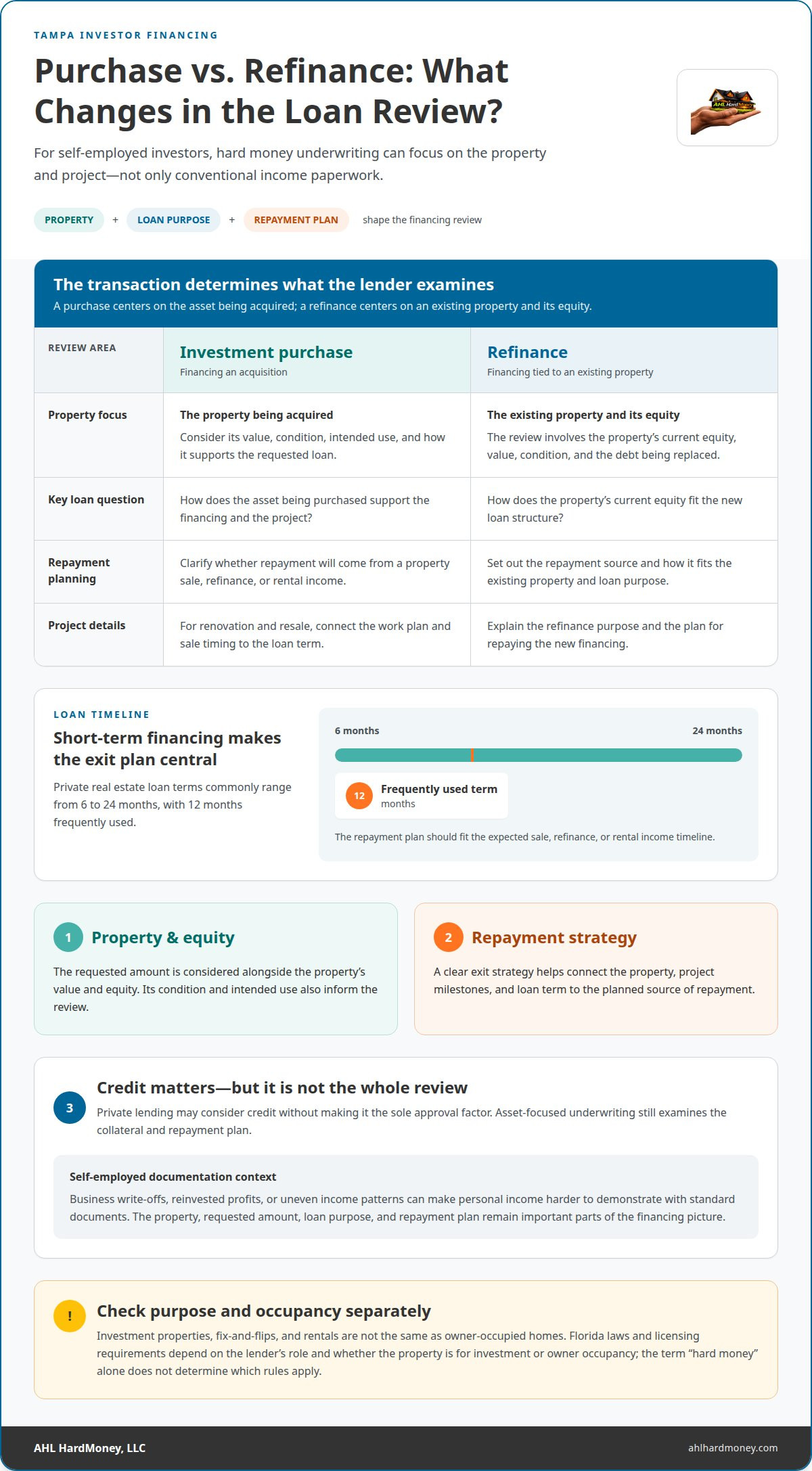
For a Tampa investment purchase, financing can be structured around the property being acquired and the investor’s repayment plan. A refinance, by contrast, involves an existing property and its equity. Before choosing either option, clarify the loan purpose, the property securing it, and whether repayment will come from a sale, refinance, or rental income.
Private real estate loans are often short-term: terms commonly range from 6 to 24 months, with 12 months frequently used. A private mortgage loan may instead have a term of about 12 to 24 months. That timeline makes the exit strategy central. For example, an investor planning renovations before resale needs a repayment plan that accounts for completing the work and selling the property within the loan term.
Private lending generally evaluates the transaction rather than relying only on standard income documentation. For a Tampa investor, the property’s value and equity, intended use, and repayment plan are relevant to the financing review. A purchase and a refinance require different details: a purchase centers on the asset being acquired, while a refinance involves an existing property and its current equity.
Tampa hard money lenders may finance investment properties, fix-and-flips, and rentals. Owner-occupied homes involve a different purpose, so investors should not assume financing designed for an investment property also applies to a home they plan to occupy.
Property Types and Borrower Eligibility
Single-family homes can serve as collateral for an investment property, including a rental or a property intended for renovation and resale. A borrower’s nationality does not replace the property review: foreign national investors should expect the financing assessment to focus on the asset, its intended use, and a clear repayment strategy. Property type and occupancy are separate considerations.
For a foreign national purchasing a single-family rental in Tampa, key questions include how the property supports the loan and how repayment is planned. For a Florida fix-and-flip, the project timeline and planned sale connect the property’s condition to the exit strategy. These examples show why loan purpose matters alongside borrower documentation when evaluating private real estate financing.
What factors affect the interest rate for a hard money loan?
For a Tampa real estate project, the rate reflects more than the borrower’s credit score. Property equity, loan structure, project risk, and the repayment plan all inform the lender’s decision.
Loan Terms and Payment Structure
Hard money loans commonly run 6 to 24 months, with 12 months frequently used. Some use interest-only payments, which cover interest during the term but leave principal due later. Compare the payment schedule with the expected sale or refinance date. A renovation that runs beyond the planned term can leave an investor needing an extension or another repayment source.
Default, Foreclosure, and Payment Risks
Missing required payments can put the borrower in default and may lead to foreclosure. A prepayment penalty can add a charge for paying early. With a balloon payment, the remaining principal is due at the end of the term, so a planned refinance or property sale that falls through can create repayment pressure. Review these terms and the consequences of missed payments before closing.
Rates also reflect how much the loan depends on the property’s value and equity. A lender weighs the requested amount against the collateral and considers the property’s condition and the project’s exit strategy. For example, a Tampa renovation with a clear resale plan offers a different repayment path from a rental property without a defined refinance plan.
Loan purpose determines what the financing supports. A purchase loan funds an acquisition, a refinance replaces existing debt, and renovation financing supports planned improvements. Each purpose raises different questions about the property, project milestones, and source of repayment. The loan structure should match the transaction rather than treating every real estate deal as the same risk.
Construction-fund disbursements and loan servicing also affect a project’s cash flow. For renovation financing, the agreement should explain how funds are released, which milestones support each release, and how payments are handled during construction. If the project budget depends on receiving funds before contractors are paid, the disbursement schedule should match the work sequence and closing documents.
Private money lending may consider a borrower’s credit score without making it the sole approval factor. Do not assume there is “No credit check”: asset-focused underwriting still evaluates the collateral and repayment plan, while credit may inform the broader review. A clear application, detailed property information, and a workable exit strategy can help keep the review focused.
To understand how a lender approaches these factors, learn about the lending approach before weighing a proposed loan structure.
Asset-based underwriting and credit score requirements
In Florida, asset-based underwriting centers on the real estate securing the loan. Equity and credit history help explain how lenders assess financing, but they play different roles.
Property Collateral and Asset-Based Underwriting
With asset-based lending, the property itself secures the loan. A lender considers its value, existing debt, and usable equity when reviewing the collateral. For a Tampa rental with an existing mortgage, the remaining equity differs from that of a property owned free and clear. The property’s condition and intended use also help frame the loan’s risk.
Equity is the value remaining after debts secured by the property are considered. It helps show how much financial support the real estate may provide for a loan. Underwriting also relates the requested financing to the property and repayment plan. For example, a bridge loan for an investor’s next acquisition has a different purpose from financing tied to an existing rental.
Property collateral gives the lender an asset to assess alongside the borrower’s financial profile. A review may consider the property’s location in Tampa, its current condition, ownership, and existing liens. Those details help show how the requested amount relates to the security behind it. For self-employed investors, this asset-focused approach can make property equity especially relevant.
Equity-Based Private Loan Options
Equity-based hard money and private money loans emphasize the real estate’s available equity. A borrower seeking funds against an owned Florida property has a different transaction from an investor purchasing a new asset. In either case, the loan purpose, collateral, and repayment plan clarify how the financing fits the project.
For example, an investor who owns a Tampa property may explore a private loan tied to its equity, while a buyer seeks financing secured by the property being acquired. Underwriting connects the asset to the requested loan and its intended repayment. Equity alone does not describe the full transaction: existing obligations and the property’s use also shape the assessment.
Credit Score Requirements
Credit score requirements can vary by lender and loan structure. In asset-based underwriting, a credit score is one part of the borrower’s profile, alongside the property’s equity and the repayment plan. For example, a self-employed Tampa investor with uneven reported income may have a strong asset but still needs a clear explanation of how the loan will be repaid.
A credit review and an equity review answer different questions. Credit history reflects past borrowing, while property collateral shows which asset supports the financing. A lender can consider both without relying solely on tax returns. For a Florida investor, compare how each proposed loan weighs credit, equity, property condition, and the planned exit. These factors help show whether the structure suits the investment.
Credit score and income verification requirements
For self-employed Florida investors, income records and credit history describe different parts of a loan application. Lenders can weigh both alongside the residential property and its equity.
Income Verification
Traditional lenders commonly use W-2 forms and paystubs to verify income. Those records may not reflect how a self-employed borrower earns money across changing projects or seasons. Business owners may also reinvest profits, leaving reported personal income lower than their available business resources suggest.
For example, a Tampa investor could have strong business activity but report modest personal income after reinvestment and deductions. That difference can make standard income measures less representative of the borrower’s finances. Asset-focused lending can also consider property equity and the proposed repayment plan, rather than treating tax returns as the only measure of ability to repay.
Income verification still helps explain the transaction. A lender can review the records provided to understand income sources, business stability, and existing obligations. This puts the borrower’s finances in context with the property and requested capital. For example, a rental investor may have business income and property-related income presented differently across financial records.
Flexible Underwriting for Credit Challenges
Credit-score requirements vary with the lender’s program and the overall loan profile. A credit score can inform the review, but it does not show property value, available equity, or the exit strategy. For a self-employed borrower, underwriting can consider these factors together instead of relying on a single number.
Credit challenges may include late payments or a limited borrowing history. In a Florida hard money review, the lender can assess how those issues relate to the request while also examining the residential collateral and repayment plan. A borrower seeking capital to refinance a property presents a different transaction from one financing a new purchase.
Flexible underwriting does not mean credit is irrelevant or that every application will be approved. It means the review can consider more than credit history alone. The lender evaluates how the property supports the financing, whether the requested amount fits the collateral, and how repayment is expected to happen. For investors, a clear loan purpose and exit plan help connect credit context to the real estate transaction.
Before accepting terms, compare how the proposed review treats income records, credit history, property equity, and repayment. Understanding each factor can help self-employed borrowers see how their application is assessed and whether the financing structure suits their project.
Hard money lender comparison for Tampa
For self-employed Tampa borrowers, the main difference between financing paths is what each one emphasizes. Hard money lenders focus heavily on property collateral and equity; banks and conventional lenders typically place greater weight on documented borrower income. A debt-service coverage ratio (DSCR) loan centers on whether rental income supports the property’s debt payments. When comparing hard money loans for self-employed Tampa investors, match these approaches to the transaction.
Traditional banks can take weeks or months to process loans. Their documentation process may be challenging for a business owner with variable income or reinvested profits. Conventional financing can suit investors whose income records fit standard underwriting. The practical comparison is not just about speed, but which review best fits the borrower, property, and intended use.
A DSCR loan can be relevant when an investment property generates rent. Its central measure is the relationship between property income and debt payments, rather than the borrower’s personal income alone. For a Tampa rental, lease income and the property’s operating picture become important parts of the review. This differs from hard money underwriting, which focuses more directly on collateral and equity.
Private lenders can structure funding around a specific real estate transaction, such as a purchase, refinance, or renovation. That flexibility can help when a project needs financing before a longer-term loan or sale. But short-term financing requires a defined exit strategy. A borrower planning to refinance after improvements should consider whether the project timeline supports that transition.
Compare offers using the same details for each lender: loan purpose, property value, equity, payment structure, term, and repayment plan. Then compare how each lender handles self-employed income and credit. This makes differences clearer than comparing a headline rate alone, especially when one lender evaluates rental performance and another emphasizes property collateral. A side-by-side review can clarify whether hard money loans for self-employed Tampa borrowers suit a project.
For example, an investor buying a Tampa rental with uneven business income could compare a DSCR review of expected rent with a hard money review of the property and equity. A borrower renovating a residential property may instead prioritize how funding aligns with project milestones and the planned exit. The right fit depends on the transaction and the borrower’s ability to repay.
Hard money can be useful when property-based underwriting fits the project better than income-driven criteria. It may be less suitable when an investor needs long-term financing or lacks a clear repayment route. Banks, conventional loans, and DSCR products serve different borrower and property profiles, so compare their structures and fit before choosing a path.
Use the comparison to identify which financing approach matches your property, documentation, and exit plan. A focused review of these factors can help Tampa borrowers discuss the right funding structure, including whether hard money loans for self-employed Tampa investors fit their next move.
AHL HardMoney
AHL HardMoney, llc helps Florida real estate borrowers consider property-based financing when self-employed income records do not tell the whole story. Its loan programs include Cash-Out Refinance, Home Equity Loans, Private Money Loans, and Foreclosure Refinance Loans.
For a Tampa investor, the next step is to connect the property, financing purpose, and repayment plan. This context can help clarify which loan option aligns with an existing property or refinancing need. AHL HardMoney, llc can review the request in light of the borrower’s real estate goals and available property equity.
Contact AHL HardMoney, llc to discuss your Tampa real estate financing needs, especially when looking for reliable hard money loans for self-employed Tampa borrowers.
Turn your next property decision into a clear plan
Your next financing step should start with the real estate goal, not a generic loan template. Before moving forward, clarify what the capital needs to accomplish, how the property supports the request, and what will repay the loan. This focus can help you assess whether hard money loans for self-employed Tampa investors fit your project’s timing and structure.
Consider the transaction as a whole: purchase or refinance purpose, property details, income context, and a realistic exit plan. A lender can then assess the request against the project rather than treating self-employment as the only defining factor. If the project’s needs point elsewhere, another financing structure may be more appropriate.
A thoughtful next step can turn a complicated financing decision into a manageable conversation. Move forward with a clear picture of your property and goals.
Frequently Asked Questions
Which Tampa hard money lenders work with self-employed borrowers?
AHLHardMoney™ is based in Tampa and serves the entire state of Florida. Its focus areas include Hillsborough, Pasco, Pinellas, Polk, Manatee, Citrus, and Hernando Counties, serving borrowers in Tampa, Clearwater, Saint Petersburg, Palmetto, Largo, Newport Richey, Port Richey, Brooksville, Brandon, Orlando, Daytona, Napels, Ocala, Deltona, Deland, Jupiter, Palm Beach, Lakeland, and Boca Raton. For self-employed investors, its property-based financing may be relevant when conventional income documentation does not fully reflect the investment or the borrower’s financial situation.
Can self-employed borrowers qualify for a Tampa hard money loan without tax returns or traditional income verification?
Tax returns aren’t the only possible part of a property-based loan review, but borrowers shouldn’t assume they can omit them. AHL HardMoney states “No Hard Credit Inquiry,” which refers to the type of credit inquiry, not tax-return requirements. Its FAQ identifies income verification, tax returns, and K-1s among possible documents. Reinvested business profits can make personal income appear lower, so include relevant financial context with the property information.
What credit score, down payment, equity, and property requirements do Tampa hard money lenders have?
AHLHardMoney™ accepts any credit profile, but that does not establish a universal down-payment or equity threshold for every loan. Property value and available equity matter in asset-based financing, while the property’s use and the loan purpose help frame the request. A residential investor should distinguish a purchase from a refinance, since each involves different property and transaction details.
What documents do self-employed borrowers need to apply for a hard money loan in Tampa?
Useful application records can include property documents, income verification, tax returns, and K-1s. For a self-employed applicant, organizing business and personal income records together can help explain how earnings, reinvestment, and the property relate to the request. Keep the property details consistent across documents, including the address and ownership information. The required materials depend on the transaction and the information needed to assess it.
How long does hard money loan approval and funding take in Tampa?
AHL HardMoney advertises “30 Min Approvals” and a possible closing period of “5 to 15 days.” Approval and closing are separate stages, so a quick initial decision doesn’t mean every transaction closes immediately. Property details, application materials, and the loan structure all form part of the process. These stated timelines offer a planning reference for Tampa investors coordinating a purchase or refinance.
How can self-employed borrowers compare reputable hard money lenders in Tampa and choose a provider?
Compare the financing structure against the project, not just a headline rate. Review how the lender treats property equity, borrower credit, income records, loan term, payment schedule, and repayment plan. For example, a Tampa investor planning renovations should consider whether the proposed funding and repayment timing fit the work and exit strategy. AHLHardMoney™ offers Florida hard money loans for borrowers seeking property-based financing for real estate needs.
Disclaimer:
While Dan is not a real estate attorney, he is a Full Time, Licensed Florida Mortgage and Real Estate Broker Professional coupled with 21+ years of successful strategies, methodologies and techniques that have proven effective to the benefit of Florida families.
While not every conversation is a deal, we promise to leave you better off then before you called. We serve everyone we come in contact, with the highest levels of integrity and dignity.
We invite you to make the call 📲


