


Article by
Dan Conneally - NMLS 339916, LO13164, BK3246524, CQ1072086
Dan Conneally has been successfully helping Florida families with thier real estate related situations for the last 21+ years, regardless of credit or past financial background.
While Dan is effective with institutional lending, he particuarly shines when matters require unique strategies involving noninstitutional resources.
Check out his legions of testimonials from real Florida families at Google, Facebook and the BBB to get a sense of the caliber and effectiveness he achieves. Dan has appeared on television speading the message of hope to good folks that need diligent, discrete, nonjudgy care.
The fastest hard-money option isn’t automatically the best fit. Hard money loans are short-term loans secured by real estate, with the property serving as collateral, and usually have repayment terms of 6 to 24 months. Read Equity Trac hard money reviews alongside those basics, then compare property fit, borrower requirements, rates, fees, funding speed and time to close.
A tight timeline can make speed feel like the deciding factor. It matters, but so do the property’s condition and value, the loan terms, and whether the repayment plan fits your project. Weigh the potential speed against borrowing costs and requirements to see the full picture.
This guide explains the key comparison points, including how hard money differs from traditional financing and what can affect the process from application to closing. You’ll get a clearer way to assess your options and identify the questions that matter for your Florida property and goals.
Key Takeaways
- Compare property condition and equity alongside your financing goal to judge whether hard money may fit a distressed or unusual property.
- Weigh the property’s collateral value and your project plan, not just credit history, when assessing borrower requirements.
- Look at interest rates and fees together with repayment terms to understand the total borrowing trade-off.
- Separate funding speed from time to close: documentation, valuation, and other steps can affect how quickly a deal moves.
- Use the decision guide to match your timeline and equity needs with a suitable path, including cash-out refinance options.
Financing for distressed and unusual properties
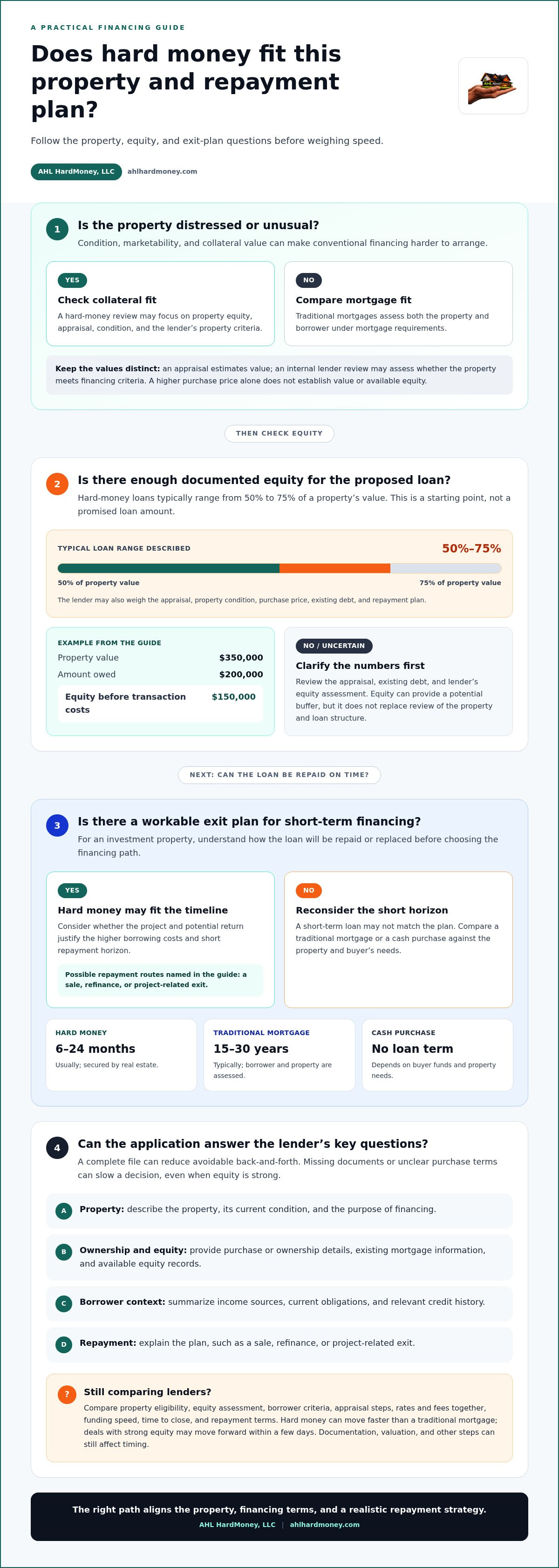
Distressed homes and unconventional properties can complicate financing because condition, marketability, and collateral value all matter. Hard money loans are secured by real estate, with the property serving as collateral. This can put property equity at the center of a lender’s risk assessment, particularly when repairs or a nonstandard layout make a conventional mortgage harder to arrange.
Hard money loans typically range from 50% to 75% of a property's value. That range is a starting point, not a promise of a specific loan amount. A lender may weigh the appraisal, property condition, purchase price, existing debt, and the borrower’s plan for repayment. A higher purchase price alone doesn’t establish the property’s value or the available equity.
Consider a property valued at $350,000 with $200,000 owed on it. The example borrower has $150,000 in equity before transaction costs. Equity gives a lender a potential buffer if repayment fails, but it doesn’t remove the need to assess the property and loan structure. For an investment property, the exit plan matters too: the borrower should understand how the short-term financing will be repaid or replaced.
Credit requirements vary by lender and loan structure. A property-focused review may weigh equity and collateral more heavily than a traditional mortgage review, but credit still matters. Compare the lender’s borrower criteria with its property criteria, and distinguish an appraisal, which estimates value, from an internal review, which may assess whether the property meets financing criteria. Ask what each process evaluates and how differences between the purchase price and appraised value affect the decision.
Use this comparison to organize the key trade-offs. Traditional mortgages typically run 15 to 30 years, while hard money loans usually have repayment terms of 6 to 24 months. That shorter horizon makes a realistic repayment strategy especially important for investment purchases or properties requiring work.
| Financing option | Property fit | Equity and review | Repayment horizon |
|---|---|---|---|
| Hard money loan | Distressed or unusual properties may be assessed for collateral fit | Equity, appraisal, condition, and lender review can shape the decision | Usually 6 to 24 months |
| Traditional mortgage | Property and borrower are assessed under mortgage requirements | Appraisal and borrower qualifications inform approval | Typically 15 to 30 years |
| Cash purchase | Depends on the buyer’s funds and property needs | No loan appraisal for lender collateral | No loan repayment schedule |
When reading Equity Trac hard money reviews, compare lenders on property eligibility, how they assess equity, borrower criteria, appraisal steps, and repayment terms. The right comparison is the one that fits the property and your exit plan. Match the collateral requirements and short-term repayment structure to the purchase, property condition, and investment strategy.
Potential closing speed and borrower requirements
Hard money financing can move faster than a traditional mortgage because the lender’s review often centers on the property, available equity, and repayment plan. Deals with strong equity may move forward within a few days. That faster path still depends on a clear file: property records, purchase details, requested loan amount, and a workable exit strategy all help the lender assess the transaction.
Traditional mortgage lenders typically require a strong credit score, a good credit history, and a low debt-to-income ratio. Hard money lenders may put more weight on collateral, but credit and income still matter. Credit history shows how a borrower has managed obligations, while income and other repayment resources help show how the loan can be serviced before the planned exit.
There is no single credit score or income figure that applies to every hard money loan. Qualification depends on how the borrower’s financial picture aligns with the property and proposed terms. For an investment purchase, explain the project, expected repayment route, and how existing debt affects available equity. For a refinance, be ready to document current ownership and outstanding obligations.
Prepare a focused application before comparing lenders. These steps can make the review more efficient:
- Describe the property, its current condition, and the purpose of the financing.
- Provide purchase or ownership details, existing mortgage information, and available equity records.
- Summarize income sources, current obligations, and relevant credit history.
- Explain the repayment plan, such as a sale, refinance, or project-related exit.
Each item answers a different underwriting question. Property details help establish whether the collateral fits; mortgage balances clarify equity; and income, obligations, and credit provide context for repayment capacity. A complete package can reduce avoidable back-and-forth. Missing documents or unclear purchase terms can slow a decision, even when the property has strong equity.
Compare lenders by asking how they weigh collateral, credit, income, and exit strategy, rather than treating “fast approval” as the only measure. A borrower with a complicated property but substantial equity presents a different case from one with limited equity and a strong credit profile. Match the lender’s review approach to the transaction, then confirm the repayment plan suits the loan’s short-term structure.
The final suitability check is whether the financing matches the intended use and the project’s potential return. Hard money loans are best suited to short-term financing needs or real estate investment projects where potential returns justify the higher borrowing costs. Weigh those costs against the loan’s purpose and the investment’s expected benefit. If the need is short-term, clarify how the financing serves that purpose; if it is tied to an investment, assess whether the potential returns make the borrowing costs reasonable.
This approach keeps speed and collateral from becoming the only measures of fit. The repayment plan should make sense alongside the project’s expected return and borrowing costs. If those elements do not align, reconsider whether this type of financing suits your needs.
Funding speed
Hard money funding can occur within 24 hours, while traditional bank financing can take weeks. Those timelines describe different points in the process: funding means money is disbursed, while closing includes the steps needed to complete the loan transaction. For a Florida purchase or refinance, knowing which milestone matters helps you plan around a seller’s deadline, contractor schedule, or other time-sensitive need.
The fastest path depends on how quickly the lender can assess the property and meet its criteria. A complete application, clear ownership records, and accessible property information can help keep the review moving. A complicated title, missing documents, or an appraisal delay can add time. The borrower’s preparation and transaction details matter as much as the lender’s decision process.
Some hard money loans can close in 5-7 days when appraisals and other delays are avoided. That is a closing timeframe, not a promise that every borrower receives funds within the same period. A borrower working toward a purchase deadline should account for the appraisal, title work, loan documents, and coordination among the parties involved. Each step must be completed before the transaction can finish.
Review the timeline before choosing alternative financing. Start with the date you need the funds, then work backward through the remaining tasks. Identify what is ready and what depends on another party. A refinance involving existing mortgage information may require different records from a property purchase. Efficient review depends on a complete application and clear transaction details.
- Set the actual funding deadline and distinguish it from the target closing date.
- Gather property, ownership, and existing loan records before submitting the application.
- Clarify appraisal requirements and arrange access to the property promptly.
- Review loan documents as soon as they are available, then coordinate signatures and closing steps.
These steps make it easier to compare timelines across money lenders. Ask about the expected funding point, appraisal process, documentation needs, and conditions that must be met before disbursement. An initial decision does not mean funds are ready; remaining requirements can still affect the closing schedule. For a refinance, map out the existing loan payoff and new financing steps so the transition is planned.
Choose financing that fits the actual deadline and the property’s review requirements. If your plan depends on a specific purchase or refinance date, focus on the sequence of appraisal, documentation, closing, and funding rather than relying on a headline speed claim.
Interest rates and fees
A hard money loan often costs more in interest and fees than a traditional mortgage. Hard money lenders price loans around the property, transaction, and repayment plan, while traditional loans generally have lower interest rates. Compare the full borrowing cost, not just the headline rate. Fees can change the overall cost, even when a quoted rate looks lower.
Interest rates for hard money financing vary by lender and deal structure. The property’s value, available equity, condition, requested financing, and repayment plan can all affect the terms. A private loan also needs to be considered alongside its short-term repayment horizon. Hard money loans usually have repayment terms of 6 to 24 months, so the interest and payment schedule matter together.
Review the written terms line by line. Separate the interest rate from lender charges and transaction expenses. Check how interest accrues, when payments are due, and whether repayment is in installments or at the end of the term. Identify charges tied to underwriting, appraisal, title work, or closing. These categories help compare offers, although actual charges depend on the transaction.
- Interest: Find the rate, how it accrues, and the payment schedule.
- Lender fees: Identify each charge and when it becomes payable.
- Closing expenses: Review appraisal, title, and other transaction costs.
- Repayment: Confirm the due dates and how the balance is paid off.
Compare offers side by side, including rates, lender fees, closing expenses, and repayment terms. Don’t assume an offer is cheaper just because its advertised rate is lower. Use the written terms to calculate the total amount due over the expected holding period. If you plan to refinance or sell, check that the exit aligns with the loan’s maturity and payment schedule.
Ask how the lender calculates the payoff if you repay early and whether charges change with the payoff date. Check which costs are due at closing and which are added to the balance. This affects how much capital remains available for renovation, debt consolidation, or another project expense.
For a Florida borrower, compare the total obligation with the property plan and expected repayment source. Put the interest, fees, payment timing, and payoff structure in one worksheet, then compare the total with alternative financing costs and timelines. Choose terms you can support throughout the repayment period, not just at the initial funding stage.
Because pricing varies by lender and transaction, these ranges are a comparison point rather than a quote for a particular property. Hard money lenders typically charge higher interest rates and fees than traditional mortgage lenders. Hard money loan interest rates typically range from 8% to 15%, while traditional loans typically have interest rates from 3% to 7%.
Traditional mortgages generally have lower interest rates than alternative lending options. Compare the quoted rate with all charges and the expected repayment period, and confirm that the projected exit can cover the balance. A rate alone cannot show which offer fits your plans or affordability.
Time to close
Closing time measures the path from application to completed loan documents, not simply the time to an initial approval. Traditional bank financing can take weeks, while some hard money loans can close in 5-7 days when appraisals and other delays are avoided. A Florida hard-money lender can close loans in 5 to 15 days, regardless of credit history. These timelines help set expectations, but the transaction’s readiness still shapes the schedule.
Approval is one milestone. Closing requires a review of the property and borrower details, preparation of loan terms, and coordination among the necessary parties. A home purchase may involve the seller and title professionals. A refinance also requires existing loan information and payoff coordination. Larger or more complex transactions may need additional review before documents are ready to sign.
Conventional lending commonly considers a strong credit score, good credit history, and low debt-to-income ratio. Hard money reviews may emphasize property equity and collateral, but credit history and the repayment plan remain useful context. Organize ownership records, property details, existing mortgage information, and the planned use of funds before applying. A clear file can help the lender assess the transaction and reduce document-related delays.
Map the closing path with these practical steps:
- Set the required closing date and identify the purchase or refinance deadlines tied to it.
- Collect property, ownership, mortgage, and borrower documents in one organized file.
- Arrange property access for the appraisal or other valuation review.
- Review proposed terms and closing documents promptly, then coordinate signatures.
- Confirm that title and payoff details are ready before the scheduled closing.
Each step addresses a different potential delay. An appraisal depends on property access and valuation work; title preparation relies on accurate ownership details; and a refinance payoff requires existing loan information. If one item is incomplete, other steps may have to wait. A credit score alone does not determine the closing date, and an early approval does not mean every closing requirement is complete.
For a purchase with a firm seller deadline, compare the target date with the lender’s expected process and the readiness of the property file. For a refinance, align the closing plan with the existing mortgage payoff and intended use of proceeds. Assess timing alongside the repayment schedule instead of treating a faster closing as the only measure of a suitable loan.
AHL HardMoney: Cash Out Refinance
AHL HardMoney, llc offers Cash Out Refinance for Florida homeowners seeking to use property equity toward a financial goal. It may suit borrowers exploring a refinance to access equity, while Home Equity Loans, Private Money Refinance, and Foreclosure Refinance Loans address other property-backed needs. AHL HardMoney, llc reports approvals often within 30 minutes and closings in 5 to 15 days, regardless of credit history.
Before choosing a route, consider the purpose of the funds, existing mortgage obligations, property equity, and the repayment plan. These details help frame whether a cash-out refinance aligns with your needs. Compare the structure and terms with the alternatives discussed above, then explore Cash Out Refinance options as a next step.
Contact AHL HardMoney, llc, or visit ahlhardmoney.com to discuss your property financing goals.
Move Forward With a Clear Financing Plan
Use Equity Trac hard money reviews as one input, then turn your research into a property-specific plan. Decide what the funds need to accomplish, how you expect to repay the loan, and which terms matter most for your next move. A focused plan makes it easier to assess whether financing supports your goals or adds pressure.
AHL HardMoney, llc serves Hillsborough, Pasco, Pinellas, Polk, Manatee, Citrus, and Hernando Counties. The company offers Cash-Out Refinance, Home Equity Loans, and Private Money Loans. These options can help frame a conversation about property equity and how you intend to use the funds. Bring your priorities and property details together before choosing a direction.
Take the next step with clarity. Contact AHL HardMoney, llc to discuss a plan that fits your property goals and repayment strategy.
Disclaimer:
While Dan is not a real estate attorney, he is a Full Time, Licensed Florida Mortgage and Real Estate Broker Professional coupled with 21+ years of successful strategies, methodologies and techniques that have proven effective to the benefit of Florida families.
While not every conversation is a deal, we promise to leave you better off then before you called. We serve everyone we come in contact, with the highest levels of integrity and dignity.
We invite you to make the call 📲


