


Article by
Dan Conneally - NMLS 339916, LO13164, BK3246524, CQ1072086
Dan Conneally has been successfully helping Florida families with thier real estate related situations for the last 21+ years, regardless of credit or past financial background.
While Dan is effective with institutional lending, he particuarly shines when matters require unique strategies involving noninstitutional resources.
Check out his legions of testimonials from real Florida families at Google, Facebook and the BBB to get a sense of the caliber and effectiveness he achieves. Dan has appeared on television speading the message of hope to good folks that need diligent, discrete, nonjudgy care.
Private money lenders and local portfolio lenders are common LendingOne alternatives for Florida real estate investors. The right fit depends on the property, timeline, and refinance plan. One investor reported finding no lender with lower costs or a seasoning period shorter than six months, underscoring why headline rates alone are not enough. Compare seasoning requirements, total loan costs, loan structure, property eligibility, and closing timelines together.
It makes sense to seek financing that fits your investment, especially when renovation or refinance plans are time-sensitive. This guide explains how private money lenders compare, what to consider when reviewing options, and how to match financing to your strategy. It also covers when Florida-focused hard-money financing may offer a different path.
Key Takeaways
- Compare seasoning rules, total borrowing costs, loan structure, and closing timelines together; a headline rate alone won’t show how well financing fits your project.
- Match the financing type to your plan, whether you’re purchasing, renovating, refinancing, or accessing equity.
- Property eligibility and underwriting priorities can differ, so focus on how the lender evaluates the asset and your exit strategy.
- Credit, down payment, and investing experience may affect loan terms differently across lenders; understand how each factor fits into the full application.
- For a Florida refinance or equity need, explore which financing path aligns with your property and investment goals.
Private money lenders for real estate investors
Private money lenders can finance purchases, renovations, and refinance plans for Florida real estate investors. They often assess the property, project, and repayment plan alongside borrower information. Local portfolio lenders and national lenders may also fit, depending on the deal. One investor reported contacting more than 30 lenders before completing eight deals with two local portfolio lenders.
Florida investors can compare private money, local portfolio, and national real estate lenders. Terms vary by deal, depending on factors such as property eligibility, loan purpose, title, and underwriting.
For a quick overview of financing trade-offs, watch this BiggerPockets video:
Compare each lender’s real estate financing by purpose, repayment structure, and underwriting focus. LendingOne operates in finance, but investors should distinguish broad company descriptions from specific loan terms. When reviewing LendingOne alternatives, match the loan to the intended exit, such as sale, refinance, or rental income.
Fixed-rate commercial real estate loans can make scheduled payments easier to plan, but suitability depends on the property, loan structure, and your timeline. Bridge loans serve a different purpose: temporary financing during a purchase, renovation, or transition. Compare the repayment schedule and exit plan, not just the loan label.
Featured commercial real estate deals can show how financing fits a real project. Review each example’s property type, renovation scope, financing purpose, and exit strategy, then consider how closely it resembles your deal. A featured transaction is a reference point, not a substitute for analyzing your own property.
- Estimate renovation work and operating needs before choosing a loan structure.
- Map the expected exit to the repayment schedule and project milestones.
- Review title, property condition, and rental or resale assumptions together.
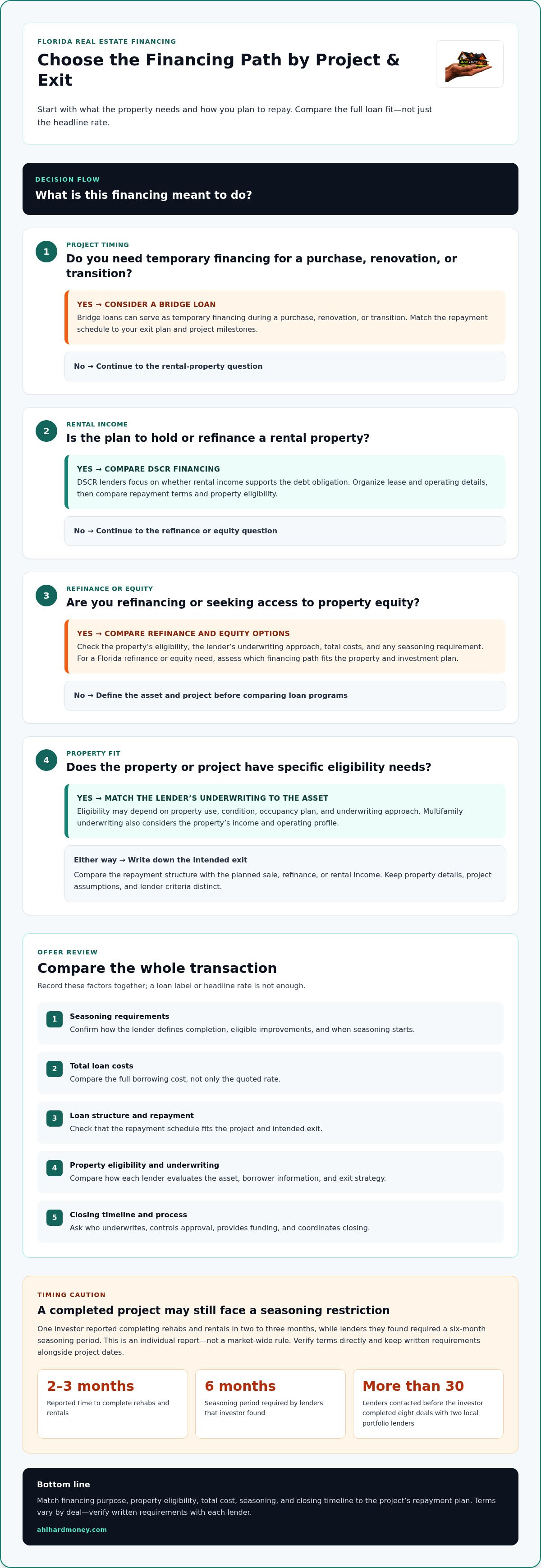
Real estate deal analysis starts with realistic income, costs, timing, and resale assumptions. One investor said rehabs and rentals were completed in two to three months, but reported that lenders they found required a six-month seasoning period. That gap shows why timing matters: a finished project may still face a financing restriction tied to its history.
Compare the full transaction, including how financing affects the cash available for repairs and reserves. Keep lender underwriting criteria separate from your own deal assumptions. A property that works on paper can become difficult if the exit takes longer, renovation scope changes, or rental income falls short of projections. Write down your plan before comparing offers.
That search also highlights the value of tracking what each lender actually offers, rather than treating an initial response as a final comparison. A forum participant reported completing 8 deals with two local portfolio lenders after contacting more than 30 lenders. The outcome points to the practical role of local relationships, while leaving each investor to verify whether a lender’s criteria match the property and planned exit.
The original poster said they had not found a lender offering a lower cost or seasoning period shorter than 6 months. That experience is a caution, not a market-wide rule: confirm costs and seasoning directly, and ask how the lender defines completion, eligible improvements, and the point from which seasoning is measured. Keep written terms alongside project dates so a planned refinance or sale is not based on an assumption the lender does not share.
Looking for similar companies to LendingOne?
Compare lenders by financing purpose, underwriting approach, and funding process. The right fit may differ for a bridge purchase, rental hold, or multifamily project.
Alternative Lender Services and Funding
LendingOne’s direct-lender model offers a useful comparison point: identify who underwrites the loan, controls approval, and provides funding. A direct lender handles these steps, while a broker may arrange financing through another institution. This distinction can affect communication and the application process.
To compare LendingOne alternatives, write down the project type, loan purpose, property details, and intended exit. Then compare written terms and process steps side by side. Ask how the lender handles valuation, document review, and closing coordination. A bridge purchase, for example, needs funding aligned with acquisition timing, while a rental refinance centers on property income and repayment.
Hard Money and DSCR Lender Comparisons
Hard money lenders typically assess the property and project, which may suit time-sensitive purchases or renovations. DSCR lenders focus on whether rental income supports the debt obligation. For a rental, organize lease and operating details; for a fix-and-flip, outline repairs, resale assumptions, and the exit.
For fix-and-flip, rental, and multifamily financing, start by identifying the intended use. A renovation bridge loan and a long-term rental loan solve different problems. Multifamily underwriting also considers the property’s income and operating profile. Match each offer’s repayment structure to the project instead of treating all alternatives as interchangeable.
Loan Types and Property Eligibility
Loan options vary by lender. Some financing is designed for purchases or renovations; other programs address rental properties, refinances, or larger commercial assets. Eligibility may depend on property use, condition, occupancy plan, and underwriting approach. Identify those details before comparing offers.
Use a comparison sheet to record property type, loan purpose, eligible condition, occupancy requirements, and exit plan. For a mixed-use or multifamily property, describe each use clearly. For a renovation, separate the current condition from planned improvements. These details help show whether a lender’s program matches the deal.
Approval and Funding Speed
Approval and funding speed depend on the lender’s intake process, property review, title work, and application completeness. Compare the steps and timing at each stage, not just an advertised closing target. A complete project file can help reduce avoidable back-and-forth.
Investors have reported seasoning periods of six months, while another reported a 120-day minimum holding period for a Freddie Mac loan. To compare offers and apply, prepare property details, project scope, financing purpose, and repayment plan. Submit the same core information to each lender, then compare approval conditions, funding sequence, and loan structure.
Frequently asked questions about LendingOne competitors
Competitor counts, staffing, and revenue can provide context, but they do not reveal whether a loan fits. Compare those figures with the financing purpose, underwriting criteria, and repayment plan for your investment.
When comparing LendingOne and its alternatives, focus on practical risks: unclear terms, delays, valuation differences, seasoning requirements, and an exit plan that does not match the loan schedule. Review written conditions and the funding sequence before committing capital.
Competitor Companies and Alternatives
LendingOne has 19 active competitors, including two funded competitors and two that have exited. The broader list also includes 24 competitors. These counts describe a changing market, not a ranked list of lenders for Florida investments.
Among LendingOne’s top 10 competitors, average revenue is $359.5 million and average staffing is 657 employees. The 24 listed competitors have an estimated combined workforce of 16,300. Treat these figures as company-scale context. They don’t show whether a lender offers the property type, loan structure, or funding timeline your deal requires.
Use company figures as context, then compare the actual financing. A large company may offer a broad portfolio, while a smaller lender may focus on particular investments. Size alone does not establish fit. Compare loan purpose, underwriting process, geographic coverage, repayment terms, and how the lender handles your planned exit.
Borrower Complaints and Risks
Examine timing, total transaction terms, and whether the property meets underwriting requirements. An investor who finishes renovations, for example, may still face a seasoning period before refinancing. Repayment can also become difficult if the projected sale or rental income does not support the exit plan.
Before accepting an offer, compare the written loan conditions with your project schedule. Identify what triggers approval, which documents remain outstanding, and when funding can occur. Then match the repayment date to a realistic sale, refinance, or rental plan. This can expose timing conflicts before they disrupt an investment.
Revenue estimates and employee counts do not measure borrower experience. Compare the clarity of each lender’s terms, responsiveness during underwriting, and consistency between proposed conditions and final documents. Keep a written record of assumptions, milestones, and required items. This gives you a practical basis for evaluating offers without mistaking company scale for loan quality.
For a Florida investment, assess the property, capital needs, and repayment strategy together. A lender’s status as a competitor says little about whether its financing suits a particular project. Focus on loan purpose, collateral, approval conditions, timeline, and exit. Apply the same criteria across offers, then choose the structure that aligns with your investment plan.
How do LendingOne competitors compare on loan types and property eligibility?
Compare each lender’s program with the property and investment plan. A fix-and-flip purchase, rental refinance, and multifamily acquisition require different underwriting. LendingOne alternatives may include overlapping loan categories, but eligibility depends on the property, borrower, and intended use. Identify the financing purpose before comparing lender names.
Hard-money and bridge loans can serve purchases or renovation projects with defined exit plans. An investor buying a dated single-family home, for example, should outline repairs, resale assumptions, and repayment timing. A rental-focused loan may instead emphasize income and operating details. The label alone does not show whether a program fits.
Debt-service coverage ratio, or DSCR, financing evaluates a rental property’s income against its debt obligations, making rent and operating assumptions central to the application. A bridge loan may focus more on the property and transition plan. Compare the documents and underwriting criteria each lender uses.
Property type also affects eligibility. A lender may treat a detached home differently from a condominium, mixed-use building, or multifamily property. For a condo, identify the unit’s condition and intended use. For a multifamily acquisition, organize rent and operating information. Clear property details help reveal program fit early.
Condition matters, too. A move-in-ready rental presents a different financing case from a property needing substantial work. Describe existing repairs, planned improvements, and how the project will reach its intended use. If the property will transition from renovation to rental, explain both stages. This gives the lender a clearer picture of the investment.
Use this checklist to compare offers consistently:
- Match the loan purpose to purchase, renovation, refinance, or rental hold.
- Record eligible property types, including single-family, condominium, and multifamily.
- Compare how each lender treats property condition and planned improvements.
- Align repayment terms with the expected sale, refinance, or rental strategy.
An investor planning to renovate and sell, for example, should compare bridge financing with the project schedule. Someone keeping the same home as a rental should examine income-based loan criteria. A multifamily buyer should assess how each program handles the building’s use and income profile.
Build a side-by-side comparison before applying. Record the loan category, property requirements, underwriting focus, permitted use, and exit strategy. Then test each option against the same deal assumptions. A clear comparison helps separate a suitable program from one that merely shares a familiar label with another lender’s product.
Eligibility depends on the property and proposed financing. A rental refinance, renovation purchase, and multifamily investment each call for different supporting details. Prepare a concise property summary and financing purpose for every application. This makes LendingOne alternatives easier to assess than broad company descriptions do.
What are the minimum credit score, down payment, and experience requirements for competing lenders?
There is no single minimum credit score, down payment, or experience threshold shared by every real estate lender. Each lender weighs borrower history alongside the property, loan purpose, available equity, and repayment plan. Compare the full underwriting picture instead of treating one qualification as an automatic approval or rejection.
Credit score can influence how a lender evaluates repayment risk, but it is not the only factor. An investor with a lower score, for example, may present a documented renovation plan, property equity, and a clear exit strategy. Another borrower with stronger credit may have a less complete project file. Lenders assess these details under their own criteria.
Down payment requirements depend on the transaction and loan structure. A purchase, refinance, and renovation project each have different collateral and funding needs. Compare your required contribution, how the lender values the property, and whether funds must also cover repairs or reserves. Keep those figures distinct in your deal analysis.
Experience can shape how a lender views execution risk. An investor with completed renovations can show project records, budgets, and sale or rental outcomes. A newer investor can outline contractor roles, renovation milestones, and the planned exit. Organized documentation helps connect either borrower’s experience to the specific property.
Build a comparison sheet with these fields before reviewing offers:
- Credit history factors the lender evaluates.
- Required borrower contribution and its intended use.
- Relevant experience and supporting project records.
- Property value, condition, and planned improvements.
- Repayment source and intended exit strategy.
Compare each lender’s criteria against the same deal. A fix-and-flip application should show purchase assumptions, repair scope, and resale plans. A rental application should explain how the property will operate and support repayment. Consistent information makes underwriting differences easier to spot.
Experience does not require a long list of completed transactions. A clear description of your role can show how you will manage contractors, approve expenses, and track milestones. Include comparable projects where available, and connect each example to the property under review. The lender needs to understand how your background supports this project.
Finally, consider how qualification factors interact. A higher borrower contribution may affect the lender’s collateral position, while property condition can influence the work needed before an exit. Credit, experience, and deal structure all contribute to the application. Compare written requirements by loan purpose, then prepare a file that addresses each criterion.
The 24 listed LendingOne competitors have an estimated 16.3K employees combined, a measure of the group’s overall scale rather than a qualification standard for an individual borrower. That figure does not establish any shared minimum for credit, contribution, or project history, so use each lender’s stated criteria when comparing a deal.
Ask each lender how it evaluates your credit profile, required funds, and relevant experience for the specific property. Keep the answers alongside the proposed financing structure and repayment plan, and note any additional project conditions. This helps distinguish company-wide scale from the factors affecting your application.
AHL HardMoney: Cash Out Refinance
AHL HardMoney, llc can help Florida property owners explore a Cash Out Refinance when they want to access equity for an investment or other property-related goals. This option may suit an owner whose property value and existing financing support a refinance strategy. Home Equity Loans, Private Money Refinance, and Foreclosure Refinance Loans address other financing needs.
Prepare a clear picture of the property, current financing, intended use of funds, and repayment plan. AHL HardMoney, llc often provides approvals within 30 minutes and can close loans in 5 to 15 days, regardless of credit history. The right next step is to discuss how your property and refinancing goals fit the available approach. Contact AHL HardMoney, llc to talk through your options.
Turn Your Financing Plan Into a Clear Next Step
Choosing among LendingOne alternatives is about more than finding another lender. It means making financing work with your property strategy and a repayment path that fits your goals. Before moving forward, define what the funds need to accomplish and how your investment plan supports repayment.
AHL HardMoney, llc offers Cash Out Refinance, Home Equity Loans, and Private Money Refinance. These options can support property owners pursuing different equity or refinancing goals. Bring your property details and intended use of funds into the conversation, so the financing discussion can focus on your actual situation.
A thoughtful financing decision can help you move ahead with greater clarity. Take the next step when you’re ready, and keep your investment goals at the center of the plan.
Disclaimer:
While Dan is not a real estate attorney, he is a Full Time, Licensed Florida Mortgage and Real Estate Broker Professional coupled with 21+ years of successful strategies, methodologies and techniques that have proven effective to the benefit of Florida families.
While not every conversation is a deal, we promise to leave you better off then before you called. We serve everyone we come in contact, with the highest levels of integrity and dignity.
We invite you to make the call 📲


