


Article by
Dan Conneally - NMLS 339916, LO13164, BK3246524, CQ1072086
Dan Conneally has been successfully helping Florida families with thier real estate related situations for the last 21+ years, regardless of credit or past financial background.
While Dan is effective with institutional lending, he particuarly shines when matters require unique strategies involving noninstitutional resources.
Check out his legions of testimonials from real Florida families at Google, Facebook and the BBB to get a sense of the caliber and effectiveness he achieves. Dan has appeared on television speading the message of hope to good folks that need diligent, discrete, nonjudgy care.
The obvious alternative may not be the right one: the best Monroe Funding Corp alternatives depend on your property, investment plan, and financing timeline. Tampa-area borrowers can compare hard-money loans, bridge financing, DSCR loans, and conventional bank financing. Each option weighs the property, repayment plan, borrower qualifications, and timing differently.
Look beyond the headline interest rate when comparing Monroe Funding Corp alternatives. Consider the loan structure, fees, available equity, and qualification requirements together. These details shape how financing affects your investment strategy and cash flow.
This guide explains how the main options differ, which borrower and property profiles they may suit, and how to assess rates and fees. It also shows how Monroe Funding Corp alternatives compare with private-money financing when a purchase, refinance, or property improvement calls for a different approach.
Key Takeaways
- Match the loan type to your investment plan, property condition, and repayment strategy before comparing lenders.
- Look beyond the interest rate: origination points and other upfront charges can change the total cost of financing.
- Compare offers using the same details, including loan structure, qualification requirements, closing timeline, and repayment terms.
- Hard-money and bridge financing may suit time-sensitive purchases or properties that need work, while longer-term options serve different goals.
- For equity access or a refinance, explore financing options that align with the property and the purpose of the funds.
Lender comparison by investment strategy and loan type
For Florida real estate investors, financing depends on the property, project plan, and exit strategy. Compare loan structures first, then consider each lender’s process and available programs.
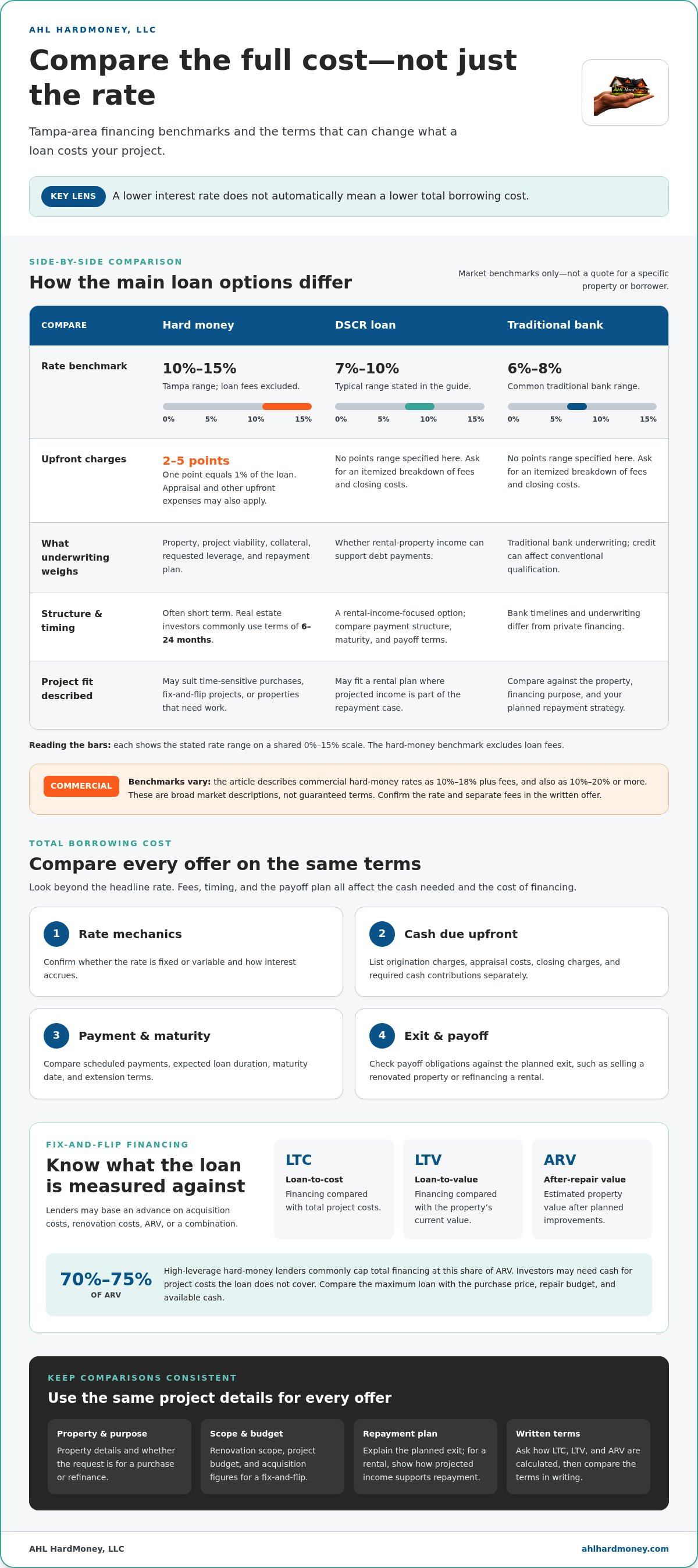
Start with the leverage calculation. Loan-to-cost (LTC) compares financing with total project costs, while loan-to-value (LTV) compares it with the property’s current value. After-repair value (ARV) estimates the property’s value after planned improvements. For fix-and-flip financing, lenders may base the advance on acquisition costs, renovation costs, ARV, or a combination. High-leverage hard money lenders commonly cap total financing at 70% to 75% of ARV, so investors may need cash for costs the loan doesn’t cover.
That distinction matters on a distressed-property acquisition. If an investor buys below market and budgets substantial repairs, an ARV-based offer may fund differently from one driven mainly by current LTV. Ask how the lender calculates each figure and which costs count toward LTC. Then compare the maximum loan amount with the purchase price, repair budget, and available cash. A hard money loan often suits a short-term project; real estate investors commonly use terms of 6 to 24 months.
Loan Amounts, Rates, Fees, and Terms
Compare offers using the same requested loan amount and project assumptions. Review the interest rate alongside origination charges, appraisal costs, other upfront expenses, payment structure, maturity date, and extension terms. Different loan types assess investment-property income and property equity in different ways, so match the product to your repayment plan.
Offer Comparison and Financing Applications
Prepare a consistent application package with property details, the purchase or refinance purpose, renovation scope, project budget, and repayment plan. For a fix-and-flip, include acquisition figures and expected work; for a rental, explain how projected income supports repayment. Ask each lender to explain how it calculates loan-to-cost, loan-to-value, and after-repair value, then compare the same terms in writing. This makes cash needs and requirements easier to evaluate.
A lender’s focus can clarify whether it fits your project. Some specialize in short-term, property-secured financing; others offer financing based on rental income or hold loans in a portfolio. Loan types, underwriting, and timelines vary. A quick process may help with a time-sensitive purchase, but speed alone does not show whether the structure suits your strategy. Compare the full terms with the property’s needs and your planned exit.
Interest rates and origination fees
Compare financing by total borrowing cost, not the headline interest rate alone. In Tampa, hard money loan rates typically range from 10% to 15%, excluding loan fees. That range is a market benchmark, not a quote for a specific property or borrower. The lender’s underwriting, collateral, requested leverage, and repayment plan all shape an actual offer.
Origination points are an upfront charge calculated as a share of the loan. One point equals 1% of the loan, and hard money lenders may charge 2 to 5 points. For example, compare the same requested loan amount across offers, then calculate how each lender’s points affect the cash you need at closing. Commercial hard money loans can also involve appraisal and other upfront expenses, so include those in the comparison.
Interest rates and fees work together. A lower rate may not mean a lower overall borrowing cost if the offer has higher origination charges or a shorter repayment window. A higher rate may be easier to assess when the payment schedule and fees are clear. Compare the expected loan duration, payment timing, maturity, and extension terms alongside the rate.
Different loan types use different underwriting priorities. A hard money lender may focus heavily on the property and project, while a rental-property DSCR loan evaluates whether income can support debt payments. DSCR loan rates typically range from 7% to 10%. Traditional bank loans commonly carry rates between 6% and 8%, but bank underwriting and timelines differ from private financing. The lowest displayed rate may not fit an investor who needs a different loan structure or faster acquisition timeline.
Use a consistent comparison process. First, confirm whether each offer has a fixed or variable rate and how interest accrues. Next, list origination charges, appraisal costs, closing charges, and required cash contributions separately. Then compare scheduled payments and the payoff amount with your planned exit, such as selling a renovated property or refinancing a rental. Clear terms make offers easier to evaluate.
Credit can affect conventional underwriting, while private lenders may assess property equity and project viability differently. While borrowers facing immediate personal cash flow gaps might turn to short-term resources like QuickCashDirect, those looking to consolidate obligations, fund home improvements, or address tax debt should compare each property-secured option’s purpose and repayment structure. The right offer is the one whose costs and timing align with the property and repayment plan, not simply the one advertised as competitive.
Commercial real estate hard money loans commonly carry interest rates of 10-18, plus additional fees. Commercial hard money loans often have interest rates of 10% to 20% or more. These ranges are broad market descriptions, not guaranteed terms for a particular transaction. The gap between them reinforces the need to review each written offer rather than rely on a general benchmark. Ask the lender to clarify how the quoted rate applies to the requested loan and whether fees are charged separately. Then assess the full cost against the project’s expected timeline and repayment source. If terms are presented differently, request a consistent breakdown of interest, upfront charges, payment timing, and payoff obligations before comparing offers.
How do I compare offers and apply for financing from alternative lenders?
Use the same property details and financing request for each lender. A consistent comparison makes differences in underwriting, cash requirements, and repayment structure easier to spot. For a Tampa-area acquisition, organize the property address, purchase contract, intended use, estimated repairs, and repayment plan before seeking offers. This gives each lender the same starting point.
Then compare the terms side by side. Look beyond the requested loan amount and record how each lender assesses the property, borrower, and project. For a fix-and-flip, include the purchase price, renovation scope, expected completion, and sale strategy. For a rental, explain expected income and planned ownership period. These details help show whether the financing matches the investment.
Prepare a consistent application package
Gather documents that explain the property and your plan. Include the purchase contract or current mortgage statement, property photos, repair estimates, and an itemized project budget. For a rental, add leases or rent projections and operating expenses. For a refinance, outline the current loan, requested proceeds, and intended use. A clear file can reduce follow-up questions.
Describe your exit strategy in practical terms. A renovation project may depend on selling the improved property, while a rental plan may rely on operating income or a later refinance. Show your timeline assumptions, expected work, and how the loan will be repaid. If the project involves contractors, include their work scopes or bids so the budget aligns with the planned improvements.
Review each offer before choosing
Compare written terms with the same checklist: interest rate, origination charges, appraisal requirements, payment schedule, maturity date, extension conditions, and cash needed at closing. Separate one-time costs from recurring payments. Check whether the lender’s valuation uses current value, loan-to-cost, or after-repair value, and confirm which project expenses count toward its calculation.
Test each offer against your plan. If a repair estimate changes, recalculate the cash contribution and whether the project remains workable. If rental income is central to repayment, compare the lender’s assumptions with your lease and expense figures. A lower payment can still be a poor fit if the maturity date arrives before the sale or refinance is ready.
Before accepting, compare the final loan documents with the written offer. Confirm the borrower and property details, proceeds, fees, payment terms, and payoff conditions. Resolve discrepancies before signing, and keep the approved budget and repayment plan with the closing papers. This final review connects your application with the financing you will receive.
Hard money
Hard money financing can help Tampa investors act when a property needs work or a purchase moves quickly. Unlike financing centered mainly on a borrower’s credit profile, these loans commonly emphasize the property’s value, condition, and planned use. That can suit a distressed acquisition or renovation, but the short repayment window makes the exit strategy essential from the start.
Real estate investors commonly use hard money loans with terms of 6 to 24 months. Commercial hard money loans commonly have terms of 6 to 12 months, while most commercial hard money lenders expect repayment within 6 to 18 months. These short timelines can work for a project with a defined sale or refinance plan. They can create pressure if repairs, leasing, or resale take longer than expected.
Before applying, map the loan to the deal in three steps:
- Set the purpose. Separate acquisition financing from funds for renovations or a short-term bridge between transactions.
- Build the budget. List the purchase price, project costs, and cash available for expenses the loan won’t cover.
- Name the exit. Explain whether a property sale, refinance, or other repayment source will pay off the balance.
Leverage affects how much capital an investor must bring. High-leverage hard money lenders commonly cap total financing at 70% to 75% of a property’s after-repair value. That means the projected value after improvements matters, but it doesn’t eliminate the need to fund remaining project costs. For example, if the lender’s advance doesn’t cover the full purchase and renovation budget, the borrower needs another source for the gap, whether that involves tapping personal reserves or addressing separate short-term cash needs through services like ILoveYourLoans.
Speed can be a meaningful advantage for an auction purchase or distressed property. Traditional bank financing may not move quickly enough for investors buying at auction, while hard money loans can close in days rather than weeks. A commercial real estate hard money loan can fund a deal in five days. That timeline can help an investor compete with cash buyers, provided the acquisition and payoff plan are ready.
There are trade-offs. Hard money rates typically range from 10% to 15%, excluding loan fees, and commercial loans may also carry upfront charges. A short-term loan can become costly if a renovation stalls or a planned refinance is delayed. Compare maturity dates, payment terms, extension conditions, and total cash needed before committing. If a project depends on stable long-term rental income rather than a quick sale or refinance, evaluate whether short-term hard money matches that strategy.
Real estate
Choose real estate financing by the property’s current condition, intended use, and repayment plan. A Tampa investor buying a stabilized rental faces different financing needs from someone acquiring a building that needs repairs. Bridge loans can cover a financing gap while an investor arranges permanent financing, including when buying before selling another property or improving a building before long-term financing.
For a property that needs renovation or stabilization, short-term financing may help fund the purchase and improvement period. Connect the acquisition, work, and eventual repayment in your plan. Explain whether you intend to sell, refinance, or keep the property as a rental after improvements. This helps determine whether short-term financing suits the project better than a longer-term loan.
Longer-term rental plans may point toward DSCR financing, which assesses a property’s income in relation to debt payments. DSCR loan repayment terms can extend up to 30 years. By comparison, traditional bank loan terms can range from 10 to 30 years. The useful comparison is not just term length: consider whether expected rental income supports payments and whether the property can meet the lender’s underwriting requirements.
Loan size can also narrow the options. For a one-unit property, the 2026 baseline conforming loan limit in most of the United States is $832,750, according to the Federal Housing Finance Agency. These figures describe different financing categories, so identify the property type and loan purpose before treating either amount as a relevant benchmark.
Some transactions depend on precise timing. Transactional funding for double closings can be used when an investor takes ownership and resells within 24 hours. That structure differs from a bridge loan, which may cover a broader financing gap while the investor arranges permanent financing. Map the closing sequence, resale timing, and expected source of repayment before comparing these approaches.
For a Tampa investment, sort the decision into three questions: Does the property need work before it can qualify for long-term financing? Is rental income central to repayment? Must the purchase and resale happen in a tightly timed sequence? The answers help distinguish bridge, DSCR, transactional, and bank financing. Match the loan’s term and structure to the actual property plan, rather than choosing by loan label alone.
For Florida commercial real estate investors, a property’s condition can shape the financing path. Short-term financing may be used for properties that need improvements or stabilization before qualifying for traditional long-term financing. Include the expected work and the point when the property may qualify in your plan. Consider whether financing will support an acquisition or renovation, or bridge the gap until longer-term financing.
Short-term financing may help investors purchase investment properties, renovate buildings, or bridge the period before longer-term financing. Relate the borrowing purpose to the next financing step to clarify repayment. Identify what must happen to the building and what financing is expected to follow, so the temporary loan has a defined role in the investment.
AHL HardMoney: Cash Out Refinance
AHL HardMoney, llc serves Hillsborough, Pasco, Pinellas, Polk, Manatee, Citrus, and Hernando Counties in Florida. If you’re comparing Monroe Funding Corp alternatives and need to access property equity, AHL HardMoney, llc's Cash-Out Refinance may fit. Home Equity Loans offer another way to borrow against home equity. Private Money Loans and Refinance Loans may suit other financing needs, while Foreclosure Refinance Loans address a different, time-sensitive situation.
Start by clarifying the property, current financing, and how you plan to use the proceeds. AHL HardMoney, llc offers approvals often within 30 minutes and can close loans in 5 to 15 days, regardless of credit history. These timelines can help you assess whether the financing suits your needs. Explore Cash Out Refinance options, then contact AHL HardMoney, llc or visit ahlhardmoney.com to discuss your next step.
Choose financing that supports your next move
Connect your financing decision to a clear purpose for the property and funds. As you compare Monroe Funding Corp alternatives, focus on the loan structure that fits your goal and how repayment aligns with your broader plans. A well-defined purpose helps keep the choice grounded in the outcome you want, not just the appeal of an offer.
AHL HardMoney, llc offers Cash Out Refinance, Home Equity Loans, and Private Money Refinance. These options can address different needs, from accessing property equity to refinancing existing financing. Consider which situation best describes yours, then bring that purpose into the conversation. Clear priorities make it easier to explore a financing path that fits your circumstances.
Your next financing decision can start with a straightforward conversation and a clear goal.
Frequently Asked Questions
What credit score, revenue, and time-in-business requirements do competing lenders have?
Requirements vary by loan type and underwriting approach. Florida conventional home purchase borrowers typically need a minimum credit score of 680, while alternative real estate lenders may weigh property equity, project viability, and repayment plans more heavily. For business or rental financing, lenders can assess documented income, leases, operating cash flow, and the borrower’s investment experience. Compare the exact criteria for the specific loan purpose, rather than assuming one credit, revenue, or operating-history threshold applies across lenders.
Disclaimer:
While Dan is not a real estate attorney, he is a Full Time, Licensed Florida Mortgage and Real Estate Broker Professional coupled with 21+ years of successful strategies, methodologies and techniques that have proven effective to the benefit of Florida families.
While not every conversation is a deal, we promise to leave you better off then before you called. We serve everyone we come in contact, with the highest levels of integrity and dignity.
We invite you to make the call 📲


