


Article by
Dan Conneally - NMLS 339916, LO13164, BK3246524, CQ1072086
Dan Conneally has been successfully helping Florida families with thier real estate related situations for the last 21+ years, regardless of credit or past financial background.
While Dan is effective with institutional lending, he particuarly shines when matters require unique strategies involving noninstitutional resources.
Check out his legions of testimonials from real Florida families at Google, Facebook and the BBB to get a sense of the caliber and effectiveness he achieves. Dan has appeared on television speading the message of hope to good folks that need diligent, discrete, nonjudgy care.
Bad credit isn't an automatic dead end for fix-and-flip loans in Tampa. Some Florida lenders generally look for credit scores of 620 to 670, while borrowers with lower scores may still be considered with a larger down payment or stronger financial reserves. Typical down payments range from 10% to 25% of the purchase price, so your credit profile is only one part of the qualification picture.
It’s understandable to worry that a credit score could stop a promising Tampa property deal before it starts. The key is knowing what lenders may weigh alongside credit, including your available cash and the project itself, so you can approach financing with a clearer plan.
This guide explains how credit, down payment, and loan quote inquiries can affect qualification, including what to ask about before authorizing a hard credit inquiry. You’ll also learn how fix-and-flip financing works, what can strengthen an application, and when a lower-credit borrower may have a path forward.
Key Takeaways
- Find out whether an initial loan quote can be discussed before a hard credit inquiry, and clarify what type of credit check the next step involves.
- Understand how a property's after-repair value and the lender's underwriting shape the amount you may be able to borrow.
- Learn which parts of your credit and financial profile can matter beyond your score when a lender reviews a project.
- See how project costs, available reserves, and deal details can affect the cash you need to bring to closing.
- Explore how Florida financing options may fit when a credit challenge makes traditional qualification harder.
Can I get a loan quote in Tampa without a hard credit inquiry?
Start by requesting a preliminary estimate using the Tampa property, purchase price, renovation scope, and expected resale plan. Ask whether the estimate requires a hard credit inquiry, and don’t authorize one until you understand when it occurs and what information it evaluates. A quote based on project details can help you assess financing before moving into a formal application.
Less-than-perfect credit doesn’t automatically rule out a fix-and-flip loan. Some lenders consider an investor’s flip history, property value, available funds, and renovation plan alongside credit. Certain programs may offer up to 100% loan-to-cost for qualifying borrowers with a proven record of successful flips. That doesn’t mean every project receives full financing: lenders may control renovation-fund disbursements, and terms can include higher interest rates.
Loan-to-cost compares the proposed loan with the project’s combined acquisition and renovation costs. It differs from financing based only on the purchase price. An appraisal and documented scope of work help assess the property and planned improvements, while your budget shows how the project will be funded. Ask how the loan structure handles renovation funds, since this affects cash flow during construction.
Florida private or hard-money lenders can close fix-and-flip loans in 7 to 14 days, depending on document submission and inspections. Traditional mortgages can take 30 to 60 days. A complete application, timely property access for an appraisal, and organized renovation details help keep the financing process moving. Those timelines describe different loan types and processes, not a promised closing date for every Tampa deal.
How do hard-money, private, and DSCR loans compare for Tampa house flips with bad credit? Hard Money Loans and Private Money Loans are options for borrowers exploring real estate financing with credit challenges. A DSCR loan focuses on a rental property’s income rather than a flip’s resale plan. Match the loan structure to the exit strategy, because a resale project and a long-term rental need different repayment plans.
What alternatives can Tampa investors use if they cannot qualify for a fix-and-flip loan? Consider a joint venture with an investor who contributes capital, seller financing, or using available cash or property equity to fund the acquisition and work. Each approach changes how costs, control, and eventual proceeds are shared, so document the arrangement before committing to the purchase.
Which Tampa lenders offer fix-and-flip loans to borrowers with bad credit? Florida private-money and hard-money lenders are the main lender categories to investigate for project-based financing. For a Tampa application inquiry, provide the property address, purchase price, renovation outline, estimated after-repair value, and intended exit plan; these details help frame the project before a credit inquiry is authorized.
Are There No Money Down or Low Down Payment Fix and Flip Loans?
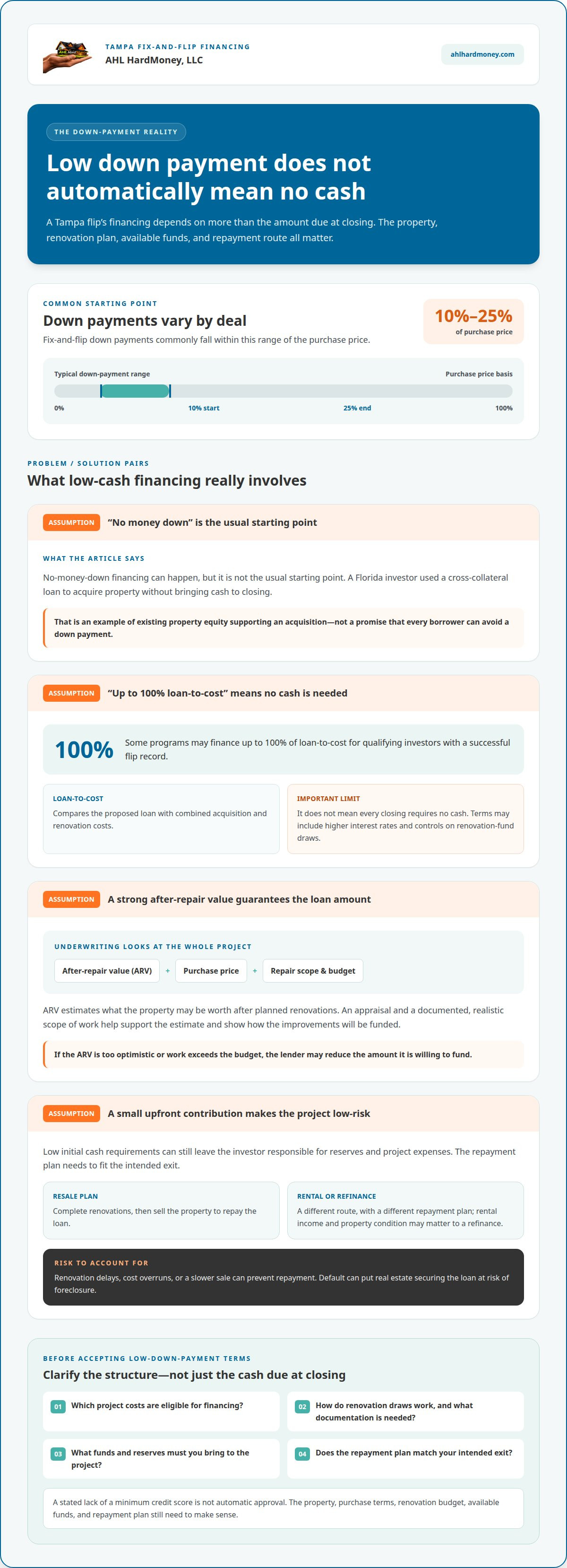
No-money-down financing can occur, but it isn’t the usual starting point for a Tampa flip. Fix-and-flip down payments commonly range from 10% to 25% of the purchase price. A Florida investor used a cross-collateral loan to acquire property without bringing cash to closing. That example shows how existing property equity can support an acquisition, not that every borrower can avoid a down payment.
A stated lack of a minimum credit score does not mean automatic approval. Financing discussions can still consider the property, purchase terms, renovation budget, available funds, and repayment plan. Real estate investors with damaged credit should distinguish flexible credit consideration from guaranteed approval. The deal’s financial structure still needs to make sense.
After-repair value, or ARV, estimates what a property may be worth after planned renovations. Underwriting compares that estimate with the purchase price, repair scope, and supporting property information. An appraisal can help assess value, while a realistic renovation plan helps show how the finished property could reach its projected condition. If the ARV is too optimistic or the work exceeds the budget, the lender may reduce the amount it is willing to fund.
Some programs may finance up to 100% of loan-to-cost for qualifying investors with a successful flip record. That means the loan can cover eligible project costs under the lender’s terms, not that every closing requires no cash. Financing at that level may carry higher interest rates or controls on renovation-fund disbursements. Ask how draws work and what documentation is needed before counting on repair funds.
A Tampa investor considering a flip should model the exit before accepting low-down-payment terms. A resale plan depends on completing renovations and selling the property; a term rental or refinance follows a different route. If the project relies on refinancing, consider whether the property’s condition and expected income support that plan. The lender’s underwriting must align with the intended exit, not just the purchase.
What are the risks of fix-and-flip loans with bad credit, including default and foreclosure? If renovation delays, cost overruns, or a slower sale prevent repayment, a borrower can default under the loan terms. When real estate secures the loan, default can put that property at risk of foreclosure, so stress-test the budget and repayment plan before closing.
Compare Tampa hard-money lender listings by the financing structure they describe, including down payment, ARV basis, renovation draws, and repayment terms. A low initial cash requirement can still leave the investor responsible for reserves and project expenses. Review how each term affects the whole deal before treating “no money down” as a workable plan.
Credit score requirements and case-by-case review
A credit score can shape a Tampa fix-and-flip financing decision, but it’s only one part of the discussion. The property, investment plan, and repayment strategy also matter.
Credit Score Expectations and Requirements
Some Florida fix-and-flip lenders report that borrowers generally need a credit score of at least 620 to 670. A lower score can mean a lender looks for a larger down payment or stronger financial reserves. These expectations describe common qualification patterns, not a single requirement shared by every lender. Ask what credit review applies before submitting a full application, and understand whether the inquiry is hard or soft.
Credit history gives context beyond the score itself. For example, a recent late payment and a long pattern of missed payments can present different concerns. Organize an explanation of any credit issue and show how the proposed project will be funded. A clear budget connects your financial position with the property’s purchase, renovation work, and planned exit.
Case-by-Case Review Factors
Yes. Tampa borrowers with credit challenges can explore financing that considers the property and project alongside credit history. These details help show whether the acquisition and repair plan support the expected resale or repayment strategy. A well-documented project gives context to a weaker score, though the property and finances still matter.
For example, an investor with a completed flip can document prior project experience, renovation scope, and the outcome. A first-time investor can instead present a detailed work plan, realistic cost estimates, and a clear timeline. Property value and the appraisal help assess the collateral; the renovation budget shows how the work will be completed. Each piece gives the lender a clearer basis for its decision.
Credit can also affect the cost and projected returns of an investment. Florida fix-and-flip interest rates often range from 8% to 12%, depending on lender, borrower credit profile, and project details. Model the interest expense against purchase, repairs, holding costs, and expected sale proceeds. If the projected margin shrinks under less favorable loan terms, revise the acquisition price or project scope before committing.
A practical application sequence can make the review easier to follow:
- Summarize the property, purchase price, and planned renovations.
- Show the project budget, funding sources, and available reserves.
- Describe prior flips or explain how the work will be managed.
- Connect the expected sale or refinance plan to loan repayment.
That package helps frame the full investment, rather than focusing on the credit score alone.
Down payment requirements
For Tampa fix-and-flip projects, a typical down payment ranges from 10% to 25% of the purchase price. Treat that range as a planning reference, not a fixed offer for every borrower. The required contribution depends on the property, renovation plan, loan structure, and underwriting. A weaker credit profile can make the requested contribution more significant, because the lender weighs the borrower’s available capital alongside the project.
Separate purchase-price financing from loan-to-cost leverage. The purchase price covers acquisition, while loan-to-cost compares financing with combined acquisition and renovation costs. A financing structure may treat each differently. Ask how the proposed plan divides purchase funding and renovation funding; otherwise, a seemingly manageable down payment can leave a cash gap during construction.
Some qualifying investors with a proven record of successful flips may obtain up to 100% loan-to-cost financing. That means the loan can cover eligible project costs under the lender’s terms, not that every closing requires no cash. Some programs apply higher interest rates or controls on renovation-fund disbursements. Confirm how the lender treats the acquisition, repair budget, and each renovation draw before relying on the maximum leverage.
Build a cash plan around the actual project rather than a headline percentage. List the purchase contribution, renovation expenses not covered at closing, and reserves needed while work proceeds. If renovation funds are released in stages, you may need other capital to keep the project moving between payments. The cash required depends on the financing structure and how funds are released.
A bridge loan can support a short-term acquisition and renovation, but the exit plan still matters. A resale project relies on completing the work and selling the property. A rental strategy depends on preparing the property for tenants, while a refinance plan depends on qualifying for replacement financing. Don’t treat rental income or a future refinance as available down-payment money before the terms and timing align.
Before accepting an offer, compare how your contribution affects the investment’s projected returns. A larger down payment may reduce the amount borrowed, while preserving cash can help cover repairs and carrying expenses. Consider the whole project: purchase price, renovation funding, loan repayment, and expected proceeds. Check whether the plan remains workable if repairs exceed estimates or the sale takes longer than expected.
For a Tampa property, prepare the purchase details, itemized renovation scope, project budget, and clear exit plan. These details help explain how much capital you can contribute and where financing is needed. If a low-cash structure depends on property equity or renovation funding, identify those assumptions before closing. That makes the requested down payment easier to understand and the project plan more precise.
Qualification for Florida fix-and-flip loans
Florida flip financing brings together credit history, property value, renovation needs, and repayment strategy. A clear application shows how each part supports the investment, rather than relying on one number alone.
What Tampa-area property types and neighborhoods qualify for fix-and-flip financing? Qualification depends on the individual property and project, not a neighborhood name by itself. For a Tampa-area property, the financing discussion can consider its condition, purchase terms, valuation, renovation scope, and proposed exit. Don’t assume a property fits simply because it is in a familiar neighborhood.
Credit expectations remain part of the decision. Some Florida lenders report that borrowers generally need a score of at least 620 to 670; a lower score may require a larger down payment or stronger financial reserves. Those factors matter alongside the deal’s potential, since the lender evaluates repayment capacity and the property securing the loan. Present credit issues accurately and include context that helps explain the current financial picture.
A useful project package connects the property to the plan. Include the purchase details, property valuation information, an itemized renovation budget, and a construction schedule. Then explain whether repayment depends on resale, rental income, or refinancing. Each document answers a different question: what is being acquired, what work is planned, and how the loan will be repaid.
- Property: Describe current condition and the planned improvements.
- Budget: Separate acquisition costs from renovation expenses.
- Experience: Summarize completed flips, or show how the work will be managed.
- Exit: Explain how sale proceeds, rental income, or a refinance would repay the loan.
- Reserves: Show available funds for expenses that arise during construction.
These details help a lender assess whether the proposed flip loan aligns with the property’s value and planned work. For example, a modest renovation with a supported valuation presents a different project profile from extensive construction with uncertain costs. A prior successful flip can document experience, while a first project needs a clear scope and management plan. Neither example replaces review of credit and finances.
For Tampa borrowers, build one consistent story across the application: purchase, repairs, value, available equity or reserves, and repayment. If one estimate changes, update the connected budget and exit plan. This keeps the financing discussion grounded in the same project assumptions and makes it easier to identify which part needs attention before moving forward.
AHL HardMoney, llc
AHL HardMoney, llc helps Florida borrowers explore hard-money financing when credit history complicates a real estate plan. For a Tampa flip, the next step is to discuss the project’s funding need, available property equity, and repayment plan, then consider which financing path fits. Depending on the situation, relevant options include Home Equity Loans, Private Money Refinance, Cash Out Refinance, or Foreclosure Refinance Loans. These offerings address different borrowing needs, so the right fit depends on the property and purpose of the funds. AHL HardMoney, llc considers borrowers regardless of credit history. Contact AHL HardMoney, llc to discuss your real estate financing needs.
Move your next Tampa deal forward with a clear plan
A credit setback doesn’t have to define your next move. Connect your financing needs with your broader property plans, whether you’re preparing an acquisition or considering how existing real estate could support your goals. For borrowers exploring fix and flip loans Tampa bad credit, a clear picture of the project and its repayment path makes the discussion more focused.
AHL HardMoney, llc offers Cash Out Refinance, Home Equity Loans, and Private Money Refinance. These are distinct financing options, and the right direction depends on your property and what you’re trying to accomplish. Bring your questions and outline your goals to start a practical conversation.
Take a practical next step: prepare your property and project details, then contact AHL HardMoney, llc to discuss a financing plan that fits your real estate goals.
Frequently Asked Questions
What Is a Fix and Flip Loan, and How Does It Work?
A fix-and-flip loan finances the purchase and renovation of a property intended for resale. The borrower uses the funds for the acquisition and planned repairs, depending on the loan structure. Repayment usually follows the project’s exit plan, such as selling the renovated property. Before taking a loan, map the purchase, renovation schedule, holding period, and expected sale proceeds so the financing plan fits the project.
How Fast Can You Get Funding for a Fix and Flip Project?
Funding speed depends on application readiness, property review, appraisal, and required documents. AHL HardMoney, llc states “30 Min Approvals” and a possible closing period of 5 to 15 days. Approval and closing are separate steps, so a quick initial decision doesn’t mean funds are available immediately. A complete property file and clear renovation plan can help keep the process moving through underwriting and closing.
How Important Is the Property’s After-Repair Value (ARV)?
ARV matters because it helps assess a property’s potential value after renovations and the project’s financing risk. Support the estimate with comparable properties and a renovation scope that explains how the finished home will differ from its current condition. If the planned work changes, revise the budget and resale assumptions together. An optimistic ARV without a matching scope can weaken the project’s financial case.
How Long Does It Take to Close?
Florida private and hard-money fix-and-flip closings can take 7 to 14 days, depending on document submission and inspections. A closing can take longer if the appraisal, title work, property access, or renovation details are delayed. Keep the purchase contract and project documents organized, and respond promptly to requests. These steps help avoid preventable hold-ups, though each lender’s process and the property’s circumstances affect timing.
How fast can a loan close in Tampa?
AHL HardMoney, llc states that loans can close in 5 to 15 days, including in Tampa. The company serves the local coverage area while maintaining a broader focus, and also works with clients throughout surrounding regions. A complete file and timely property access can help keep the closing process on track.
Can you get a fix-and-flip loan in Tampa with bad credit?
Yes, borrowers with credit challenges may still explore financing for a Tampa flip. AHL HardMoney, llc states that it considers borrowers regardless of credit history and lists “No Hard Credit Inquiry” as a feature. The property, renovation plan, available funds, and repayment strategy still matter to the financing discussion. For a useful initial review, have the purchase details and project budget ready to share.
What credit score do Tampa fix-and-flip lenders require?
There isn’t one score threshold used by every Tampa fix-and-flip lender. Some Florida lenders generally look for scores from 620 to 670, while lower scores may call for a larger down payment or stronger reserves. Ask what kind of inquiry applies before proceeding with an application. Prepare a concise explanation of significant credit issues and show how the project budget and repayment plan fit together.
What are typical Tampa fix-and-flip loan rates, fees, and down payment requirements?
Terms depend on the borrower’s credit profile, property, renovation scope, and financing structure. Down payments commonly range from 10% to 25% of the purchase price, but a lender’s specific terms may differ. Don’t assume a market rate or fee range applies to your offer; review the loan quote for the stated interest and charges.
Disclaimer:
While Dan is not a real estate attorney, he is a Full Time, Licensed Florida Mortgage and Real Estate Broker Professional coupled with 21+ years of successful strategies, methodologies and techniques that have proven effective to the benefit of Florida families.
While not every conversation is a deal, we promise to leave you better off then before you called. We serve everyone we come in contact, with the highest levels of integrity and dignity.
We invite you to make the call 📲


