

Article by
Dan Conneally - NMLS 339916, LO13164, BK3246524, CQ1072086
Dan Conneally has been successfully helping Florida families with thier real estate related situations for the last 21+ years, regardless of credit or past financial background.
While Dan is effective with institutional lending, he particuarly shines when matters require unique strategies involving noninstitutional resources.
Check out his legions of testimonials from real Florida families at Google, Facebook and the BBB to get a sense of the caliber and effectiveness he achieves. Dan has appeared on television speading the message of hope to good folks that need diligent, discrete, nonjudgy care.
The quicker source of funds may bring greater repayment pressure. In the hard money vs home equity line of credit comparison, a hard money loan generally provides a lump sum secured by real estate, while a HELOC lets you draw repeatedly against your home’s equity. Both can put property at risk if you can’t repay, but they differ in how you access funds and qualify.
It’s reasonable to focus on access to cash, especially when timing matters. But the borrowing structure, total costs, application requirements, and repayment schedule all shape whether an option fits your situation.
This guide explains how each option works, compares its benefits and trade-offs, and highlights foreclosure risks to understand before borrowing. You’ll also find a practical way to weigh a lump-sum loan against a flexible credit line.
Key Takeaways
- Understand how borrowing against home equity can put your property at risk if you can’t repay.
- Learn how to calculate home equity and what that figure can tell you about borrowing capacity.
- See why a lump-sum home equity loan may suit a different need than a credit line you draw from over time.
- Compare how hard money loans work, including their property-focused approach to evaluating a loan.
- Identify when AHL HardMoney’s home equity and refinance offerings may fit your financing needs.
Home equity as collateral and foreclosure risk
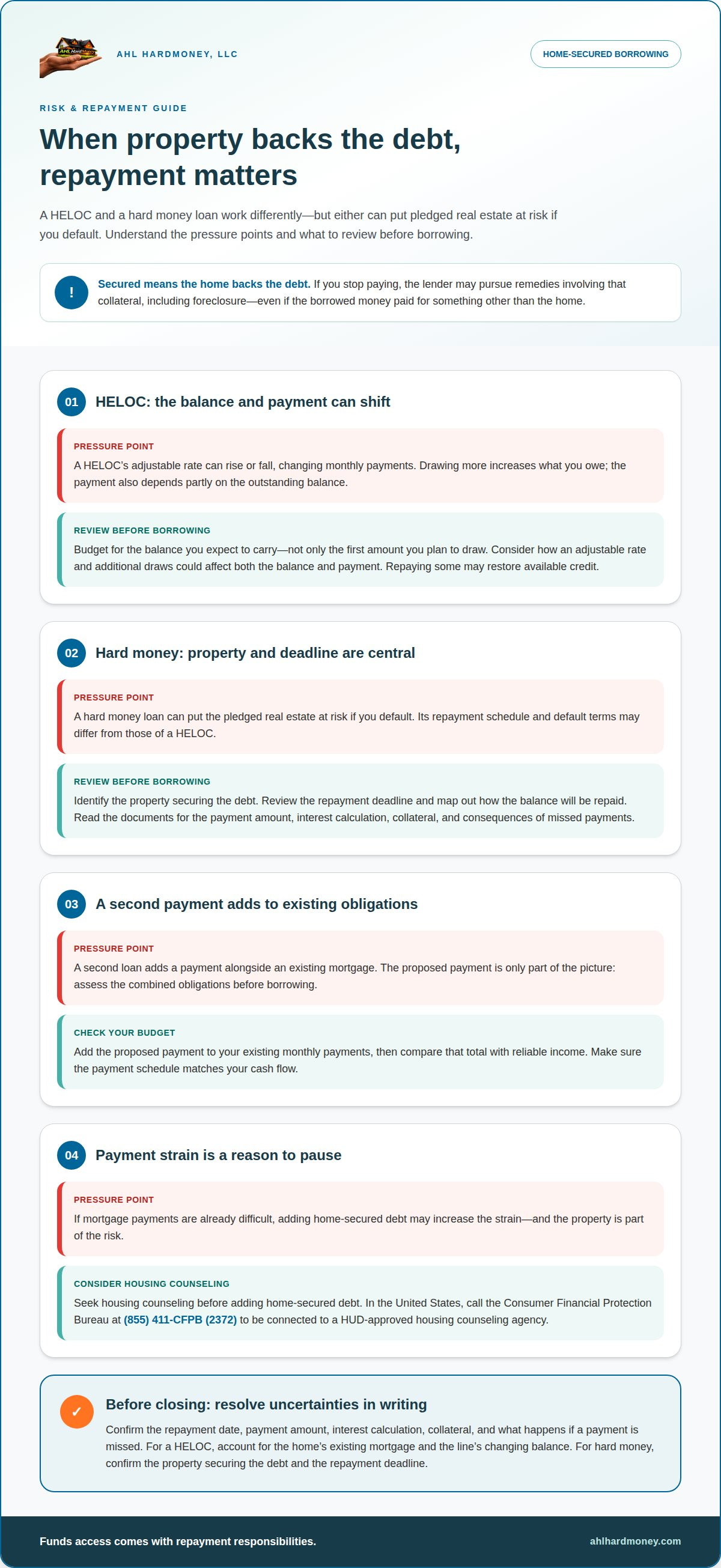
A HELOC is secured by your home, so missed payments can put the property at risk. A hard money loan can also put pledged real estate at risk if you default. With a HELOC, a variable interest rate can also change your monthly payments.
“Secured” means the home backs the debt. If you stop paying, the lender may pursue remedies involving that collateral, including foreclosure. That risk applies even when the borrowed money paid for something other than the home. A second loan also adds a payment alongside an existing mortgage, so assess the combined obligations before borrowing.
Rate changes make a HELOC’s payment less predictable. Its adjustable rate can rise or fall, and the payment depends partly on the outstanding balance. Drawing more increases what you owe; repaying some may restore available credit. Budget for the balance you expect to carry, not just the amount you plan to draw first.
Hard money and HELOC agreements may set different payment schedules and default terms. Read the documents for the repayment date, payment amount, interest calculation, collateral, and consequences of missed payments. For a hard money loan, identify the property securing the debt. For a HELOC, account for the home’s existing mortgage and the line’s changing balance.
- Before closing: Add the proposed payment to your existing monthly payments and compare that total with reliable income.
- For a HELOC: Consider how an adjustable rate and additional draws could affect the balance and payment.
- For hard money: Review the pledged property and repayment deadline, then map out how the balance will be repaid.
- If payments are already difficult: Seek housing counseling before adding home-secured debt.
That last step matters when mortgage payments are already causing strain. People in the United States can call the Consumer Financial Protection Bureau at (855) 411-CFPB (2372) to be connected to a HUD-approved housing counseling agency. A counselor can help assess the current payment problem before you take out a home equity loan or HELOC.
Use the closing stage to resolve uncertainties in writing. Make sure the payment schedule matches your cash flow, and understand what happens if repayment becomes difficult. A home-secured loan can provide access to funds, but the property securing it is a serious part of the decision.
Home equity definition and calculation
Home equity is the difference between a property’s current value and the debt secured by it. If a home is worth $500,000 and its mortgage balance is $200,000, the owner has $300,000 in equity. The calculation is direct: subtract the remaining mortgage balance from the home’s estimated value. If other loans are secured by the property, include those balances when calculating the owner’s net equity. A hard money vs home equity line of credit comparison starts with this figure, but equity alone doesn’t determine which borrowing structure fits.
Equity is a snapshot, not a fixed amount. The home’s value can change, while paying down mortgage principal reduces the amount owed. If the mortgage balance falls while the estimated property value stays the same, equity rises by the principal repaid. If the value falls, equity can shrink even while you keep making payments.
Use current figures for both parts of the calculation. Start with a realistic estimate of the home’s present value, then total the outstanding balances secured against it. Use the remaining mortgage balance, not the original amount. Interest rates affect borrowing costs, but they don’t change the equity formula. They can affect how much a new loan costs to repay. When comparing hard money vs home equity line of credit financing, separate the equity estimate from the repayment terms.
Equity and available borrowing are different figures. A homeowner may have equity but still need to meet a lender’s qualification requirements. Equifax says lenders generally allow borrowers to borrow no more than 80% of their home equity through a home equity loan. This is a general borrowing limit, not a promise that the full amount will be available. Existing secured debt and the lender’s assessment affect the amount offered.
A separate example gives $90,000 as the maximum eligible home equity loan amount for a home at that value and mortgage balance. The distinction matters: equity is calculated from value minus debt, while an eligible loan amount depends on how the lender applies its borrowing criteria.
Before comparing a lump-sum loan with a credit line, write down the property value and each secured balance. Recalculate if the value estimate or loan balance changes. Then compare the amount you need with each option’s repayment schedule and monthly payments. A larger equity figure doesn’t automatically make a new payment manageable. For a property-secured loan, both the amount borrowed and the repayment plan matter.
If a home equity loan is the option you’re evaluating, explore the home equity loan option alongside your equity calculation and repayment needs.
Home equity loan benefits and risks
A home equity loan provides a lump sum backed by the home, repaid through scheduled payments. Its benefits center on predictable repayment, while its main risks involve added debt and property collateral.
Home Equity Loan Benefits
Unlike a HELOC, which lets borrowers draw from a credit line over time, a home equity loan provides the agreed amount upfront. Payments generally cover principal and interest and stay fixed over the loan’s life. That structure can help someone plan for a defined expense, such as renovations, without managing repeated withdrawals or a changing balance.
A set schedule can also make budgeting more straightforward. Home equity loan repayment terms typically range from 5-30 years, so the term affects how long payments continue. Interest may be deductible when the loan funds home improvements and the borrower itemizes income taxes. For example, a homeowner planning renovations can compare the project cost with the loan amount and scheduled payments before borrowing.
Home Equity Loan Risks
The home secures the loan, so default can put the property at risk of foreclosure. If a mortgage already exists, the home equity loan adds another monthly payment rather than replacing the first mortgage. That differs from a HELOC’s reusable credit line: the loan’s lump sum is paid out upfront, and the full borrowed balance enters repayment.
Using a loan to pay a credit card balance also changes the nature of the debt. The card balance becomes part of a loan secured by the home, linking repayment trouble to the property. Before using loan proceeds for debt consolidation, include the new payment alongside the mortgage and other recurring obligations. A lower monthly payment alone doesn’t show the full repayment cost or added collateral risk.
Assess the decision with a short, practical review:
- Purpose: Match the lump sum to a defined expense, such as renovations, rather than borrowing without a clear use.
- Income: Compare the new payment with reliable monthly income and existing debt payments.
- Term: Consider how a 5-30 year repayment period fits the expense’s useful life and your budget.
- Tax treatment: For home improvements, check whether you itemize income taxes before relying on a possible interest deduction.
A home equity loan may suit a one-time expense and a borrower who values fixed payments. A HELOC may suit expenses that arrive in stages, but its adjustable rate can make payments change. Either option adds debt secured by the home. Weigh the payment structure against the expense, income, and consequences of missed payments before choosing.
Home equity loan lump-sum borrowing
A home equity loan pays out a lump sum, making it suited to a defined expense with a known amount. HELOCs differ by letting borrowers draw funds as needed from an available credit line. The key question is whether you need the full amount at once or expect costs to arrive in stages.
Consider a planned renovation with a clear estimate. A single disbursement can cover known project costs, while a HELOC may better match work paid for in stages. With a lump sum, the full borrowed amount enters repayment according to the loan schedule. You don’t decide later to draw only part of the approved amount.
The example shows how the borrowed amount, interest rate, and repayment term work together. It isn’t a quote for a particular borrower. A different loan amount, rate, or term changes the payment.
A fixed payout can make planning easier, but it requires a careful estimate before closing. Borrowing more than the expense requires means repaying funds that may sit unused. Borrowing too little can leave a funding gap. List expected costs, separate essential work from optional upgrades, and compare the total with the amount needed at each project stage.
- Choose a lump sum when the expense has a defined total and the full amount is needed upfront.
- Consider staged borrowing when the costs will arise over time and withdrawals may be more practical.
- Map repayment by comparing scheduled payments with income and existing obligations.
- Revisit the estimate if the project scope changes before borrowing.
For example, a homeowner replacing a roof may have one contractor estimate and a main payment date. A homeowner renovating in stages may face separate expenses over time. The first situation aligns more naturally with a lump-sum structure. The second may call for flexibility, though repeated access to credit can make spending harder to track.
Before choosing, compare the expense timeline with the repayment timeline. Ask what the monthly payment would be if you borrowed the full amount immediately, and consider whether the planned work fits the budget. A lump sum works best when the amount and purpose are clear. The practical takeaway: borrow for a defined need, not simply because credit is available.
What is a hard money loan and how does it work?
A hard money loan is private financing secured by real estate. The property acts as collateral, and the loan agreement sets the amount, payment schedule, and repayment terms. Unlike a HELOC, it isn’t a reusable credit line. You receive the loan proceeds under the agreement and repay them according to its terms.
The property and repayment plan both matter. A borrower might use a hard money loan for a time-sensitive property expense, then repay it through a planned refinance or property sale. These are possible strategies, not automatic outcomes. You need a workable repayment plan that fits the agreement’s deadlines and your cash flow.
Think through the process in practical steps:
- Define the need: Set out the purpose and amount sought, such as funding a property improvement.
- Review the collateral: Identify the real estate securing the loan and the debt already attached to it.
- Read the agreement: Understand how proceeds are disbursed, when payments are due, and when the balance must be repaid.
- Plan repayment: Match the expected source of funds to the repayment schedule, including a backup plan.
Compare that structure with a HELOC. A HELOC lets a borrower draw multiple times up to an available maximum, and payments can replenish available credit. A hard money loan follows its agreement; it doesn’t offer repeated draws just because earlier payments reduced the balance. That difference matters when expenses arrive in stages rather than all at once.
For example, imagine a property owner needs funds for a defined project and expects to repay after completing a planned transaction. A hard money loan may fit if the collateral and repayment schedule work for the project. If the owner wants continuing access to funds for separate expenses, a credit line has a different draw structure. The choice depends on timing, purpose, collateral, and a credible repayment plan.
Before signing, trace the repayment plan from start to finish. Identify the source of funds, when they’re expected, and what happens if they arrive later. Then compare that timeline with every payment and final due date in the agreement. A refinance depends on qualifying for replacement financing; a sale depends on completing the transaction. Neither is guaranteed.
The key difference is structure: hard money provides financing secured by real estate under defined loan terms, while a HELOC offers access to a revolving credit line. Choose based on how much you need, when you need it, and how you’ll repay it. If no realistic repayment source fits the loan schedule, give the collateral risk particular attention.
AHL HardMoney: Home Equity Loans
AHL HardMoney, llc offers Home Equity Loans for borrowers seeking funds secured by home equity. If you need a lump sum for a defined expense, this option may fit better than a revolving credit line. Explore home equity loan financing alongside the amount needed and your repayment plan.
For a different financing need, AHL HardMoney, llc also offers Cash Out Refinance, Private Money Refinance, and Foreclosure Refinance Loans. Approvals often come within 30 minutes, and loans can close in 5 to 15 days, regardless of credit history.
Contact AHL HardMoney, llc to discuss financing options for your property and borrowing needs in Florida.
Make Your Next Financing Decision With Clarity
A careful comparison of hard money vs home equity line of credit financing comes down to one practical question: which structure supports your next move without making repayment harder? Before choosing, put the intended use, funding timeline, and repayment source on the same page. This can show whether a lump sum or ongoing access to credit better matches when your expenses will arrive.
Then consider the commitment attached to the property. A financing choice affects more than the amount available today; it shapes future payments and the flexibility you’ll have if plans change. Weigh those trade-offs against your budget and priorities. A clear plan is a stronger starting point than urgency alone.
For a conversation about financing options that fit your property and goals, connect with AHL HardMoney.
An informed next step can help you move forward with greater confidence.
Frequently Asked Questions
What is a Home Equity Line of Credit and How Does it Work?
A HELOC is a revolving credit line secured by a home, with borrowing available up to an approved limit. It can be useful when expenses arrive in stages, since you draw funds as needed instead of taking the full amount upfront. Interest is charged on the amount borrowed, not the unused portion of the credit line. For example, you might fund a planned project in phases as bills come due.
What can a HELOC help you do?
A HELOC can provide access to funds for expenses that don’t arrive all at once, such as home projects or education costs. One example is a homeowner borrowing $35,000 through a HELOC to help pay for a child’s college education. The line’s structure lets the borrower access money as needed, while keeping in mind that draws increase the balance secured by the home.
How does a HELOC work?
A HELOC has a draw period followed by a repayment period. During the draw period, borrowers may be able to make interest-only payments on the amount borrowed. A variable rate is calculated using an index and a margin, with the margin remaining constant over the credit line’s life. When the draw period ends, borrowers can’t draw more and must repay principal and interest.
What is a home equity line of credit (HELOC) and how does it work?
A HELOC is a home-secured credit line that allows repeated borrowing within an approved limit. Its tax treatment depends on how the funds are used: according to the Internal Revenue Service, interest is deductible only when funds buy, build, or substantially improve the home securing the loan. That condition can matter if you’re weighing a HELOC for a project against other uses for the money.
What credit score, equity, income, and property requirements apply to hard money loans versus HELOCs?
HELOC lenders generally consider credit history, employment history, monthly income, monthly debts, and home equity. Many lenders prefer a credit score of at least 620, and a general debt-to-income rule is below 43%. Hard money loans are secured by real estate, but requirements vary with the property and repayment plan. AHL HardMoney, llc states it accepts any credit profile. It serves Florida, including Tampa, Clearwater, Saint Petersburg, Palmetto, Largo, Newport Richey, Port Richey, Brooksville, Brandon, Orlando, Daytona, Napels, Ocala, Deltona, Deland, Jupiter, Palm Beach, Lakeland, and Boca Raton.
What are typical HELOC interest rates, fees, credit limits, and repayment terms?
HELOCs usually have adjustable rates, and payments vary with the amount borrowed; ask the lender about application, annual, and cancellation or early-closure fees. You can draw repeatedly up to the available credit limit, with payments restoring available credit. The draw period typically lasts 5 to 10 years, followed by a repayment period of 10 to 20 years.
Disclaimer:
While Dan is not a real estate attorney, he is a Full Time, Licensed Florida Mortgage and Real Estate Broker Professional coupled with 21+ years of successful strategies, methodologies and techniques that have proven effective to the benefit of Florida families.
While not every conversation is a deal, we promise to leave you better off then before you called. We serve everyone we come in contact, with the highest levels of integrity and dignity.
We invite you to make the call 📲


