


Article by
Dan Conneally - NMLS 339916, LO13164, BK3246524, CQ1072086
Dan Conneally has been successfully helping Florida families with thier real estate related situations for the last 21+ years, regardless of credit or past financial background.
While Dan is effective with institutional lending, he particuarly shines when matters require unique strategies involving noninstitutional resources.
Check out his legions of testimonials from real Florida families at Google, Facebook and the BBB to get a sense of the caliber and effectiveness he achieves. Dan has appeared on television speading the message of hope to good folks that need diligent, discrete, nonjudgy care.
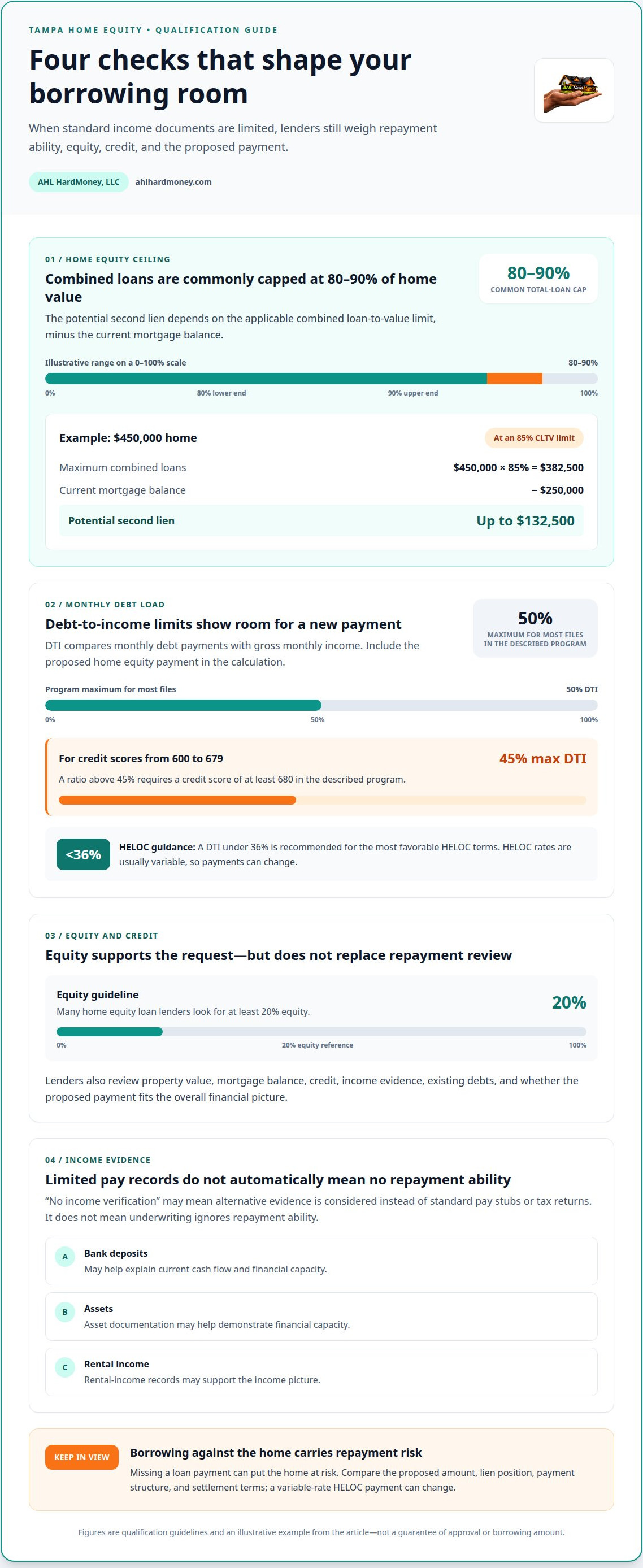
You may be able to borrow against home equity even when your income is hard to document, but lenders generally cap total loans secured by the home at 80-90% of its value. For an equity loan with no income verification in Tampa, the potential amount depends on that limit minus your current mortgage balance. For example, a $450,000 home with a $250,000 mortgage could support a second lien of up to $132,500 at an 85% combined loan-to-value limit.
Limited pay stubs or tax records don’t automatically rule out an equity loan with no income verification in Tampa. Repayment ability still matters, and lenders may consider other documentation, such as bank deposits, assets, or rental income. If you’re considering an equity loan with no income verification in Tampa, this guide compares home equity loans, HELOCs, and cash-out refinances, then explains how equity, credit, and income documentation can affect the amount you may qualify to borrow.
Key Takeaways
- Estimate borrowing room by considering your home’s value, current mortgage balance, and the combined loan-to-value limit.
- Compare a HELOC, home equity loan, cash-out refinance, and home equity investment by how each accesses equity and handles repayment.
- Understand how credit history and debt-to-income levels can affect eligibility when conventional income documents are difficult to provide.
- Explore whether bank deposits, assets, or rental income can help demonstrate your ability to repay.
- Use the comparison to identify which financing route best fits your equity position, documentation, and borrowing goals.
Is it easier to get a home equity investment, HELOC, or cash-out refinance with no income?
No option is automatically easier when income is difficult to document. The right fit depends on repayment ability, available home equity, credit, and how you want to access the funds.
No-Income-Verification Financing
“No income verification” usually means an application may use alternative income evidence instead of standard pay stubs or tax returns. It doesn’t mean repayment ability is ignored. Modern lenders generally must assess whether borrowers can repay, and older no-income-verification loan types largely disappeared after 2008. Bank deposits, assets, or rental income may help document financial capacity, but they don’t remove the need for underwriting.
A home equity loan provides a lump sum and adds a second lien while leaving the first mortgage in place. A HELOC also creates a second lien, but offers a revolving line of credit, often with a variable rate. A cash-out refinance replaces the existing mortgage with a larger one, changing the first mortgage’s balance and terms. A home equity investment, or HEI, provides a lump sum in exchange for a share of future home appreciation, rather than using a conventional loan repayment schedule.
| Option | How funds are accessed | Existing mortgage | Repayment structure |
|---|---|---|---|
| Home equity loan | One lump sum | Remains in place | Loan payments |
| HELOC | Flexible draws from a credit line | Remains in place | Variable-rate repayment |
| Cash-out refinance | Cash from a larger replacement mortgage | Replaced | Payments on the new mortgage |
| HEI | Lump sum for a share of future appreciation | Typically remains in place | Settlement tied to a future event |
Compare payment structure, first-mortgage terms, and whether sharing future appreciation fits your plans.
Florida homeowners should understand the lien and repayment terms before signing. Ability-to-Repay rules require lenders to establish that borrowers can repay loans, even when documentation is nontraditional. Review how the agreement handles interest, repayment, and a possible sale; Florida homeowners facing foreclosure pressure can also read about Florida foreclosure refinance loans.
Using home equity without documented income can strain your budget if cash flow falls short. Missing a loan payment can put your home at risk, while an HEI may require settlement when you sell, refinance, or use another source of cash. Weigh these outcomes against your expected income and plans for the property.
To apply, organize the information that supports your request: mortgage balance, property details, credit history, and available income records. Depending on the application, bank statements, asset documentation, or rental-income records can help show repayment capacity. Then compare the proposed amount, lien position, payment structure, and settlement terms.
Finding and Comparing Tampa Lenders
When comparing Tampa lenders, request written terms for the same borrowing amount and review rates, repayment structure, lien position, and documentation requirements side by side. Ask how bank deposits, assets, or rental income are considered when pay records are limited. A clear comparison spells out the total obligation and repayment consequences, especially if you’re considering a variable-rate HELOC or an appreciation-sharing agreement.
Income, equity, and debt-to-income qualification
Approval depends on the full financial picture, not home equity alone. Tampa lenders weigh income evidence, credit, existing debts, property value, and the proposed payment together.
A debt-to-income ratio compares monthly debt payments with gross monthly income. It helps show how much room remains for a new home equity payment. In the described program, most files have a maximum ratio of 50%. For credit scores from 600 to 679, the maximum tightens to 45%; a ratio above 45% requires a score of at least 680.
Debt-to-Income Limits and Payments
DTI limits show how the new payment fits alongside obligations such as a mortgage, credit-card minimums, or other loans. A HELOC’s payment can change because its rate is usually variable, while a fixed-payment loan offers a more predictable schedule. For the most favorable HELOC terms, a DTI under 36% is recommended. The calculation must include the proposed obligation.
For example, someone near the 45% threshold needs to consider whether the new payment pushes the ratio above it. In the described program, that higher ratio calls for at least a 680 credit score. A stronger credit profile may therefore matter when existing monthly debts already use much of the borrower’s income.
Equity is another part of the decision, but it doesn’t replace repayment analysis. Many home equity loan lenders look for at least 20% equity. A lender also reviews the home’s value, current mortgage balance, credit, and income evidence to determine whether the requested amount fits. A valuable home can support borrowing capacity, but existing debts and the new payment still affect qualification.
Income Underwriting
Income underwriting evaluates whether documented or alternative financial resources can support repayment. For a Tampa HELOC application, common documents include recent pay stubs, W-2 forms, and tax returns. When conventional records don’t reflect current cash flow, bank deposits, assets, or rental income may help explain the borrower’s financial position. The lender still considers income alongside debts and credit.
Keep the distinction clear: incomplete pay documentation isn’t the same as having no ability to repay. Underwriting considers the consistency and source of income evidence, then weighs it against monthly obligations and the proposed payment. For rental income, the property’s receipts and related debt payments help show its contribution to the overall picture.
To prepare, organize income records, debt-payment details, credit information, and your mortgage balance. Then estimate the proposed payment and see how it affects DTI. This makes it easier to identify whether income documentation, existing obligations, or available equity is the main qualification constraint.
Credit score requirements
No-doc HELOC programs commonly set minimum scores of 600-660 for a primary residence and 680-700 for an investment property. Many lenders require 620-680 or higher for home equity products, while many home equity loan lenders look for 680 or above. Equity also matters: lenders often look for at least 20% home equity, and home equity investments commonly require 25-30%.
Those ranges are guideposts, not one universal approval cutoff. In the described program, a primary-residence line has a minimum score of 600. A score of 720 or above may open access to better rates and higher loan-to-value options. For a home equity loan, 700 or higher is usually considered good credit; scores from 740 to 799 are very good, and 800 or higher is excellent.
Occupancy can affect credit requirements. A home used as your primary residence may qualify under a lower minimum-score range than an investment property. That distinction matters when comparing a line of credit with other home equity options. Rental income from an investment property may support the financial picture, but the property’s occupancy category can bring a higher score requirement.
Credit history matters alongside the score itself. In the described program, borrowers need either two tradelines seasoned for 12 months or one tradeline seasoned for 24 months. A tradeline is a reported credit account; its seasoning reflects how long it has appeared in the borrower’s credit history. A newer account history may therefore affect approval even when the score meets a stated minimum.
Credit also connects to monthly payment capacity. Under the described program, a debt-to-income ratio above 45% requires at least a 680 score. For scores from 600 to 679, the maximum debt-to-income ratio is 45%. A borrower with a score near the minimum should consider how existing expenses and the proposed payment affect that ratio.
Credit score, equity, and property value work together. An appraisal informs the value used to assess available equity, while credit history helps indicate how you’ve managed financial obligations. A strong score can’t create equity if the mortgage balance leaves little room. Likewise, substantial equity doesn’t remove credit or repayment review.
For a cash-out refinance, the credit review applies to the replacement mortgage, not a separate line of credit. Compare the score threshold, occupancy category, tradeline history, and monthly payment impact for the option you’re considering. This helps identify which factor may limit eligibility before you proceed.
Combined loan-to-value limits
Combined loan-to-value, or CLTV, compares all loans secured by a home with its appraised value. The existing mortgage and proposed home equity loan or line of credit both count. To estimate the maximum new lien, multiply the home’s value by the applicable CLTV cap, then subtract existing mortgage balances. The result is a calculation ceiling, not an automatic approval amount.
Lenders commonly cap home equity borrowing at 80-90% CLTV. The cap matters because it limits the combined mortgage balance, rather than the new loan by itself. Subtract the current mortgage balance to estimate potential room before considering credit, income, and payment qualification.
Property use can change the applicable limit. In the described program, a primary-residence home equity line can reach 80% CLTV, while a second-home or investment-property line can reach 70%. The owner’s occupancy category therefore affects how much room remains for another lien.
Consider a Tampa home valued at $700,000, with a $350,000 existing mortgage and an 85% CLTV cap. If the cap were lower, the available amount would shrink, even though the property value and mortgage balance stayed unchanged.
A line limit and a lump-sum loan use the same basic equity calculation, but provide funds differently. A HELOC establishes a maximum line, with borrowers drawing funds as needed; a home equity loan provides a lump sum. With either option, the first mortgage remains part of the combined balance. A cash-out refinance replaces that mortgage, so the new loan balance is assessed as replacement financing.
Use these steps to understand the borrowing ceiling:
- Start with the property value used for the lender’s CLTV calculation.
- Multiply that value by the applicable cap, such as 80% or 85%.
- Subtract the current mortgage and other liens secured by the property.
The final amount may be lower than the calculated ceiling because CLTV is only one qualification measure. Credit, income documentation, repayment capacity, and the proposed payment also matter. For Tampa homeowners, compare the remaining lien capacity with the amount you need, while keeping payments manageable and understanding whether funds come as a lump sum or through a line of credit.
Alternative income verification using bank deposits, assets, or rental income
When pay stubs or tax returns don’t reflect current finances, alternative documentation can help explain repayment capacity. Some programs review 12 to 24 months of bank deposits, while alternative documentation for no-doc HELOCs may span 3-24 months of statements. These records can show income patterns that a standard employment document misses.
Bank statements are most useful when deposits and their sources are clear. For example, recurring business receipts may appear alongside transfers between personal accounts. Separating income deposits from transfers, refunds, and one-time proceeds helps show cash flow more clearly. Lenders review statements as evidence, not as automatic approval, and still consider debts and the proposed payment.
Assets can provide another view of financial strength, especially when income varies. Savings or investment balances may show available resources, but assets and income aren’t interchangeable. An underwriter considers whether funds are accessible and how they relate to ongoing repayment. A large account balance alone doesn’t establish a stable monthly income stream.
Rental income can be relevant for owners of investment properties. DSCR lenders assess an investment property’s rental income relative to its debt payment when evaluating repayment ability. This approach focuses on the property’s income compared with its financing obligation, rather than relying only on the owner’s employment income. Rental records and property debt details help show that relationship.
Documentation flexibility can affect which financing structure fits. A home equity line provides revolving access, so the requested limit and expected draws matter. A cash-out refinance replaces the existing mortgage, making the new mortgage payment central to repayment review. For either option, alternative income records can clarify the financial picture, but don’t remove the lender’s repayment assessment.
Organize documents by source and timeframe before applying. A practical file can include:
- Bank statements covering the period requested for review, such as 12 to 24 months.
- Records that explain recurring deposits, business receipts, or transfers.
- Current asset statements showing balances and account ownership.
- Rental records paired with the related property debt payment.
The clearest application connects each deposit or asset to its source and shows how it supports repayment. For a Tampa homeowner with variable self-employment income, matching deposit records to business receipts can explain cash flow more clearly than relying on a single tax document. For a rental-property owner, comparing documented rent with the debt payment shows the property’s contribution. Organized evidence helps lenders assess the full financial picture.
AHL HardMoney, llc: Home Equity Loans
AHL HardMoney, llc offers Home Equity Loans and Cash Out Refinance for homeowners weighing ways to access property equity. If income is difficult to document, the application still needs to show repayment capacity; the home’s value and mortgage balance are part of the overall picture. AHL HardMoney, llc also offers Private Money Refinance and Foreclosure Refinance Loans for borrowers facing those specific financing needs.
Approvals are often within 30 minutes, and loans can close in 5 to 15 days, regardless of credit history. These timeframes don’t replace underwriting or guarantee approval. Explore the details of Home Equity Loans to understand how this option may fit your borrowing needs.
Contact AHL HardMoney, llc to discuss your home equity financing needs.
Set a Clear Next Step for Your Home Equity
Before moving forward, define what the funds need to accomplish and what payment fits your household budget. This gives the financing conversation a practical starting point, rather than letting the maximum available amount set the goal. A clear purpose also helps you decide which terms deserve the closest attention.
For an equity loan with no income verification in Tampa, organize the records that best show how money reaches you, whether through business deposits, assets, or rental proceeds. Connect those records to your intended use and repayment plan. Clear priorities make it easier to discuss a structure that fits both the property and your financial goals.
AHL HardMoney can help you consider a next step based on your situation. Bring your goals and financial picture into the conversation, and focus on a path that supports responsible borrowing.
You can move forward with greater clarity when your borrowing plan starts with your needs and a realistic approach to repayment.
Frequently Asked Questions
How much equity can I borrow against in Tampa?
Your borrowing room depends on the home’s appraised value, the combined loan-to-value limit, and debts already secured by the property. Multiply the value by the applicable cap, then subtract existing mortgage balances. This calculation gives a starting ceiling, not a guaranteed loan amount. Credit, income evidence, property use, and the proposed payment also shape the amount a lender may approve.
Can I use home equity to renovate an older Tampa bungalow?
Yes. Home equity can provide renovation funds, but the project budget should fit both your available equity and a manageable repayment plan. For an older bungalow, separate essential repairs from optional upgrades and identify how each expense supports the property. A lump-sum home equity loan provides funds upfront, while a line of credit lets you draw funds over time. Match the financing structure to the project’s timing and cash needs.
Do “no income verification” or “no doc” home equity loans exist?
Older no-income-verification loan types largely disappeared after lending standards tightened following the 2008 housing crisis. Today, “no doc” often describes alternative documentation rather than financing with no repayment review. Bank deposits, assets, or rental income can help demonstrate financial capacity. Lenders still evaluate whether the borrower can repay, along with credit, property value, existing debts, and the new obligation.
Is it possible to get a home loan without proof of income?
Borrowers can use documentation beyond standard pay stubs, but home financing still requires evidence of repayment ability. Self-employed borrowers can present bank deposits; property investors can document rental income and related debt payments. Assets can add context about available resources. The key distinction is between lacking conventional income paperwork and having no evidence of financial capacity. Alternative records address the first, not the second.
What do lenders look at instead of income?
Lenders can review bank deposits, asset statements, rental receipts, and debts tied to an investment property. Deposit history helps explain cash flow, while asset records show available resources. For rental property, debt-service coverage analysis compares property income with its debt payment. These records supplement the broader review of credit, home value, existing mortgage balance, and the proposed payment; they don’t replace repayment assessment.
What is a no-income-verification home equity loan and how does it work?
The phrase generally refers to home equity financing that uses alternative evidence instead of conventional income documents. The borrower still receives financing secured by home equity and remains responsible for repayment. A home equity loan provides a lump sum, while a HELOC offers access through a credit line. An investment agreement works differently: it exchanges funds for a share of future appreciation rather than standard loan payments.
Do lenders offer no-income-verification home equity loans in Tampa, Florida?
Tampa borrowers can find home equity financing that considers alternative income documentation, but “no verification” doesn’t mean repayment ability goes unreviewed. For a Tampa homeowner seeking an equity loan without income verification, the key question is whether deposits, assets, or rental income can support underwriting. AHL HardMoney, LLC offers Home Equity Loans and Cash-Out Refinance, with applications still subject to financial review.
What loan-to-value limits do Tampa lenders allow for home equity loans?
Lenders commonly cap combined loan-to-value at 80-90%, counting the existing mortgage and the new home equity debt together. The applicable cap varies with property use and program terms. For example, the described program allows up to 80% for a primary-residence line and 70% for a second home or investment property. Subtract current secured balances from the permitted total to estimate borrowing room.
Disclaimer:
While Dan is not a real estate attorney, he is a Full Time, Licensed Florida Mortgage and Real Estate Broker Professional coupled with 21+ years of successful strategies, methodologies and techniques that have proven effective to the benefit of Florida families.
While not every conversation is a deal, we promise to leave you better off then before you called. We serve everyone we come in contact, with the highest levels of integrity and dignity.
We invite you to make the call 📲


