


Article by
Dan Conneally - NMLS 339916, LO13164, BK3246524, CQ1072086
Dan Conneally has been successfully helping Florida families with thier real estate related situations for the last 21+ years, regardless of credit or past financial background.
While Dan is effective with institutional lending, he particuarly shines when matters require unique strategies involving noninstitutional resources.
Check out his legions of testimonials from real Florida families at Google, Facebook and the BBB to get a sense of the caliber and effectiveness he achieves. Dan has appeared on television speading the message of hope to good folks that need diligent, discrete, nonjudgy care.
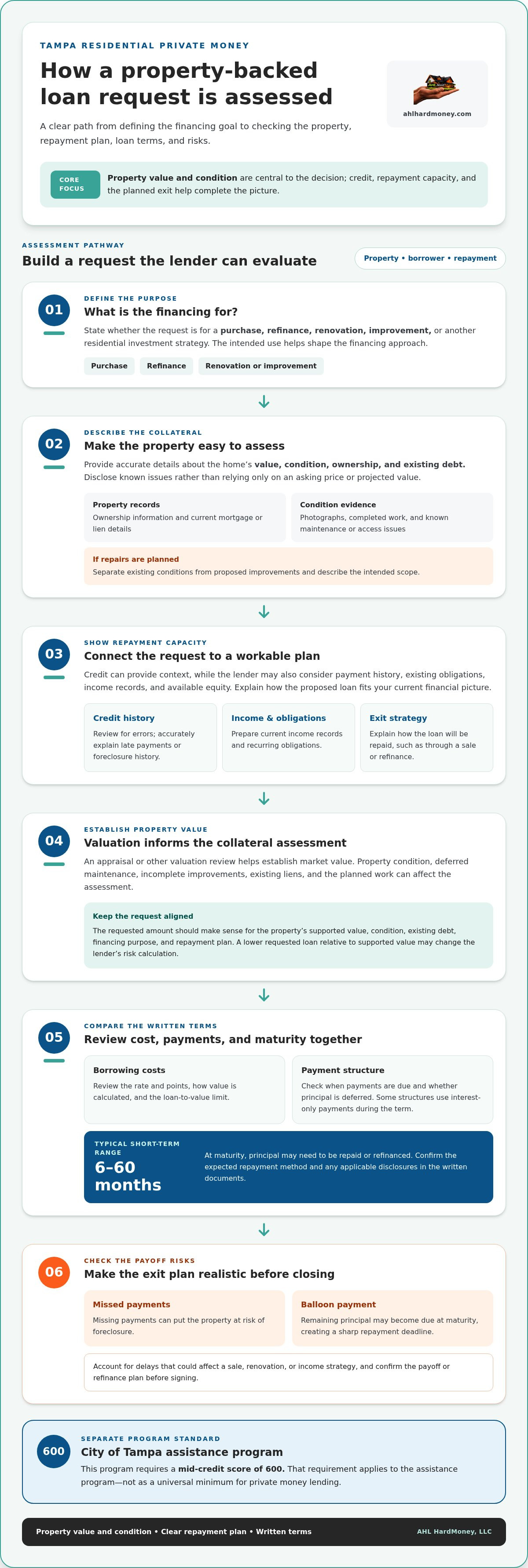
The property can matter more than a borrower’s credit profile. Tampa residential private money loans are typically short-term financing, with terms between 6 and 60 months; lenders primarily base credit decisions on the value and condition of the property securing the loan. That puts the home, its equity, and the repayment plan at the center of the discussion.
It’s understandable to want clear numbers before deciding whether Tampa residential private money fits your plans. This guide explains what can shape loan costs, what lenders may consider, and how your contribution affects the amount you need to bring to the transaction. You’ll also learn how cash-out refinancing works and how existing equity may support a new borrowing goal. The aim is to make the moving parts easier to assess so you can consider the property, financing structure, and repayment plan with a clearer picture.
Key Takeaways
- Understand how short-term property-backed financing works and which loan terms and costs to review before committing.
- Prepare to discuss the property’s value and condition, your repayment plan, and the financial documents a lender may consider.
- See how your contribution affects the amount you need to bring and how the property’s equity fits into the financing.
- Learn how cash-out refinancing can replace an existing mortgage and make some of the home’s equity available for another purpose.
- Explore when a cash-out refinance, home equity loan, or private money refinance may align with your financing goal.
What is a Tampa Hard Money Loan?
A Tampa hard money loan is short-term financing secured by real estate, with the property’s value and condition central to the decision. Tampa residential private money may suit borrowers whose purchase, refinance, or improvement plans need a property-focused financing approach.
Compare the written terms, collateral assessment, and repayment plan before weighing an offer.
For a step-by-step look at loan structure and documentation, watch this video:
Rates, Points, and Loan-to-Value Limits
A lender’s rate and points shape borrowing costs, while the loan-to-value limit affects how much financing the property may support. Review how the lender calculates value, including property condition, existing liens, and whether planned repairs affect the assessment. A lower requested loan relative to the property’s supported value may change the lender’s risk calculation.
Private money and hard money often describe property-secured financing, while bank loans and DSCR loans use different underwriting approaches. Compare the full repayment structure, not just the quoted rate.
Loan Terms and Qualification Criteria
Tampa hard money loans are typically short-term, with terms between 6 and 60 months. Some structures use interest-only payments during the term, leaving principal to be repaid or refinanced later. Check when each payment is due, whether principal is deferred, and what repayment method is expected at maturity.
Qualification centers on the property’s value and condition, along with the borrower’s repayment plan. Prepare property details, current lien information, and a clear exit strategy so the lender can evaluate the request.
Loan Amounts and Customized Financing
There is no single loan amount that fits every Tampa property. The lender considers collateral value, condition, existing debt, and financing purpose. The amount requested should make sense for both the property and the repayment plan. Explain whether the funds are for a purchase, refinance, renovation, or another residential investment strategy.
Residential properties may be considered for purchase, refinance, or improvement financing, with the property and intended use shaping the program. Investors should outline the planned work, how it affects the home, and how the loan will be repaid.
Florida Rules and Borrower Risks
Florida lending and licensing requirements depend on the loan structure, borrower occupancy, and transaction purpose. Loan documents should clearly identify the parties and collateral, explain repayment terms, and include applicable disclosures. Review the terms before signing, especially when a residential property secures the financing.
Missing payments can put the property at risk of foreclosure. A balloon payment can also create a sharp repayment deadline because the remaining principal may become due at maturity. Build a realistic payoff or refinance plan before closing, and account for delays that could affect a sale, renovation, or income strategy.
Credit, income verification, and appraisal requirements
For a Tampa residential loan, organize the application around three areas: credit history, repayment capacity, and property value. Private lenders may weigh these differently from banks, so present a clear picture of the borrower and the real estate securing the request.
Credit Review and Repayment Capacity
Credit can provide context, even when property value carries substantial weight in a private lending decision. A lender may review payment history, existing obligations, and recent credit events alongside the property’s condition and available equity. Explain any late payments or foreclosure history accurately, then show how the proposed loan fits your current obligations and repayment plan.
The City of Tampa assistance program has a separate standard: it requires a mid-credit score of 600. That requirement applies to that program, not as a universal minimum for private money lending. Keep the distinction clear when comparing financing routes, and avoid assuming a bank or assistance-program threshold automatically applies to a private loan.
Income verification helps connect the requested financing to a workable repayment strategy. Prepare current income records, recurring obligations, and a written explanation of how you plan to use the funds. For an investment property, outline expected operations and the planned exit, such as a sale or refinance. This helps the lender assess your financial picture alongside the collateral.
Property Appraisal and Documentation
An appraisal or other valuation review helps establish market value and informs the lender’s collateral assessment. Condition matters too: deferred maintenance, incomplete improvements, or uncertain access can affect how the property is evaluated. Provide accurate property details and disclose known issues rather than relying on an asking price or projected value alone.
Make the application file easy to assess. Gather ownership information, existing mortgage or lien details, property photographs, and records of completed work. If the home needs repairs, distinguish existing conditions from planned improvements and describe the intended scope clearly. This helps align the requested loan with the property being evaluated.
Preparing a Clear Application
Before applying in Tampa, match the requested amount to the property, existing debt, and repayment strategy. Review your credit report for errors, assemble income and obligation records, and collect property documents in one file. A concise explanation of the transaction helps the lender connect each document to the financing request.
If you’re facing foreclosure, organize the current loan status, notices received, and proposed payoff plan. Foreclosure refinance financing addresses a different situation from routine investment lending, so timing and the existing lien position matter. Present the facts plainly, including what must be resolved and how repayment will work.
Tampa-area private money lender listings
A Tampa private money lender search displayed zero results, so that listing view alone doesn’t identify local options. Treat directories as a starting point, then compare lenders using written terms and transaction details.
Available Tampa-Area Lender Options
With zero results displayed in that search, there isn’t a listing set to compare there. This doesn’t establish that Tampa has no private lenders; it means one directory isn’t a complete inventory. Real estate investors can broaden their search to lenders serving Florida and ask whether they consider the property type and financing purpose.
For each potential lender, record the legal business name, lending contact, property location served, and loan purpose considered. Keep these details together in a comparison sheet. An owner refinancing a rental home, for example, may need a different financing structure from an investor purchasing a property for renovation.
Verifying Lenders and Comparing Offers
Verify a lender’s identity before sharing sensitive financial documents. Match the business name on the written proposal with the name on the loan documents, and review who will fund the loan and hold the mortgage. Ask for an itemized term sheet stating the loan amount, rate, points, term, payment schedule, and maturity payoff.
Compare offers line by line, not by the advertised rate alone. A lower rate may come with different points, payment timing, or repayment terms. Check whether the proposed amount accounts for existing liens and whether the lender’s property valuation matches the transaction assumptions. Keep copies of every offer version.
Use a consistent review process for each listing:
- Confirm the fit: Note the property address, residential use, loan purpose, and requested amount.
- Read the repayment terms: Identify regular payments, maturity date, and any balloon balance.
- Review the collateral: Compare the lender’s valuation assumptions with the property’s condition and current debt.
- Check the documents: Make sure the written proposal and final loan papers describe the same transaction.
For example, two lenders may evaluate the same Tampa home but structure financing differently. Compare the total obligations through the expected payoff date, including how principal is repaid, rather than focusing on one figure. This helps homeowners assess whether the payment schedule fits the planned sale, refinance, or investment timeline.
Save the final offer, supporting records, and questions in one transaction file. A clear paper trail makes changes easier to spot before signing and helps real estate investors understand the commitment they’re taking on.
Borrower contribution requirements
Your contribution affects how much financing you need and how much equity remains in the property. For a Tampa private money loan, the lender considers the property, existing debt, requested amount, and transaction plan when assessing the funds you’ll bring.
How Contributions Work in Private Money Deals
For a purchase, your funds may cover the gap between the property price and loan proceeds, along with transaction expenses. For a refinance, the calculation can differ because existing mortgage debt and property equity shape the amount available. The structure depends on the loan request, collateral, and repayment plan.
Cash investors in Tampa pay an average of 67.5% of a home’s after-repair value. That market figure is context, not a required down payment or a universal private lending limit. After-repair value is an estimate tied to planned work, so investors should distinguish the property’s current condition from its projected condition and support the renovation plan with clear details.
Before making an offer, map out your funding sources and identify which funds are available for the purchase, repairs, and ongoing payments. Keep personal funds distinct from borrowed funds in your records. A clear breakdown shows how your contribution fits the transaction instead of leaving the lender to infer the source or use.
Separate Tampa Assistance Program Requirements
The City of Tampa assistance program has its own contribution rule for eligible buyers: at least $2,000, including at least $1,000 from the borrower’s own verifiable funds. This applies to the City program, not to private money loans generally. Don’t use that amount as a default contribution estimate for a private loan or another housing program.
If you’re comparing options, first identify which financing route applies. Then organize your contribution records according to that route’s rules. For the City program, document the required personal funds separately from other eligible contribution sources. For a private money purchase, focus on the proposed loan structure, property value, existing mortgage obligations, and funds available for the transaction.
Plan for the Full Payment Picture
Contribution planning shouldn’t stop at closing. A purchase or refinance also needs a repayment strategy that accounts for scheduled payments and the expected payoff. List available funds, planned property expenses, and the expected exit, such as a sale or refinance. If repairs are part of the plan, separate purchase funds from the improvement budget to keep the numbers clear.
Use this practical sequence: confirm the property’s current value and debt, calculate the funds you can document, then compare that amount with the proposed financing and expected payments. This gives Tampa borrowers a clearer view of the cash needed and the equity they’ll retain.
Cash-out refinance loans
A cash-out refinance replaces an existing mortgage with a new loan secured by the same property. The borrower uses part of the new loan to pay off the current mortgage, then receives any remaining proceeds after transaction obligations. For Tampa homeowners and investors, the key question is whether usable equity supports the goal and the new repayment plan.
How the Proceeds Are Determined
Start by identifying the property’s current value, mortgage payoff, and any other liens. The new loan must account for those obligations before proceeds can be released. The amount available also depends on the lender’s valuation, the property’s condition, and the proposed financing terms.
For example, an owner planning home improvements should separate the amount needed to complete the work from the funds required to pay existing debt. This clarifies the intended use and connects the request to the property’s value and repayment strategy. Equity is not the same as cash on hand; it must support a loan the borrower can repay.
Matching the Refinance to the Goal
Borrowers may use cash-out proceeds for a defined purpose, such as improvements, debt consolidation, or covering unexpected expenses. For instance, if sudden financial burdens stem from an injury or traffic crash, resources like Accident Lawyers Hotline can evaluate potential legal claims before homeowners commit to new property debt. Set out the intended use before comparing offers. A Tampa investor might use proceeds to prepare a property for sale, while a homeowner may prioritize repairs that protect the home’s condition.
Compare a cash-out refinance with a home equity loan by considering how each affects existing mortgage debt. A refinance replaces the current mortgage; a home equity loan generally adds another secured obligation. The right structure depends on the existing loan, the requested funds, and the borrower’s planned payments.
Plan the Repayment Before Closing
Cash-out financing can provide access to equity, but it also increases or restructures debt against the home. Review the payment schedule, term, maturity date, and payoff expectations together. If the loan has a balloon payment, identify how you’ll repay the remaining balance before signing.
Bridge loans may help investors address a temporary financing need, but they require a defined exit plan, such as a sale or refinance. Don’t base repayment solely on a hoped-for increase in property value. Consider what happens if renovations take longer, a sale is delayed, or refinancing terms change.
Prepare a Clear Loan Request
Before applying, gather the current mortgage statement, lien details, property information, and a concise budget for the planned use. Then compare written offers by total obligations and repayment structure, not just the proceeds. A clear file helps the lender assess the equity and the transaction as a whole.
For Tampa borrowers, the practical test is straightforward: connect the requested proceeds to a specific purpose, confirm the new payment fits your plan, and identify how the full balance will be repaid. That turns available equity into a deliberate financing decision rather than open-ended borrowing.
AHL HardMoney: Cash Out Refinance
AHL HardMoney, llc offers Cash-Out Refinance for homeowners seeking to use available property equity toward a defined financial goal. The process can replace an existing mortgage with new financing, with proceeds shaped by the property, current debt, and repayment plan. AHL HardMoney, llc also offers Home Equity Loans, Private Money Loans, and Foreclosure Refinance Loans for different financing needs.
Approvals are often completed within 30 minutes, and loans can close in 5 to 15 days, regardless of credit history. Review the proposed terms and repayment strategy carefully to understand how a refinance fits your situation. Explore the Cash Out Refinance option, then contact AHL HardMoney, llc to discuss your goals and next steps.
Make Your Next Move With a Clear Goal
A Tampa residential private money loan should support a clear financial objective, not simply unlock funds because equity is available. Before moving ahead, write down what the financing needs to accomplish, how the property supports the request, and what repayment path fits your broader plans. This preparation can make a complex decision a more focused conversation.
AHLHardMoney™ offers Cash-Out Refinance, Home Equity Loans, and Private Money Loans. These options address different financing needs, so frame your inquiry around the property, intended use of funds, and repayment approach. Keep your goal specific, and let the financing structure follow the need rather than the other way around.
Whether you’re planning a refinance or considering another use of home equity, take the next step with a clear purpose and room to ask direct questions. A thoughtful plan can help you assess the path ahead with confidence.
Your next financing decision can start with a practical goal and a conversation that moves you forward.
Frequently Asked Questions
What is residential private money lending in Tampa?
Residential private money lending uses real estate as collateral for financing arranged outside conventional bank lending. In Tampa, the property’s value, condition, existing debt, and intended use can shape the loan structure. Borrowers may consider it for a purchase, refinance, or property improvement. “Hard money” is often used for similar property-backed financing, though the written terms define the actual arrangement.
Which Tampa private money lenders finance residential real estate?
AHLHardMoney™ provides hard-money financing throughout Florida, including Tampa, Clearwater, Saint Petersburg, Palmetto, Largo, Newport Richey, Port Richey, Brooksville, Brandon, Orlando, Daytona, Napels, Ocala, Deltona, Deland, Jupiter, Palm Beach, Lakeland, and Boca Raton. Its focus counties are Hillsborough, Pasco, Pinellas, Polk, Manatee, Citrus, and Hernando Counties. A Tampa lender search displaying zero results doesn’t prove that no lenders operate locally. Compare written proposals and confirm that the lender’s legal name matches the loan documents.
What are current Tampa private money loan rates, fees, and points?
Rates and fees depend on the property, loan purpose, term, collateral, and repayment structure. A point is 1% of the loan amount (1 point = 1% of loan); 100 basis points = 1 point. The actual cost depends on the proposed loan and is provided after a quote request. Compare the rate, points, payment schedule, and payoff terms together, rather than judging an offer by one figure.
What loan-to-value and loan-to-cost ratios do Tampa private lenders offer?
There isn’t one universal loan-to-value or loan-to-cost ratio for Tampa private lending. Lenders assess the property’s supported value, purchase or improvement costs, existing liens, and condition. For a renovation, document the current property state and planned work separately; projected value alone doesn’t show the full financing picture. Compare how each offer calculates valuation and eligible costs, then check how much borrower funding the transaction requires.
What are typical credit, down payment, and experience requirements for Tampa private loans?
Private loan requirements vary by transaction rather than following one universal credit score or down payment threshold. Credit history can provide context, while property value, condition, available equity, and repayment strategy also matter. Organize proof of available funds and explain your planned contribution. Real estate experience can help clarify a project plan, but the property and proposed repayment method remain important parts of the request.
How quickly can a Tampa private money loan close, and what documents are required?
AHL HardMoney says loans can close in 5 to 15 days. To support the application, gather property documents, income verification, tax returns, and K-1s when applicable. A current mortgage statement and lien details can also help explain the property’s existing obligations. Organize the records around the transaction purpose, such as purchase or refinance, so the lender can connect the documents to the property and financing request.
How do Tampa private money loans compare with hard money, bank, and DSCR loans?
Private money and hard money often describe property-secured financing, with decisions centered on the property’s value and condition. Bank and DSCR loans use different underwriting approaches, so compare the full repayment structure, not just the rate.
Disclaimer:
While Dan is not a real estate attorney, he is a Full Time, Licensed Florida Mortgage and Real Estate Broker Professional coupled with 21+ years of successful strategies, methodologies and techniques that have proven effective to the benefit of Florida families.
While not every conversation is a deal, we promise to leave you better off then before you called. We serve everyone we come in contact, with the highest levels of integrity and dignity.
We invite you to make the call 📲


