


Article by
Dan Conneally - NMLS 339916, LO13164, BK3246524, CQ1072086
Dan Conneally has been successfully helping Florida families with thier real estate related situations for the last 21+ years, regardless of credit or past financial background.
While Dan is effective with institutional lending, he particuarly shines when matters require unique strategies involving noninstitutional resources.
Check out his legions of testimonials from real Florida families at Google, Facebook and the BBB to get a sense of the caliber and effectiveness he achieves. Dan has appeared on television speading the message of hope to good folks that need diligent, discrete, nonjudgy care.
What if the best funding path for a Tampa flip isn’t the one labeled “fix-and-flip”? The label alone won’t tell you whether the purchase price, renovation scope, and resale timeline make a workable deal. Finding private money for fix and flip Tampa starts with the project math and a credible plan to repay.
Property value, available equity, renovation costs, and resale timing all shape the financing picture. A delay or budget overrun can put pressure on repayment, so build a clear plan before pursuing funding.
This 2026 guide explains how to assess whether your Tampa project is financeable, compare funding structures, and prepare a concise deal summary, realistic budget, and exit strategy. You’ll also see how equity-based options, such as a cash-out refinance or home equity loan, differ from financing for a property purchase and renovation. AHL HardMoney provides real-estate-secured, asset-based financing in Florida, including home purchase and home improvement hard-money loans, as well as cash-out refinance and home equity loans. These options serve different purposes, so match the financing to the project.
Key Takeaways
- Assess private money for fix and flip Tampa by connecting the purchase, renovation plan, projected resale, and repayment path.
- Understand why “fix and flip” describes an investment strategy, not one universal financing structure.
- Compare purchase and improvement financing with options that use equity in a property you already own.
- Build a financing-ready project plan with property documents, a renovation scope, a budget, and a realistic timeline.
- Understand how AHL HardMoney’s Florida asset-based lending and real estate financing options can fit different investment needs.
Private Money for a Tampa Fix and Flip: What the Financing Can Mean
Searching for private money for fix and flip Tampa can lead to different kinds of financing, not one standard loan. Private money generally means non-institutional financing secured by real estate. It isn’t a gift with no repayment obligation. Unlike an unsecured personal loan, the property may serve as collateral. The structure, repayment terms, and eligible uses depend on the specific financing arrangement.
“Fix and flip” describes an investment strategy: acquire a property, improve it, then sell it. It doesn’t name a universal loan structure. As What is Real Estate Flipping? explains, a flip’s outcome can depend on the renovation and resale process. Consider financing needs alongside the project plan.
For a general overview of how investors approach this kind of financing, watch the video below.
What does private money for a fix and flip usually refer to?
It’s a broad category, not a promise that financing will cover every project expense. Real estate collateral can factor into a lender’s assessment, but the property is only one part of the picture. Purchase basis, condition, renovation scope, projected resale, borrower experience, and repayment plan can all affect how financing fits a deal.
Asset-based lending considers real estate equity and property value as part of a financing decision. For example, two investors may target similar properties but need different structures because one is buying and renovating, while the other already owns a property with equity. Investment-property financing also differs from financing for an owner-occupied home. Intended use and occupancy matter, so represent your plans accurately and review the applicable terms.
How is a flip loan different from equity-based financing?
Purchase and rehabilitation financing is a broad market category intended to address a property acquisition and renovation as parts of an investment project. Structures can vary, including how funds are allocated and how repayment is planned. AHL’s HardMoney Home Purchase is a purchase financing option, while its home improvement hard-money loans address improvement financing. These options have different purposes.
Cash-out refinance follows a different route. It involves refinancing a property already owned and accessing equity, rather than financing the purchase of a new flip. AHL offers cash-out refinance as a distinct financing option. Home equity loans and private money refinance are also separate categories, not interchangeable labels for a single flip loan.
Start by identifying what needs funding: acquisition, improvements, or equity already held in a property. Then match that purpose to a financing structure and map out a realistic repayment route, such as a sale or refinance. That clarity turns a broad search into a project-specific financing plan.
How Tampa Private Lenders May Assess a Fix-and-Flip Deal
A financing proposal is easier to evaluate when the numbers tell one connected story. The purchase basis, current condition, renovation scope, and projected resale value should support each other. A high acquisition price or extensive repairs can leave less room for delays and unexpected work. A lender may also consider the property’s collateral value, available equity, borrower experience, and expected repayment. Criteria vary, so treat these as possible assessment factors rather than universal approval rules.
For a useful overview of the sector, Understanding Private Real Estate Lending offers broader context on private financing and real estate projects. For your own proposal, make assumptions visible, distinguish evidence from estimates, and show how the project is intended to repay short-term financing.
Which property and project details should an investor organize?
Give the deal a clear starting point. Note the property address and type, whether you’ve acquired it or are pursuing a purchase, its current condition, and the renovation scope. Then connect each planned improvement to a realistic schedule and budget. Specifics help explain the project more clearly than a broad description such as “needs updating.”
- Scope: Describe planned work by area or trade, and separate essential repairs from optional upgrades.
- Budget: Itemize expected costs, include contractor estimates where available, and state how you’ve allowed for contingencies.
- Milestones: Map key stages, such as closing, work beginning, major renovation phases, completion, and sale preparation.
- Value evidence: Organize comparable sales and explain how each relates to the property. Keep verified sale information separate from your projected resale price.
This is where private money for fix and flip Tampa becomes a project-specific question. The property may provide collateral, but a coherent budget and defensible resale assumptions help explain how the requested financing relates to the proposed exit.
Why do exit strategy and Tampa property risks matter?
A documented exit plan explains how a short-term real estate financing proposal is intended to repay and identifies assumptions that could affect repayment. A sale may be the planned route; refinancing may be another possibility, depending on the property and future financing. Neither is a guaranteed outcome. Include the time and carrying expenses that could apply while work is underway or the property is being prepared for sale.
Make the risk review property-specific. Check current flood exposure, insurance availability, permitting needs, and comparable sales for the particular location and renovation. Also account for holding time, taxes, utilities, insurance, and sale preparation. These details can affect feasibility and timing, so a favorable resale estimate is not a substitute for due diligence.
A well-organized project file helps focus the financing conversation. To understand AHL HardMoney’s broader approach, explore AHL HardMoney, llc’s background and lending approach.
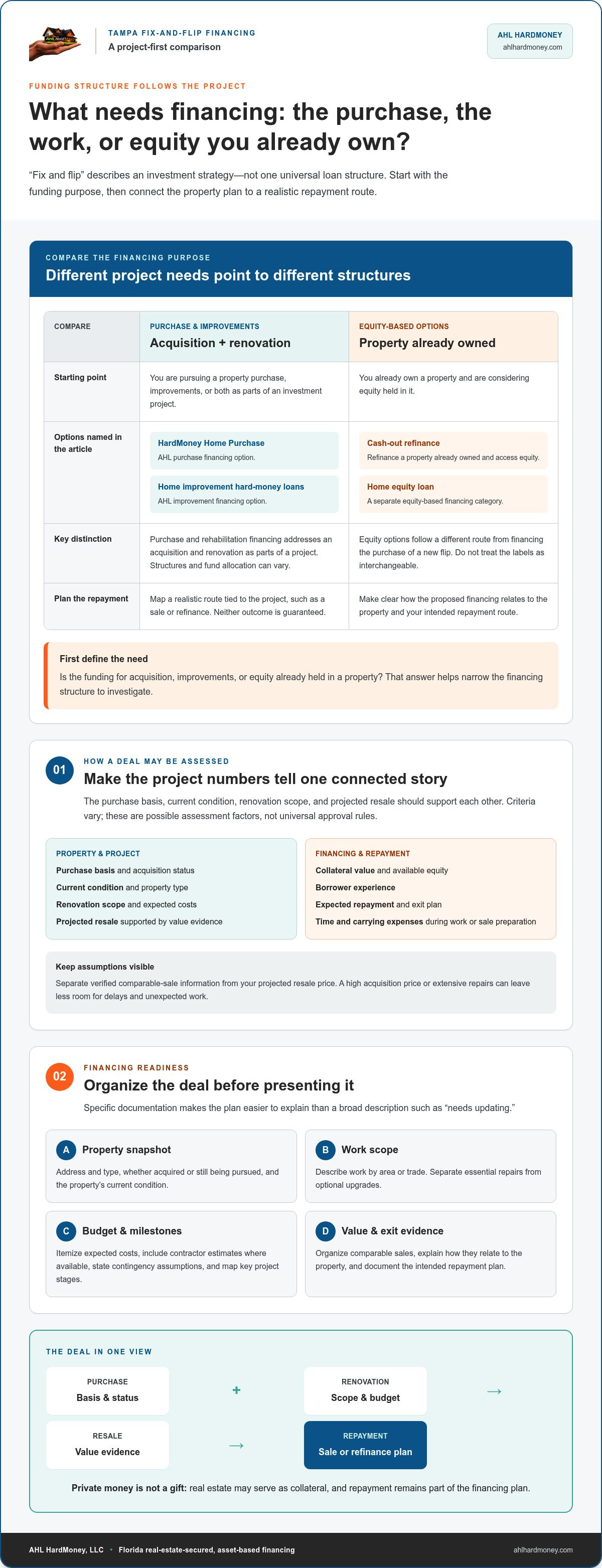
Comparing Private Money Structures for a Tampa Fix and Flip
The right comparison starts with purpose, not a loan label. A project that needs funds to acquire a property is at a different stage from one where the investor already owns a property and wants to use its equity. The phrase “private money for fix and flip Tampa” can point to either situation, but the financing structures are not interchangeable.
Purchase-and-rehabilitation financing versus equity-based options
Purchase and rehabilitation financing is a broad market category for projects where acquisition and renovation are connected. Details vary, including how the purchase and improvements are funded and how repayment is structured. AHL offers hard-money home purchase and home improvement hard-money loans as separate financing options for these distinct needs.
Equity-based options start from a different position: the borrower already owns a property with equity. A cash-out refinance replaces an existing mortgage and may allow the borrower to access equity, while a home equity loan uses the value in an owned property as the basis for financing. AHL’s home equity loans relate to this existing-property equity route, rather than automatically funding a new purchase and renovation.
| Financing structure | Purpose and ownership stage | Possible repayment concept |
|---|---|---|
| Purchase-and-rehabilitation financing | For an acquisition-stage project that includes planned improvements; availability and structure vary across the market. | May be planned around selling the renovated property or another defined repayment route. |
| Cash-out refinance | For a property the borrower already owns, with equity accessed through refinancing. | Repayment follows the refinance terms; funds may support a separate investment, subject to the financing’s permitted use. |
| Home equity loan | For an owner using equity in an existing property, rather than financing the purchase of the flip itself. | Repayment follows the loan terms and remains tied to the existing-property financing. |
| Home-improvement financing | For improvements to a property; this purpose alone doesn’t establish that it suits an investment flip. | Depends on the financing structure and permitted use. |
The distinction matters. A home-improvement loan and investment-property flip funding may both relate to renovation, but that overlap doesn’t make their intended uses, collateral, or repayment structures equivalent. Match the purpose of the funds to the property’s ownership stage and the specific work being planned.
What should the comparison reveal beyond speed?
A faster or more flexible label doesn’t automatically make financing suitable. Compare the property offered as collateral, permitted uses of funds, repayment structure, and fit with the project stage. Don’t rank options by speed alone. A schedule only helps if the financing purpose and repayment plan align with the deal.
For broader context on Florida asset-based financing, see this Florida asset-based financing guide. Use it alongside a side-by-side comparison of what the project needs, what property supports the financing, and how repayment is intended to work.
A Tampa Fix-and-Flip Financing Readiness Checklist
A well-prepared financing request makes it easier to see how the property, renovation plan, and repayment strategy fit together. Use this process to assemble a clear project file before pursuing private money for fix and flip Tampa. Keep confirmed facts separate from estimates, and explain how your plan could adapt if costs or timing change.
Prepare a clear deal and renovation file
Start with the project, then organize the supporting documents. A concise, transparent file gives the financing conversation a practical foundation and helps identify gaps early.
- Summarize the deal. Record the property address and type, acquisition status, current condition, intended renovation, and specific purpose of the funds. State whether you’re seeking financing for a purchase, improvements, or equity in a property you already own.
- Gather property records. Organize available ownership and valuation documents, property details, and insurance information. Note what’s current, what’s pending, and what still needs verification rather than presenting incomplete records as final.
- Document the work and budget. Break the renovation into clear tasks and assemble contractor estimates where available. Use a line-item budget, identify contingency assumptions, and separate confirmed figures from allowances or early estimates.
- Build a realistic schedule. Map the project through acquisition, work milestones, completion, and sale preparation. For Tampa-area due diligence, review comparable sales relevant to the property and verify current flood exposure, insurance availability, and permit requirements for the specific address and planned work. If the property is in or near Pasco County, the Pasco County lending guide offers additional regional context.
Stress-test the budget and repayment plan
A plan should account for what might change, not just the smoothest path. Consider how a longer renovation or resale period could affect the project, and identify the decisions you’d face if the original exit strategy no longer fits.
- Review the carrying plan. Include expected holding time and account for expenses such as insurance, taxes, utilities, and sale preparation. Consider how a delay or change in renovation scope could affect both the budget and timeline.
- Set out the intended exit. Identify whether repayment is planned through selling the renovated property or pursuing a refinance. Explain the assumptions behind that route without treating a projected sale or future financing as guaranteed.
- Align financing purpose with the property stage. Match the request to the actual need: acquisition, improvements, or existing-property equity. A purchase, home-improvement financing, and equity-based route serve distinct purposes, so explain why the structure you’re pursuing fits your project.
Once the file is assembled, review it as a whole. Do the budget, schedule, property evidence, and repayment plan support the same project story? For properties in Tampa, confirm location-specific details using current information before relying on assumptions.
Explore AHL HardMoney for a Tampa Investment Financing Plan
AHL HardMoney, llc is a privately owned, non-institutional lender headquartered in Tampa and serving borrowers throughout Florida. For investors considering private money for fix and flip Tampa, its real-estate-secured, asset-based lending approach considers property equity as part of the financing picture. AHL offers hard-money home purchase, home improvement hard-money loans, cash-out refinance, home equity loans, and private money refinance. Each option serves a distinct purpose, so align the financing request with the property, intended use of funds, and repayment plan.
Where AHL’s Florida lending approach may fit the discussion
AHL HardMoney, llc considers real estate equity in its lending approach, framing financing around the property as well as the borrower’s plan. Its financing categories include cash-out refinance, home equity loans, private money refinance, home improvement hard-money loans, and hard-money home purchase. These are distinct options, each tied to its own purpose and property circumstances.
For an investor who already owns real estate, cash-out refinance or a home equity loan can be relevant to a discussion about existing property equity. These options differ from financing a new investment property purchase and its renovation. A hard-money home purchase is a purchase financing option, while home improvement financing relates to improvements. Match the financing purpose to the actual need.
What to bring into a financing conversation
Come prepared with a clear picture of the project and the property supporting it. A concise summary helps focus the discussion on whether an equity-based or other real-estate-secured financing route aligns with your plans. Include relevant documents and be straightforward about assumptions, open questions, and risks.
- Property: Share the address, property type, ownership or acquisition status, current condition, and available valuation or ownership records.
- Project purpose: Explain whether funds are intended for a purchase, renovation, refinance, or another defined use. Include the renovation scope and supporting budget details when applicable.
- Equity position: Describe the property equity relevant to the request and provide available information about existing financing secured by the property.
- Repayment plan: State the intended repayment source, such as sale or refinance, and explain the assumptions behind the timeline. Identify unresolved risks, possible delays, and decisions you may need to make if the original exit changes.
AHL HardMoney offers fast approvals, often within 30 minutes, and can close loans in 5 to 15 days, regardless of credit history. The financing structure and project details shape the process, so bring a clear account of the property, intended use, and repayment path. AHL serves borrowers throughout Florida, including Tampa, Clearwater, Saint Petersburg, Palmetto, Largo, Newport Richey, Port Richey, Brooksville, Brandon, Orlando, Daytona, Napels, Ocala, Deltona, Deland, Jupiter, Palm Beach, Lakeland, and Boca Raton.
Turn Your Project Plan Into a Confident Next Step
Before moving ahead, decide what would make the project viable for you and what conditions would prompt you to pause or revise the plan. Set practical checkpoints for renovation and resale timing. That way, a delay or change in scope becomes a reason to reassess, not a surprise you haven’t planned for.
Your next step in exploring private money for fix and flip Tampa is to match the financing purpose to the property and your repayment plan. Keep project assumptions visible, including what still needs verification, and use them to guide a focused financing conversation. AHL HardMoney, llc’s NMLS ID is 380601.
A clear plan won’t remove every uncertainty, but it can help you make decisions with more confidence and keep the project grounded in your goals.
Explore AHL HardMoney’s Florida lending options and bring your Tampa fix-and-flip project plan into a focused financing conversation.
Frequently Asked Questions
Can I use private money to buy and renovate a Tampa investment property?
Potentially, but the financing must match both the purchase and renovation needs. Across the market, some private financing is structured for acquisition and improvements, while other options address a purchase or property equity separately. For a Tampa project, outline the property, proposed work, and intended use of funds before comparing structures. AHL offers hard-money home purchase and home improvement hard-money loans for these distinct financing purposes.
How do private lenders evaluate a Tampa fix-and-flip project?
Private lenders may consider the property’s value and condition alongside the purchase basis, renovation plan, borrower experience, and repayment approach. A project with a detailed scope and comparable-sale support presents a clearer case than one based only on an optimistic resale estimate. Criteria differ by financing structure, so organize your evidence and explain which assumptions are confirmed and which are still being tested.
What documents should I prepare before seeking fix-and-flip financing?
Gather available property and ownership records, acquisition details, valuation information, insurance documents, contractor estimates, and a line-item renovation budget. Add a schedule showing major work phases and when you expect to prepare the property for sale or refinance. Label estimates clearly. If permits, insurance, or property-condition questions remain unresolved, include them as open items rather than treating them as settled facts.
Is private money for a fix and flip different from a cash-out refinance?
Yes. Purchase and rehabilitation financing is a broad category associated with buying and improving an investment property. A cash-out refinance relates to a property you already own: refinancing may provide access to equity, subject to the financing terms and assessment. The two serve different purposes. For private money for fix and flip Tampa, identify whether your project needs purchase funds or financing connected to existing property equity.
Can a Tampa property’s flood risk affect a fix-and-flip financing plan?
It can affect project planning because property-specific flood exposure may relate to insurance, renovation decisions, carrying costs, and timing. Check current information for the exact address instead of relying on a neighborhood-wide assumption. Include unresolved insurance or flood-risk questions in your project file, and account for how they could change the budget or schedule before settling on a resale plan.
How should I plan an exit strategy for a Tampa fix-and-flip loan?
Choose a primary repayment route, usually a planned sale or a potential refinance, then document the assumptions behind it. Include the time needed for renovation, sale preparation, and marketing, plus ongoing property expenses during the hold. Consider what decisions you’d make if work takes longer or the original exit changes. A backup plan is a contingency to evaluate, not a guaranteed source of repayment.
Does AHL HardMoney offer a dedicated fix-and-flip loan in Tampa?
AHL HardMoney offers hard-money home purchase, home improvement hard-money loans, cash-out refinance, and home equity loans. These options address distinct financing purposes for property purchases, improvements, and existing property equity. Its real-estate-secured, asset-based approach can inform a project-specific financing discussion. AHL is headquartered in Tampa and serves Florida borrowers in Clearwater, Saint Petersburg, Brandon, Orlando, Lakeland, Ocala, and other communities across the state. NMLS ID 380601.
Disclaimer:
While Dan is not a real estate attorney, he is a Full Time, Licensed Florida Mortgage and Real Estate Broker Professional coupled with 21+ years of successful strategies, methodologies and techniques that have proven effective to the benefit of Florida families.
While not every conversation is a deal, we promise to leave you better off then before you called. We serve everyone we come in contact, with the highest levels of integrity and dignity.
We invite you to make the call 📲


