


Article by
Dan Conneally - NMLS 339916, LO13164, BK3246524, CQ1072086
Dan Conneally has been successfully helping Florida families with thier real estate related situations for the last 21+ years, regardless of credit or past financial background.
While Dan is effective with institutional lending, he particuarly shines when matters require unique strategies involving noninstitutional resources.
Check out his legions of testimonials from real Florida families at Google, Facebook and the BBB to get a sense of the caliber and effectiveness he achieves. Dan has appeared on television speading the message of hope to good folks that need diligent, discrete, nonjudgy care.
A strong property can matter more than a perfect credit profile. Private money home loans in St. Petersburg are typically short-term loans secured by real estate, with the property’s value and potential playing an important role in the lending decision.
If you’re considering hard money, it’s natural to want clear answers about how it works, where to find lending options in St. Petersburg, and what trade-offs to weigh. These loans may suit time-sensitive real estate plans, but the financing structure should match the property and your intended repayment strategy.
This guide explains hard money loans and how private lending differs from conventional financing. You’ll also learn what to consider when exploring investor loans and how cash-out refinancing can let you use property equity. The aim is to help you connect your real estate plans with financing options that may fit.
Key Takeaways
- Understand how collateral, property value, and loan-to-value limits shape hard money financing for a St. Petersburg property.
- Learn what lender availability in the area may mean for finding financing that fits your real estate plans.
- Identify the project details and repayment strategy to consider before using an investor loan.
- See how private lending differs from other financing and when a shorter-term loan may fit.
- Explore how private money refinance, cash-out refinance, home equity loans, and foreclosure refinance loans may address different needs.
What is Hard Money Loan?
Hard money financing is a loan secured by real estate. In St. Petersburg, lenders may give significant weight to the collateral and the project, rather than relying mainly on credit scores and debt-to-income ratios.
Loan-to-Value Limits and Reserves
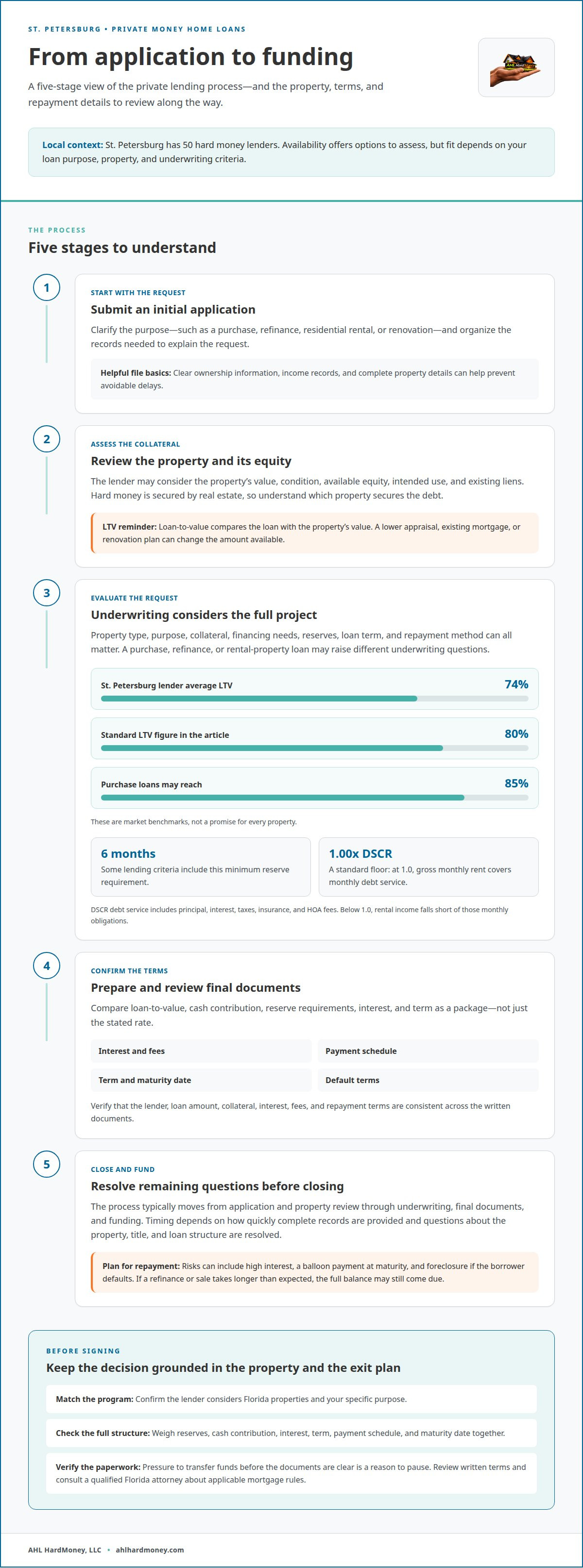
Loan-to-value (LTV) compares the loan with the property’s value. St. Petersburg lenders average 74% LTV, while purchase loans may reach 85%, with 80% a standard figure. These are market benchmarks, not a promise for every property. A lower appraisal, existing mortgage, or renovation plan can change the amount available.
Reserves can matter as well. Some lending criteria include a six-month minimum reserve requirement, providing a buffer for carrying costs and debt service. Before accepting an offer, compare the loan-to-value ratio, cash contribution, reserve requirement, interest, and term as a package. A larger loan can still strain cash flow if repayment depends on a quick sale.
Rental financing may also use debt-service coverage ratio (DSCR). The calculation divides gross monthly rental income by monthly debt service, including principal, interest, taxes, insurance, and HOA fees. A standard DSCR floor is 1.00x. At 1.0, rent covers those monthly obligations; below that level, income falls short. For example, a St. Petersburg rental projected to break even has a 1.0 DSCR, so operating costs and achievable rent affect qualification.
Florida private lenders may assess a request based on collateral value, property condition, financing needs, and intended use. A purchase, refinance, or rental-property loan can raise different underwriting questions. When comparing options, consider property type, purpose, collateral, loan-to-value approach, reserves, term, and repayment method, not just the stated interest rate.
Secured and Unsecured Eligibility
Hard money loans are secured by real property, so the lender evaluates the asset and its equity. The mortgage or other security interest gives the lender a claim against the property if repayment fails. Borrowers should understand which property secures the debt and how existing liens affect available equity. A home equity loan also uses property equity, though its terms and underwriting may differ.
An unsecured loan has no real estate collateral, so it is not a hard money mortgage. Eligibility for that type of loan depends on separate underwriting criteria, not a property’s loan-to-value ratio. Keep the distinction in mind when comparing financing options.
Florida licensing and legal requirements can depend on the lender, borrower, property, and loan purpose. Before signing, review the written terms and consult a qualified Florida attorney about how applicable mortgage rules affect your transaction.
Risks can include high interest, a balloon payment at maturity, and foreclosure if the borrower defaults. Review the due date, payment schedule, default terms, and a realistic exit plan. If a refinance or sale takes longer than expected, the full balance may still come due.
To reduce scam risk in St. Petersburg, verify the lender’s legal identity and review the written loan documents before paying or signing. Check that the lender, loan amount, collateral, interest, fees, and repayment terms are consistent across the documents. Pressure to transfer funds before the paperwork is clear is a reason to pause.
Hard money lender availability in St. Petersburg
St. Petersburg has 50 hard money lenders, giving property owners multiple financing options to assess. Availability alone doesn’t determine fit; loan purpose, property type, and underwriting criteria shape the search.
Lender Underwriting and Programs
Start by matching the loan purpose to the lender’s program. A purchase, refinance, residential rental, or renovation may call for different property details and repayment plans. Underwriting may consider the property, its condition, available equity, and intended use. Program descriptions can help clarify which requests a lender considers.
Ask how the loan is funded and what steps remain before closing. The process typically moves from an application and property review to underwriting, final documents, and funding. Missing income records, unclear ownership, or incomplete property information can delay a decision. A complete, well-organized file helps the lender assess the request.
St. Petersburg Lender Listings
Directories can help organize St. Petersburg options, but a listing alone doesn’t show whether a lender handles your project. Compare options by loan purpose, residential-property experience, collateral requirements, and stated underwriting approach. Distinguish lenders that finance purchases from those focused on refinancing or rental properties.
Use a listing as a starting point, then compare the written terms. Review the interest, payment schedule, term, and maturity date together. For a rental loan, weigh the structure against expected rent and operating expenses. These details help show whether the financing matches the property’s intended role.
A Florida lender may serve St. Petersburg without having a local office. Local lenders may know area property conditions, while nationwide private lenders may offer programs across multiple markets. Neither label determines whether a loan is suitable. Confirm that the lender considers Florida properties and your specific purpose, such as a residential purchase or rental refinance.
What are the steps and typical timeline to get a private home loan in St. Petersburg? The process includes an initial application, property and collateral review, underwriting, document preparation, and closing. Timing depends on how quickly complete records are provided and questions about the property, title, and loan structure are resolved.
For example, an investor seeking rental funding can organize the search around three filters: property location, rental use, and refinance or purchase purpose. Then compare which lenders review that combination and what underwriting details they request. This focused approach is more useful than treating all 50 available lenders as interchangeable.
A St. Petersburg borrower can also consider whether the need is tied to existing equity, a property expense, or a refinance. Those distinctions point toward different private financing structures. To explore the local perspective behind these options, review St. Petersburg lending background.
Hard money loans for St. Petersburg real estate investors
For investors, the key question is whether the loan fits the property and planned exit. St. Petersburg opportunities range from long-term rentals to renovation projects and short-term rental properties.
Investor Loan Options
Private financing can support a property purchase, refinance, renovation, or rental investment. The loan purpose shapes the underwriting: a purchase centers on acquisition and property condition, while a refinance also considers existing debt and equity. St. Petersburg hard money loans made to investors average around 10.6% interest, so include financing costs in the project plan.
Before closing, map out a clear repayment route. Investors may plan to sell after improvements, refinance into longer-term financing, or use rental income to support repayment. A realistic timeline matters: a short-term loan can become difficult to repay if repairs or leasing take longer than expected.
Property Types and Loan Purposes
St. Petersburg private lenders offer financing secured by real estate. Investors may seek funds to acquire a property, make improvements, refinance, or finance rental real estate. The property type and loan purpose determine which details underwriting considers, including condition, intended use, equity, and repayment plan.
A single-family rental may be assessed differently from a small multifamily property or a home that needs work. Explain whether you plan to use the property as a term rental, a short-term rental, or a resale after renovation. These details affect projected income, repair planning, and repayment timing.
Neighborhood economics can help investors assess whether an opportunity fits. These are market figures, not a forecast for an individual property.
Other areas offer different starting points. Compare the purchase plan with likely rents and the property’s condition.
For short-term rental plans, location and season can shape projected revenue. Treat those figures as market context, then assess the specific property’s operating plan.
Real estate investors can organize a deal before applying by documenting the purchase or refinance purpose, property condition, improvement scope, and exit strategy. For renovations, connect each planned improvement to the property’s intended use. For rentals, base projected income on the rental model and location, not solely on the highest seasonal rate.
Equity also affects a project’s flexibility. When refinancing an owned property, account for existing debt and the funds needed for the next step. For a purchase, align the loan term with renovation, leasing, or sale milestones. Connecting the property, purpose, and repayment plan helps keep financing decisions grounded.
Private hard money lending in St. Petersburg
Private lending gives St. Petersburg property owners another route to secured real estate financing. It focuses on the property, loan purpose, and repayment plan. The practical takeaway is to assess the full loan structure, not just the speed of funding.
Hard money loans are generally short-term, and St. Petersburg’s median offered term is 17 months. That makes the exit strategy central to the decision. A purchase followed by renovation and resale needs a different repayment timeline from a multifamily property held for rental income. Map expected work, leasing, sale, or refinance milestones against the loan’s maturity date.
Private funding may support a purchase or refinance, but the property and intended use shape the review. For a purchase, the lender assesses the asset being acquired and the transaction plan. For a refinance, existing debt and available equity help determine the structure. A multifamily request may also need a clear explanation of unit use, current condition, and the borrower’s operating plan.
The word “private” describes the lending source, not an automatic approval or a single underwriting formula. A hard money lender still needs to understand the collateral, ownership, transaction, and repayment route. Present those details together: identify the property, explain the purpose, outline planned work, and describe how you expect to repay. Gaps between the stated purpose and the documents can slow the review.
Before accepting terms, trace the loan from closing through payoff. Identify the payment schedule, maturity date, and any balloon payment, then account for likely delays in your exit plan. Renovations may uncover additional work, a rental may take time to reach its operating plan, and a sale may take longer than projected. Understand how each scenario could affect repayment.
Private lending also requires careful attention to the written terms. Compare the amount advanced, interest structure, term, collateral, and payoff conditions as one package. For example, with a St. Petersburg multifamily purchase, a lower payment alone doesn’t make a loan a better fit if the maturity date arrives before the property can support repayment.
Prepare a concise deal file before moving toward closing. Include the purchase or refinance purpose, property information, ownership details, planned improvements, and exit strategy. Keep the timeline consistent across the application and supporting documents. A clear package helps the lender assess the transaction on its merits.
The clearest takeaway is to match private funding to a defined property plan. A short-term secured loan may fit a purchase, renovation, or refinance when you understand its maturity and payoff route. If your plan depends on a long-term hold without a defined repayment source, reconsider the structure carefully before signing.
What are private money home loans in St. Petersburg, Florida?
Private money home loans are real estate loans funded by private lenders and secured by property. In St. Petersburg, borrowers may consider them for a purchase, refinance, or property-related financing need. The central question is how the loan purpose, property, and repayment plan fit together.
Think of the financing as a sequence, not just a loan amount. First, identify the property and the purpose of the funds. Next, establish what the lender will review, including ownership, condition, and existing debt. Then connect the proposed financing to a repayment path, such as a sale, refinance, or rental operation. Each step helps define the transaction.
A purchase loan and a refinance serve different purposes. A purchase loan supports an acquisition, while a refinance replaces or restructures debt tied to a property you already own. For example, a St. Petersburg owner with substantial equity might explore refinancing to address a planned property expense. The intended use of funds and existing mortgage obligations shape the request.
Private money financing may also address specific property needs. A renovation plan may require funding for improvements before a home is sold or rented. A borrower facing property-related tax obligations may consider financing secured by real estate. Whatever the purpose, explain the property, intended use, and repayment plan in the application.
These loans are secured by real estate, so the property is central to the transaction. That differs from borrowing without collateral. In practice, the lender reviews the asset as well as the proposed financing structure. Understand which property secures the loan and how the documents describe repayment and maturity.
For St. Petersburg homeowners, equity can be relevant when considering a home equity loan or private money refinance. Equity is the portion of the property’s value remaining after existing debt is accounted for. Available financing depends on the property and proposed loan structure. A clear summary of existing liens and intended use helps frame the request.
Before moving toward closing, organize the essentials in one file: property address, ownership, current mortgage information, loan purpose, and repayment plan. For a refinance, explain how the new loan relates to existing obligations. For an improvement project, describe the work and how it supports the property’s intended use. This gives the transaction a clear, consistent basis for review.
Private money financing may suit borrowers whose property-based plans need a different structure from conventional mortgage underwriting. It is not a substitute for a repayment plan. Connect the property, financing purpose, and exit strategy before choosing terms.
AHL HardMoney, llc: Private Money Refinance
AHL HardMoney, llc helps St. Petersburg property owners explore Private Money Loans and Refinance Loans when existing mortgage financing no longer fits their plans. Cash-Out Refinance and Home Equity Loans may suit needs involving available equity. Foreclosure Refinance Loans address a different situation: refinancing when foreclosure concerns are part of the borrower’s circumstances.
Approval is often within 30 minutes, and loans can close in 5 to 15 days, regardless of credit history. The next step is to clarify the property, the reason for refinancing, and the repayment plan. Those details help connect your situation with a relevant option for private money home loans St Petersburg.
Choose a Financing Path That Fits Your Next Move
Your next step is to turn your real estate goal into a clear financing plan. Decide what the property needs to support, what outcome you’re working toward, and how repayment fits the timeline. Those choices help focus a conversation about private money home loans in St. Petersburg on the details that matter to you.
AHLHardMoney™ offers Private Money Loans, Cash-Out Refinance, and Home Equity Loans. Bring the property details, financing purpose, and intended repayment approach to the discussion. A clear starting point helps you explore which direction may fit.
You don’t need to have every detail resolved before taking the next step. Start with the property and the decision in front of you, then build a plan from there.
Start with a focused conversation about your property goals and the financing options that may fit.
Frequently Asked Questions
Which private money lenders offer home loans in St. Petersburg, FL?
AHLHardMoney™ provides hard money financing throughout Florida, including St. Petersburg. Its service area also includes Tampa, Clearwater, Palmetto, Largo, Newport Richey, Port Richey, Brooksville, Brandon, Orlando, Daytona, Napels, Ocala, Deltona, Deland, Jupiter, Palm Beach, Lakeland, and Boca Raton. Homeowners and investors can consider the company for Purchase Loans or Refinance Loans. The suitable structure depends on the property and the borrower’s purpose.
What down payment and credit score are required for a private money home loan in St. Petersburg?
There isn’t one down payment or credit-score threshold that applies to every private loan. The required cash contribution depends on the property, its value, existing debt, and the loan structure. AHLHardMoney™ accepts any credit profile and offers “No Hard Credit Inquiry.” The property and intended financing purpose shape the terms presented for review.
How do private money home loans compare with hard money loans and conventional mortgages in Florida?
Private money loans and hard money loans often describe similar property-backed financing, though lenders may use the terms differently. Both may focus on real estate collateral and a defined repayment plan. Conventional mortgages typically place more emphasis on borrower credit and debt-to-income measures. Compare the full structure: funding purpose, property security, underwriting, repayment schedule, and maturity. Those terms show whether the financing fits your plan.
Disclaimer:
While Dan is not a real estate attorney, he is a Full Time, Licensed Florida Mortgage and Real Estate Broker Professional coupled with 21+ years of successful strategies, methodologies and techniques that have proven effective to the benefit of Florida families.
While not every conversation is a deal, we promise to leave you better off then before you called. We serve everyone we come in contact, with the highest levels of integrity and dignity.
We invite you to make the call 📲


