


Article by
Dan Conneally - NMLS 339916, LO13164, BK3246524, CQ1072086
Dan Conneally has been successfully helping Florida families with thier real estate related situations for the last 21+ years, regardless of credit or past financial background.
While Dan is effective with institutional lending, he particuarly shines when matters require unique strategies involving noninstitutional resources.
Check out his legions of testimonials from real Florida families at Google, Facebook and the BBB to get a sense of the caliber and effectiveness he achieves. Dan has appeared on television speading the message of hope to good folks that need diligent, discrete, nonjudgy care.
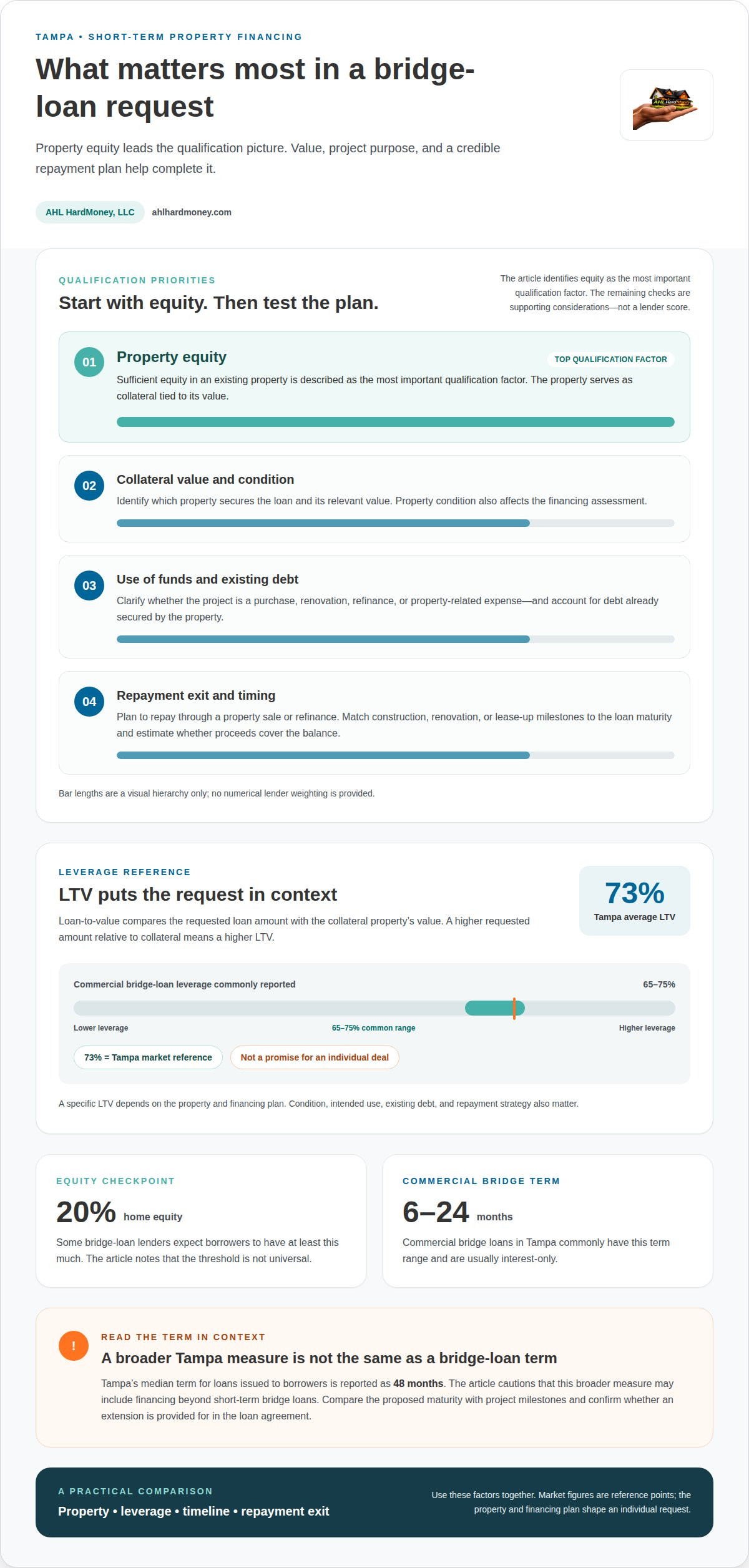
A hard-money loan may be the bridge loan you need: the terms describe different things, and the financing can overlap. For Tampa projects, the reported average loan-to-value ratio is 73%; commercial bridge loans commonly offer leverage of roughly 65-75%, depending on the deal. That gives you a useful starting point when comparing Tampa bridge loan lenders, but the property and financing plan matter too.
When a purchase, renovation, or refinance is time-sensitive, it’s natural to focus on speed and how much you can borrow. The right financing also depends on the project and how you plan to repay the loan. This guide explains how Tampa bridge loan lenders approach short-term property financing, what to consider about loan size and repayment, and how AHL HardMoney, llc serves Florida property owners.
You’ll find practical guidance on comparing hard-money financing, understanding loan-to-value (LTV), and planning an exit. Use these steps to decide whether short-term financing fits your project and what information to prepare for a conversation with a lender.
Key Takeaways
- Bridge financing describes a short-term funding role; hard money describes a type of loan. Understanding the difference helps you match financing to your project.
- Tampa’s reported average loan-to-value ratio is 73%, while a specific deal’s leverage depends on its property value and financing plan.
- Plan your exit before borrowing: a sale or refinance can determine whether short-term financing fits your timeline.
- Property equity is a key qualification factor, and the collateral property helps shape the amount a lender may offer.
- Work through the loan examples to see how interest, term, LTV, and origination charges can affect a project’s numbers.
Bridge vs Hard Money Loan: Which Do You Need in Florida?
Bridge financing describes a loan’s short-term purpose, while hard money describes property-focused lending. For a Florida real estate project, assess the property, the planned use of funds, and how you expect to repay the loan.
Bridge and Hard-Money Financing Uses
A bridge loan can cover a funding gap between buying a property and selling or refinancing it. For example, an investor may need funds to acquire a property before proceeds from another sale arrive. Hard-money financing may also support a real estate purchase, refinance, or property-related expenses. Start by identifying the immediate funding need and the specific sale or refinance you expect to repay the loan.
Commercial and Residential Financing
Commercial bridge financing generally supports income-producing real estate or business-purpose acquisitions. In Tampa, commercial bridge loans commonly have terms of 6 to 24 months and are usually interest-only. Residential hard-money financing instead focuses on a home or residential investment property as collateral. Borrowers should distinguish the property’s use and the project’s repayment plan; a rental acquisition and a home purchase can require different underwriting considerations.
Tampa Bridge Loan Lenders
When comparing Tampa bridge loan lenders, match the financing to the transaction. A home purchase or refinance is different from financing a commercial property, and not every lender offers the same programs. Check the loan’s intended use, collateral, term, and repayment plan. AHLHardMoney provides hard-money financing in Florida, including Cash-Out Refinance, Home Equity Loans, and Refinance Loans.
Florida Markets, Construction, and Lease-Up
Tampa Bay is one part of Florida’s real estate market, and AHLHardMoney serves the entire state. Short-term property financing may help address a purchase or refinance that needs funding before another transaction is complete. For a project involving construction or lease-up, compare key milestones with the loan’s maturity. If the property won’t be ready to sell or refinance by then, plan how you would repay the balance.
Rules, Taxes, and Fees in Hillsborough County
Florida and Hillsborough County property-related taxes or transaction charges may depend on the property transfer and loan documents. Separate those potential charges from the loan’s interest and lender fees when estimating the project’s total financing needs. A property facing foreclosure has a different financing need from a purchase bridge; Florida foreclosure refinancing addresses that distinct situation.
Typical loan size, term, leverage, and exit
Loan size and maturity depend on the property, financing purpose, and repayment plan. Before comparing leverage, map the loan timeline against your project milestones.
Loan Terms and Extensions
Real estate bridge loans generally last from six months to a couple of years. Tampa’s median term for loans issued to borrowers is 48 months, a broader measure that may include financing beyond short-term bridge loans. Read the proposed maturity alongside construction, renovation, or sale milestones. If an extension matters to your plan, understand whether the loan agreement provides for one and how its terms affect repayment.
Term length also shapes underwriting. A commercial acquisition may need time for renovations or lease-up, while a purchase bridge may depend on selling another property. Insurance timing can affect project readiness, so include coverage arrangements among the milestones considered. Bridge loans across states and markets don’t all follow the same schedule; the purpose and collateral help shape the structure.
Leverage and Loan-to-Value
Loan-to-value, or LTV, compares the requested loan amount with the collateral property’s value. It describes leverage, but it is not the entire financing assessment. The property’s condition, intended use, existing debt, and repayment plan also matter.
Tampa’s average LTV across loans is 73%. Treat that as a market reference, not a promise for an individual transaction. To assess leverage, identify which property secures the financing, establish the relevant value, and compare that value with the requested loan. A higher requested amount relative to collateral means a higher LTV. This lens helps borrowers estimate how much project funding may need to come from other sources.
Repayment and Exit
Plan the exit before relying on short-term financing. Common repayment plans use proceeds from a property sale or a refinance into longer-term financing. Estimate whether those proceeds can cover the outstanding balance. If construction or lease-up is involved, align the expected completion and occupancy dates with the loan maturity.
These figures show how widely loan sizes can vary; they don’t determine what a specific property can support. Compare the requested amount, LTV, term, and exit as one financing plan. For a clearer view of how a lending approach fits your situation, explore AHL HardMoney’s approach.
Eligible Tampa Bay counties and property types
For a bridge loan secured by real estate, the property and its equity are central to the financing request. For a Tampa Bay project, identify the property location, existing debt, and intended use of the funds.
Property Equity and Collateral
Sufficient equity in an existing property is the most important qualification factor for a Tampa bridge loan. The property secures the financing, giving the lender collateral tied to its value. Some bridge loan lenders expect borrowers to have at least 20% home equity. That threshold is not universal, but it offers a practical point of reference when assessing a property’s available capital.
Distinguish the property’s estimated value from the equity available to support new financing. Existing debt reduces the equity available. For example, if the property has an existing lien, consider the remaining equity rather than its total value alone. Organize the property details, current obligations, and planned use of funds to present a clear financing request.
Explain how the funds will be used, whether for a purchase, refinance, or property-related expense. Then describe how you expect to repay the loan, such as through a sale or refinance. Property condition, available equity, and the intended use of the funds help put the request in context. Include interest costs in your project budget and timing plan.
Residential, Commercial, and Construction Properties
Residential and commercial properties can both be used in real estate financing, but the project and financing needs differ. A residential borrower may be purchasing or improving a home, while a commercial borrower may be financing an income-producing property. Explain how the property will be used and what repayment path you expect.
Construction adds another timing consideration. A property under renovation may need funding before the work is complete or a refinance becomes possible. Describe the planned work, the property’s current condition, and how completion supports repayment. This connects the property to the financing purpose and the project plan.
Tampa Bay Location and Eligibility
The property’s location, equity, and intended use all help frame a financing request. For a Tampa Bay property, provide the address and county, then explain the project. Location is one part of the picture, alongside property value, existing debt, condition, and financing purpose.
For a practical first assessment, assemble the property address, ownership and debt details, estimated value, and project plan. Include whether the real estate is residential or commercial, whether construction is planned, and the intended sale or refinance exit. That lets underwriting assess the collateral and the borrower’s financing request together, instead of relying on location alone.
Lender loan amounts and LTV limits
Loan size depends on the property, the requested leverage, and the project’s financing plan. Compare the collateral value and project costs with the amount you need at closing.
Loan Amounts by Lender
These figures describe a broad market, not a single program or a commitment to fund a particular transaction.
For a fix-and-flip, estimate the purchase funds and renovation costs separately. Then consider the property’s expected value after improvements and your repayment plan. The purchase price alone doesn’t show the full financing need. Account for other project costs and closing requirements as well.
Financing an income-producing commercial property can differ from financing a residential flip. A larger requested loan does not establish the appropriate leverage. Property value, condition, transaction purpose, and repayment plan all matter. Use market figures only as context, and assess the specific project rather than assuming a typical amount will apply.
LTV and LTC Limits
Loan-to-value compares the loan amount with the collateral property’s value. Tampa’s reported average LTV is 73%, while commercial bridge loans commonly provide leverage of roughly 65-75% of value or cost, depending on the deal. These are market reference points, not universal limits for every lender or transaction.
Loan-to-cost compares financing with project costs, such as the purchase and renovation expenses. It uses a different basis from LTV, which compares the loan with the property’s value. For a fix-and-flip, calculate both ratios separately. This shows whether the requested financing is being measured against the asset or the project budget.
There is no single LTV or loan-to-cost figure that applies to every Tampa bridge loan. Compare the requested amount with both the collateral value and project costs, while accounting for the property’s condition and intended use. A refinance plan may also affect how much capital is needed at closing and when. Keep loan proceeds, total costs, and expected repayment proceeds distinct: each answers a different question.
Hard-money bridge-loan examples
Examples make it easier to see how loan structure connects to a residential investment. Consider a Tampa buyer acquiring a property for renovation, with resale planned as the exit. An illustrative hard-money bridge uses an 18-month term and interest-only payments. The borrower needs a clear plan for the work, resale, and final repayment before relying on that timeline.
Interest-only payments affect monthly cash flow, but they don’t reduce principal. In the 18-month example, the borrower must plan how to repay the outstanding balance at maturity, such as through the property sale. A rental strategy creates a different exit: projected rental income may support a refinance plan, but the borrower still needs to account for the loan’s maturity and payoff.
A separate Tampa transaction example uses a 12-month term and 65% loan-to-value against a property with a planned sale. The LTV frames the loan amount relative to collateral value; it doesn’t establish the project’s profit. The example’s projected gross profit excludes taxes and rehabilitation costs, so those expenses change the economics. A borrower should distinguish the property’s sale result from the cash available after project obligations.
Credit is only one part of a hard-money decision. Bridge financing often places substantial weight on the property and transaction, rather than requiring the same income documentation as some conventional lending. For a fix-and-flip, organize the acquisition, planned improvements, current property condition, and sale strategy. For a rental, describe how the property will produce income and how longer-term financing could repay the short-term balance.
Treat financing examples as ways to structure your analysis, not as a quote or a universal offer. Compare the requested loan with the collateral, then map the term against renovation and sale milestones. A payment that looks manageable can still leave a timing gap if the property won’t be ready before maturity. Consider the exit plan, property condition, and costs the financing may not cover.
Before choosing a structure, write down the acquisition purpose, work plan, expected exit, and repayment source. An 18-month renovation-and-sale plan differs from a 12-month purchase-and-resale timeline. Keeping those milestones distinct helps borrowers assess whether bridge financing fits the residential or rental investment and whether the projected exit can repay the loan.
AHL HardMoney, llc
AHL HardMoney, llc can help Florida property owners consider hard-money financing when a project calls for a refinance or equity-based solution. Its options include Cash Out Refinance, Home Equity Loans, Private Money Refinance, and Foreclosure Refinance Loans. The right direction depends on the property, the purpose of the funds, and the borrower’s repayment plan.
Bring the project details into focus: the property being financed, its current obligations, the intended use of funds, and the planned exit. AHL HardMoney, llc offers fast approvals, often within 30 minutes, and can close loans in 5 to 15 days, regardless of credit history.
Contact AHL HardMoney, llc to discuss your Florida real estate financing needs.
Move Your Financing Plan Forward
When comparing Tampa bridge loan lenders, start by matching the financing purpose to the property, the amount needed, and a realistic repayment plan. A clear outline of those details can make the next conversation more focused.
AHLHardMoney offers Cash-Out Refinance, Home Equity Loans, and Refinance Loans. Each serves a different property-financing need, so the right starting point depends on your goal. Explain what you’re trying to accomplish and how the financing will support the next stage.
Start with the real details of your project: the property, your funding need, and your repayment plan. Contact AHLHardMoney to discuss Florida property financing options.
Frequently Asked Questions
Are bridge loans a good idea?
Bridge financing may fit a time-sensitive purchase when there’s a workable repayment plan. For example, an investor may need to acquire a property before another sale closes. Before proceeding, compare the loan maturity with renovation, sale, or refinance milestones, and account for payments during the term. If repayment depends on a future refinance, plan for what happens if it takes longer than expected.
Can I get a bridge loan on a building that is not fully leased?
A property that isn’t fully leased may still be considered for short-term financing. Vacancy can affect income and the path to longer-term financing. For example, a buyer may plan to complete lease-up before refinancing. Build the timeline around the work needed to attract tenants, expected rental income, and the loan maturity.
Is a bridge loan more expensive than a bank loan?
Bridge loans can have higher interest rates than conventional loans, and their terms are generally shorter than traditional mortgages. Compare the borrowing cost with the value of meeting your project timeline. Short-term financing may fit a purchase or renovation, but a delayed sale or refinance can make repayment more challenging.
What areas around Tampa do you cover?
AHLHardMoney serves the entire state of Florida, with a focus on Hillsborough, Pasco, Pinellas, Polk, Manatee, Citrus, and Hernando Counties. Local areas include Tampa, Clearwater, Saint Petersburg, Palmetto, Largo, Newport Richey, Port Richey, Brooksville, Brandon, Orlando, Daytona, Napels, Ocala, Deltona, Deland, Jupiter, Palm Beach, Lakeland, and Boca Raton. Include your property location and financing purpose when you reach out.
What happens if you cannot refinance out of a bridge loan?
If refinancing isn’t available by the loan’s maturity, the balance remains due under the loan agreement. A sale may provide another repayment path, while an extension depends on the agreement’s terms. If renovation delays affect a planned sale, you may face a gap between maturity and repayment. Plan alternatives before borrowing and track milestones so you can respond early if the expected refinance changes.
What is a bridge loan in real estate?
A real estate bridge loan is temporary financing secured by property, used to cover a funding gap between transactions or project stages. For example, a buyer may use short-term financing to acquire a property before longer-term financing is ready. The borrower repays the loan through a sale, refinance, or another defined plan. Its temporary role distinguishes bridge financing from an ongoing mortgage.
What types of Tampa bridge loans are available for residential and commercial properties?
Residential borrowers may seek hard-money purchase financing, renovation funding, or refinancing secured by a home or investment property. AHL HardMoney, llc offers HardMoney Home Purchase, Home Improvement Hard Money Loans, Cash Out Refinance, and Home Equity Loans. Commercial bridge financing can support an income-producing property acquisition, renovation, or lease-up. The property’s use and the project’s repayment plan help determine which financing structure is relevant.
What credit score, income, equity, and property requirements apply to Tampa bridge loans?
Requirements vary with the property and transaction. AHL HardMoney, llc states “No Hard Credit Inquiry” and accepts any credit profile; property equity and collateral remain important to a real estate loan assessment. Income documentation may not be required for some bridge loans, but a credible repayment plan still matters. Be ready to describe the property, its condition, existing obligations, intended use, and the planned sale or refinance exit.
Disclaimer:
While Dan is not a real estate attorney, he is a Full Time, Licensed Florida Mortgage and Real Estate Broker Professional coupled with 21+ years of successful strategies, methodologies and techniques that have proven effective to the benefit of Florida families.
While not every conversation is a deal, we promise to leave you better off then before you called. We serve everyone we come in contact, with the highest levels of integrity and dignity.
We invite you to make the call 📲


