


Article by
Dan Conneally - NMLS 339916, LO13164, BK3246524, CQ1072086
Dan Conneally has been successfully helping Florida families with thier real estate related situations for the last 21+ years, regardless of credit or past financial background.
While Dan is effective with institutional lending, he particuarly shines when matters require unique strategies involving noninstitutional resources.
Check out his legions of testimonials from real Florida families at Google, Facebook and the BBB to get a sense of the caliber and effectiveness he achieves. Dan has appeared on television speading the message of hope to good folks that need diligent, discrete, nonjudgy care.
Plan for a down payment of at least 20%, with Tampa investment property loan requirements typically ranging from 15% to 25% depending on the loan program, property type, and borrower profile. The down payment matters, but it’s only one part of getting financing in place.
It’s understandable to focus first on how much cash you’ll need. But the full financing picture also depends on your income, existing debt, credit, available reserves, and whether the property’s expected rent can support the loan.
This guide explains how down payments work for Tampa real estate investor loans, which financing routes may suit different investment plans, and how lenders may assess income, debt, and credit. You’ll also learn how factors such as unit count and rental potential can influence qualification, and what to prepare before pursuing an investment property loan.
Key Takeaways
- Choose financing around the investment plan: a rental purchase, renovation, or multi-property portfolio may call for different loan structures.
- Assess the property’s rental potential alongside your personal income and debt; some loan approaches focus more on rent coverage.
- Build a realistic budget that accounts for reserves, vacancies, repairs, taxes, insurance, and property management.
- Credit, cash reserves, property type, and borrower structure can all affect eligibility and loan terms.
- For larger buildings or major repairs, consider how unit count and the project’s financing needs may shape the available path.
Financing for local and regional developers, investors, and property owners
For Tampa real estate investor loans, start by matching financing to the property’s intended use. A single rental home, a multifamily building, and a portfolio of properties create different underwriting questions. Tampa Bay portfolio lenders may offer customized financing for investors with multiple properties, including more flexibility around property count or ownership structure.
Permanent financing is intended to support an income-producing property beyond its acquisition or renovation phase. For a rental, a lender may consider the building, expected rent, borrower finances, and repayment plan together. An appraisal helps establish the property’s value, while rent estimates help assess potential income. The financing structure should suit the property’s long-term role, not just its purchase.
Property type affects financing boundaries. The 2026 conforming loan limit for a one-unit home in Hillsborough County is $832,750, according to the Federal Housing Finance Agency. The county’s 2026 conforming limits for two-to-four-unit properties are higher than the one-unit limit. Buildings with five or more units may require a different financing approach than a single-family rental.
Occupancy also matters. Someone who lives in one unit of a multi-unit property may sometimes qualify for owner-occupied financing, including an FHA or VA loan. However, approval for a rental-property loan does not itself authorize the owner to rent the home. Financing and permission to operate a rental are separate considerations.
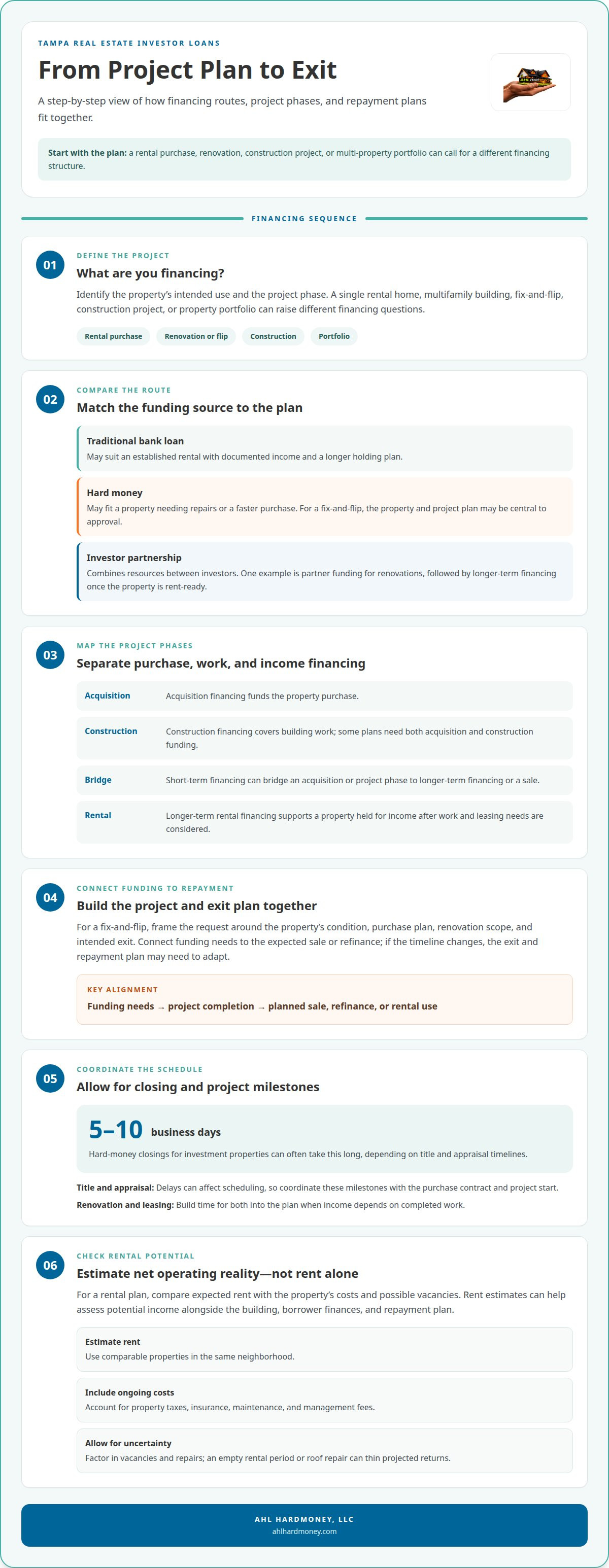
Build your return estimate from actual operating costs, not rent alone. Tampa investors should account for property taxes, insurance, maintenance, management fees, and possible vacancies. A property that appears to generate positive monthly income before repairs, for example, may produce thinner returns after a roof repair or an empty rental period.
- Estimate rent using comparable properties in the same neighborhood.
- Include recurring taxes, insurance, repairs, and management costs.
- Allow for vacancies before judging expected cash flow.
Local comparisons add useful context. Investors may consider neighborhoods such as South Tampa, Seminole Heights, Westchase, and Ybor City. Compare similar nearby properties to assess fair market value, then review property records, financials, and potential zoning or liability concerns before purchasing.
For a portfolio, assess each property’s contribution and risk alongside the others. A mix of locations or property types can reduce reliance on a single asset, while accurate expense forecasts help you judge whether projected returns support long-term financing.
Fix-and-flip, bridge, construction, and rental financing
Choosing among Tampa real estate investor loans starts with the project timeline and intended use. Hard money financing for a fix-and-flip may focus on the deal, including the property and project plan, rather than relying only on borrower qualifications.
Financing Sources for Investors
Traditional bank loans, hard money loans, and investor partnerships are among the financing options for Tampa property purchases. Each allocates funding and risk differently, so the right fit depends on the project and your exit plan.
A bank loan may suit an established rental with documented income and a longer holding plan. Hard money may fit a property that needs repairs or a faster purchase, while a partnership combines resources between investors. For example, an investor might use partner funding for renovations, then pursue longer-term financing after the property is rent-ready. Compare the repayment timeline with the planned sale or rental income.
Bridge and Hard Money Loans
A bridge loan provides short-term financing between an acquisition or project phase and longer-term financing or a sale. Hard money financing can also be an option when the property and proposed project are central to approval.
In the Tampa Bay area, hard money lenders may focus on the deal rather than the borrower. For a fix-and-flip, the property’s condition, purchase plan, renovation scope, and intended exit help frame the request. A workable plan connects funding needs with the expected sale or refinance. If the timeline changes, the exit strategy and repayment plan may need to adapt.
Multifamily investors should distinguish bridge financing from rental financing. A bridge loan can cover an acquisition or improvement phase, while longer-term rental financing supports a property held for income. For example, a building with vacant units may need repairs and leasing before rental operations stabilize. Tampa real estate investor loans should align with these phases rather than assume a newly purchased building will immediately produce steady rent.
Construction financing covers building work, while acquisition financing funds the purchase itself. Some plans require both: acquire a property, complete construction, then transition to rental use or sale. Map the project phases, funding needs, and intended exit together. This clarifies when financing is needed and how repayment connects to completion.
Timing can shape a competitive Tampa purchase. Hard money closings for investment properties can often take 5 to 10 business days, depending on title and appraisal timelines. A delayed appraisal or title process can affect scheduling, so coordinate those milestones with the purchase contract and project start. Build time for renovation and leasing into the plan when income depends on completed work.
For a project involving existing property equity, home equity financing may be relevant to the funding discussion. The right Tampa real estate investor loans structure should fit the property’s condition, intended use, and planned transition to rental income or sale.
Income, debt, and rental-income qualification
For an investment property, qualification may depend on personal finances, projected rent, or both. Conventional loans commonly assess the borrower’s income, credit, and expected rent. A debt-service coverage ratio (DSCR) loan instead measures whether rental income covers the mortgage payment. This distinction matters when personal income or existing debt makes conventional qualification more difficult.
A vacant or newly purchased Tampa rental has no established rent history. Lenders may use market-rent estimates from an appraisal or rent schedule to assess its income potential. Some Tampa Bay DSCR lenders accept projected short-term rental income based on rental comparables or historical performance. These methods help assess expected revenue, but the calculation depends on how income is evaluated.
The same example lists a DSCR of 1.25. A ratio above 1.0 means the stated rental income exceeds the mortgage payment used in that ratio, but it doesn't establish the property’s full cash flow. Taxes, insurance, repairs, management, and vacancy can change the investment’s actual returns.
Short-term rental income also depends on how the property will be operated and how projected rent is supported. A condo, for example, may have building or association rules that affect rental use. These restrictions are separate from the lender’s income calculation, so financing approval alone does not establish that the property can be used as planned.
Tampa-area zoning and rental permission require the same distinction: loan approval does not itself authorize an owner to rent a home. Review zoning, property records, and potential legal or liability issues alongside the appraisal and rental assumptions. Projected income supports qualification only if the intended rental use is workable.
Before relying on a DSCR calculation, identify the rent figure, mortgage payment, and expenses included. Then compare the lender’s view of rental income with a broader operating budget. This helps you assess both whether the property may qualify for financing and whether its income plan accounts for actual ownership costs.
How much down payment for a Tampa investment property?
Plan for at least 20% down; Tampa investment-property down payments typically range from 15% to 25%. Larger projects also require careful review of the property value, repair scope, loan amount, and repayment terms.
Florida Private Lenders and Loan Programs
Florida private lenders offer financing programs for real estate purchases and projects, with terms shaped by the property and loan structure. The available amount and borrower contribution depend on more than the purchase price.
Florida private lenders recorded an estimated $44.8 billion in funded loan volume in the second quarter of 2026, including $3.0 billion in short-term loan volume. These statewide figures show activity across the private lending market, not a specific Tampa lender’s program or approval criteria. Rankings by loan count can indicate lending activity, but they don’t show whether a program suits a particular property or project.
Private Loan Amounts and LTV Limits
The loan amount is the principal borrowed, while loan-to-value compares that amount with the property’s appraised value. This relationship matters because the purchase price, appraisal, and repair needs can affect how much cash an investor must bring.
The average private money loan amount in Southwest Florida was $388,478 in the third quarter of 2026. That regional figure is context, not a Tampa loan limit or an individual quote. For Tampa investors, the property appraisal and project plan remain central to determining the amount a lender may consider.
The typical range of 15% to 25% varies with loan program, property units, and borrower profile. A 20% contribution is a useful starting point for planning, but investors should also account for reserves and funds needed after closing.
Major repairs can change the financing calculation. A building that needs substantial work may require funds beyond the purchase loan, and the appraisal may reflect its current condition. Lay out the acquisition, repair scope, and intended exit together. This clarifies whether the requested loan amount supports the project without relying on rent or resale proceeds before the work is complete.
Before closing, review the written terms for any early-payoff charge and how it is calculated. Check the payment schedule too, including when a payment could change and when the full balance is due. These details matter if renovations finish early, the rental plan changes, or you expect to refinance. A DSCR loan may assess rent against the mortgage payment, so projected income and payment assumptions should align.
For a larger building, assess the appraisal, repair budget, expected rental income, and requested loan amount together. This gives investors a clearer basis for estimating the cash needed at closing and judging whether the loan fits the project timeline.
Borrower eligibility and credit requirements
Tampa investment-property lenders commonly look for credit scores from 620 to 680. They also consider cash reserves, existing obligations, the property, and its expected rental income.
To apply, prepare the property and borrower information used to assess the loan, along with relevant financial and ownership records. For a Tampa Bay rental loan under a business entity, borrowers need operating agreements and EIN documentation. The application connects these records with the property, proposed loan amount, and repayment plan.
Credit is one part of eligibility, not the whole application. A borrower’s score sits alongside obligations on the rental and, in some cases, other properties. Lenders commonly seek reserves covering several months of payments. Tampa investment-property borrowers should plan for 2-6 months of mortgage-payment reserves, with the amount of available cash helping show how payments could be covered during vacancies or repairs.
Rental income can also shape the lending decision. Conventional investment-property loans commonly consider personal income, credit, and projected rent. A DSCR approach assesses whether rental income covers the mortgage payment. For a vacant or newly acquired property, Tampa Bay lenders may use market-rent estimates from an appraisal or rent schedule. The income method affects how the property supports the requested funding.
Existing debt matters because mortgage obligations across multiple properties affect the borrower’s financial picture. A portfolio owner, for example, may need to account for payments across the properties, not just the new rental. Cash reserves for other properties may matter too. Organize each property’s payment and income information so the lender can assess those obligations alongside the new investment.
Florida investor borrowing also reflects activity across different loan purposes. Private money lenders in the state recorded an estimated $44.8 billion in funded loan volume in the second quarter of 2026, including $3.0 billion in short-term loan volume. These statewide figures describe market activity; they don’t determine an individual borrower’s eligibility or loan terms.
For an LLC application, keep the entity’s ownership and operating records consistent with the proposed transaction. The operating agreement documents how the business is organized, while EIN documentation identifies the entity for the lending process. Pair these records with the property details and funding purpose. Clear documentation connects the borrower, entity, and investment property in one application.
AHL HardMoney
AHL HardMoney, llc helps Tampa property owners consider financing options involving existing real estate, equity, or refinancing. Its offerings include Cash-Out Refinance, Home Equity Loans, Private Money Loans, and Foreclosure Refinance Loans. The right fit depends on the property and funding goal.
For example, an investor with property equity may consider whether refinancing or a home equity loan suits a planned purchase or another real estate need. If an existing loan or foreclosure concern affects the next move, a refinance option may be relevant. These are different financing situations, so bring the property, current obligations, and intended use of funds into the discussion.
Contact AHL HardMoney, llc to discuss your real estate financing needs.
Shape your next investment move
Your next financing decision should connect the property’s purpose with a clear repayment plan. Before moving forward, organize your purchase or refinance goal, ownership structure, intended rental use, existing obligations, and expected contribution. A concise overview can make conversations about Tampa real estate investor loans more focused and clarify which financing questions matter most.
The right structure depends on how the property fits your broader financial plans. AHL HardMoney, llc offers real estate financing options, including Cash Out Refinance, Home Equity Loans, and Private Money Refinance. Consider discussing your goals as you assess how existing property or equity could support your next step.
Approach the decision with a practical plan, room for operating costs, and a clear view of your intended outcome. Each thoughtful step can move an investment idea toward a more confident financing conversation.
Your next opportunity starts with a plan that fits your investment goals.
Frequently Asked Questions
Can I get a loan for a rental property if it’s not currently rented?
Yes, a vacant rental can be considered for financing using estimated market rent rather than current lease payments. An appraisal or rent schedule, for example, can provide an estimate for a newly acquired property. Prepare a clear rental plan that explains the intended use and expected income. Also distinguish loan qualification from permission to operate the property as a rental, since financing approval alone does not authorize rental use.
Can rental income help me qualify for a Tampa investment loan?
Yes, projected or existing rent can support an application, though the method depends on the loan structure. A conventional application may assess personal income, credit, and projected rent together, while a DSCR approach centers on rent relative to the mortgage payment. For a property without a lease, present a supportable rent estimate and distinguish long-term rental projections from short-term rental assumptions.
How fast can I close with a hard money lender?
Hard money closings for Tampa investment properties can often take 5 to 10 business days, depending on title and appraisal timelines. A delayed title review or appraisal can affect the schedule, so align those milestones with the purchase contract. AHL HardMoney states that it can close loans in 5 to 15 days, regardless of credit history. Keep property and transaction documents organized to support the closing process.
What types of real estate investor loans are available in Tampa, Florida?
Investors can consider conventional investment loans, DSCR financing, portfolio lending, hard money, bridge loans, and construction financing. Each serves a different purpose: a bridge loan can cover a transition, while construction funding relates to building work. For property owners considering existing equity or refinancing, options include Cash Out Refinance, Home Equity Loans, and Private Money Refinance. Match the structure to the property and investment plan.
How do DSCR, conventional, portfolio, and hard money investor loans compare?
These options assess different parts of a deal. DSCR financing emphasizes whether rental income covers the mortgage payment. Conventional lending commonly weighs personal income, credit, and projected rent. Portfolio lenders may tailor financing for investors with multiple properties, while Tampa Bay hard money lenders focus on the deal. Compare the property’s income plan, ownership structure, timeline, and repayment strategy to see which approach aligns with your investment.
Can foreign nationals or LLCs get real estate investor loans in Tampa?
LLCs seeking a Tampa rental-property loan need operating agreements and EIN documentation. These records establish the borrowing entity’s structure for the application. Foreign-national borrowers should consider the proposed ownership, property, repayment plan, and financial documentation together; citizenship alone does not describe the full transaction. An LLC’s paperwork supports the entity side of an application, but approval also depends on the property and loan program.
What Tampa-area property types and investment strategies qualify for investor financing?
Financing can apply to single-family rentals, multifamily properties, acquisitions, renovations, and properties held for rental income. Unit count can change the financing route: Hillsborough County’s 2026 conforming limits for two-to-four-unit properties are higher than for a one-unit home, while buildings with five or more units may need different options. Investors may also explore owner-occupied financing when living in one unit of a multi-unit property.
How do Florida taxes, insurance costs, and flood zones affect Tampa investment property loans?
Taxes and insurance belong in the property’s expense and cash-flow analysis because they reduce income after ownership costs. Flood-zone exposure can also affect a property’s risk profile and insurance planning, so include the location and insurance assumptions in the overall budget. Before judging projected returns, compare expected rent with mortgage payments, taxes, insurance, repairs, management, and vacancy costs.
Disclaimer:
While Dan is not a real estate attorney, he is a Full Time, Licensed Florida Mortgage and Real Estate Broker Professional coupled with 21+ years of successful strategies, methodologies and techniques that have proven effective to the benefit of Florida families.
While not every conversation is a deal, we promise to leave you better off then before you called. We serve everyone we come in contact, with the highest levels of integrity and dignity.
We invite you to make the call 📲


