


Article by
Dan Conneally - NMLS 339916, LO13164, BK3246524, CQ1072086
Dan Conneally has been successfully helping Florida families with thier real estate related situations for the last 21+ years, regardless of credit or past financial background.
While Dan is effective with institutional lending, he particuarly shines when matters require unique strategies involving noninstitutional resources.
Check out his legions of testimonials from real Florida families at Google, Facebook and the BBB to get a sense of the caliber and effectiveness he achieves. Dan has appeared on television speading the message of hope to good folks that need diligent, discrete, nonjudgy care.
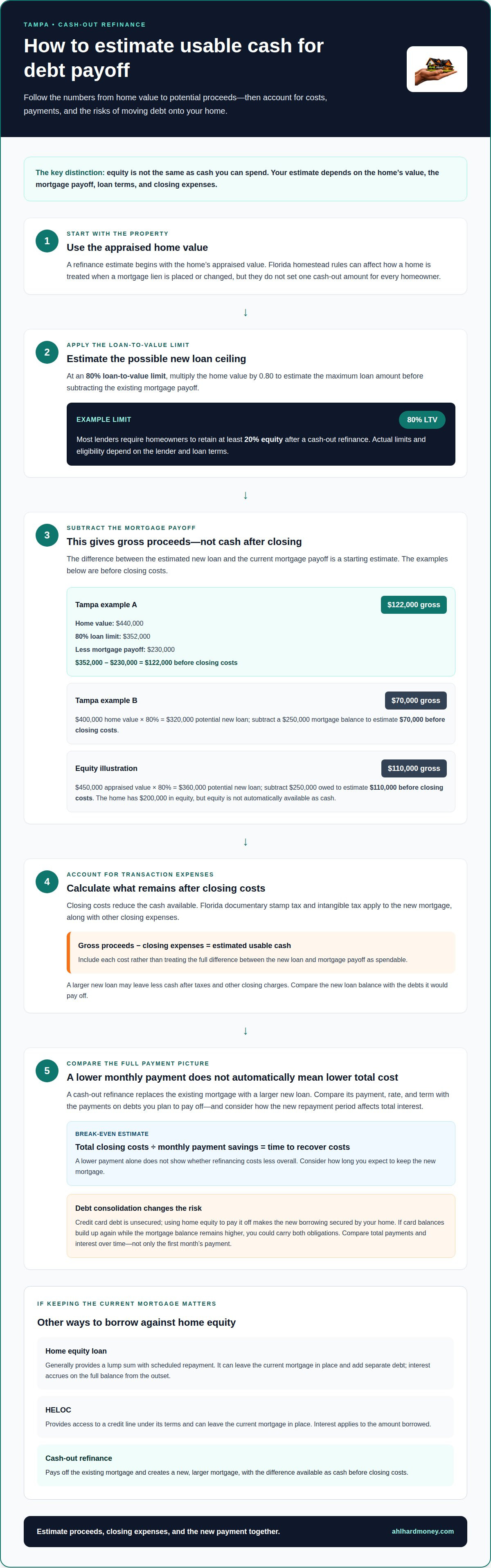
A cash-out refinance to pay off debt in Tampa could provide $122,000 before closing costs in one example: a home valued at $440,000 with a $230,000 mortgage balance, using an 80% loan-to-value limit. The actual amount available depends on the home’s value, the mortgage payoff, and the loan terms. That’s why the headline equity figure isn’t the same as the cash you’ll have to use.
If you’re considering a cash out refinance to pay off debt in Tampa, you’re likely looking for more breathing room without overlooking what a new loan could cost over time. This guide explains how refinancing may turn home equity into cash, how a home equity loan and HELOC differ, and what to weigh before rolling other debts into a mortgage.
You’ll also learn how closing costs affect usable proceeds, why consolidating payments can change the total interest you pay, and how tax treatment may depend on how you use the money. The goal is a clear comparison of the trade-offs, so you can decide which option best fits your finances.
Key Takeaways
- Estimate potential cash from your home’s value and mortgage payoff, then account for closing costs before deciding how much debt you can cover.
- Compare replacing your current mortgage with a cash-out refinance against keeping it and adding a home equity loan or HELOC.
- Consolidating higher-interest debt may simplify payments, but moving it into a mortgage also secures that debt against your home and can increase total interest over time.
- Consider how you’ll use the proceeds: tax treatment of mortgage interest can depend on whether funds go toward qualifying home improvements or other expenses.
- Weigh the payment relief you want against the new loan’s terms, repayment timeline, and effect on your home equity.
How much cash can I take out when I refinance in Tampa?
A Tampa cash-out refinance can provide $122,000 before closing costs in one example: a home valued at $440,000 with a $230,000 mortgage balance. Your usable cash is lower after the payoff and transaction expenses.
Florida homestead rules can affect how a home is treated when a mortgage lien is placed or changed. They don’t establish one cash-out amount for every homeowner. Property value, mortgage payoff, and loan terms still shape the calculation, while the home’s legal status also matters.
Start with the home’s appraised value, then apply the loan-to-value limit used for the refinance. Subtract the existing mortgage payoff and any other amounts paid at closing. For example, a $400,000 Tampa home with a $250,000 mortgage balance could provide about $70,000 before closing costs at an 80% limit. This is an estimate of gross proceeds, not money left after closing.
Closing costs reduce the cash available, so compare the new loan balance with the debt it would pay off. Florida documentary stamp tax and intangible tax apply to the new mortgage. A larger loan may leave less cash after these charges and other closing expenses. Include each cost in your net-proceeds calculation rather than treating the full difference between the loan and mortgage payoff as spendable.
Compare payments as well as balances. A refinance replaces your existing mortgage with a new, larger loan secured by your home. The new payment reflects its balance, rate, and term, while the old mortgage payment ends. Compare it with the payments on debts you plan to pay off, and consider how the new repayment period affects total interest.
A break-even analysis helps you weigh closing costs against a monthly payment reduction. Divide the total costs by the monthly savings to estimate how long it takes to recover those costs. If you expect to keep the new mortgage beyond that point, the savings may matter more. If not, upfront costs may outweigh them. A lower monthly payment alone doesn’t show whether refinancing costs less overall.
For a closer look at a Tampa cash-out refinance, compare estimated proceeds, closing expenses, and the new payment together. That gives you a clearer view of how much cash could go toward debt payoff, rather than relying only on home equity or the gross loan amount.
Comparing a cash-out refinance with a home equity loan or HELOC
A cash-out refinance replaces your mortgage, while a home equity loan or HELOC adds borrowing secured by your home. Compare access to cash, payment structure, and how much equity you’ll retain.
Loan Option Differences
A cash-out refinance pays off your existing mortgage and creates a new, larger mortgage, with the difference available as cash. A home equity loan generally provides a lump sum with scheduled repayment, while a HELOC lets you draw from a credit line under its terms.
That distinction matters if you want to keep your current mortgage. A home equity loan or HELOC can leave it in place and add separate debt rather than replace it. With a HELOC, interest applies to the amount borrowed; a home equity loan accrues interest on its full balance from the outset.
Borrower and Equity Requirements
Credit, income, outstanding debts, and home equity all influence how much a homeowner may qualify to borrow. Most lenders look for a credit score around 620 or higher for a cash-out refinance, and a cash-out application typically triggers a hard credit inquiry that may temporarily lower the score.
Debt-to-income ratio also matters because it compares monthly debt obligations with income. Lenders assess this alongside credit and the property’s value, rather than treating a score as the sole deciding factor. In Florida, homeowners should consider how a new mortgage payment or added home-equity payment fits alongside their existing obligations.
Loan Amount and Loan-to-Value Limits
Equity is the difference between a home’s market value and its outstanding mortgage balance. For example, a Tampa home appraised at $450,000 with $250,000 owed has $200,000 in equity. Equity isn’t automatically available as cash; the loan-to-value limit affects how much of it can be borrowed.
At an 80% loan-to-value ceiling, that home’s new loan could reach $360,000. Subtracting the $250,000 mortgage balance leaves a maximum of $110,000 before closing costs. Most lenders require homeowners to retain at least 20% equity after a cash-out refinance, so the available amount depends on both the appraisal and payoff.
Risks of Using Home Equity for Debt
Using home equity to pay off credit card debt turns that debt into borrowing secured by your home. That shift matters: your home backs the new obligation, unlike unsecured credit card debt. A lower monthly payment may feel easier to manage, but it doesn’t necessarily mean you’ll pay less interest over the loan’s full term.
Consider the repayment timeline and the risk of rebuilding card balances after payoff. If new card charges accumulate while your mortgage balance remains higher, you could end up carrying both obligations. Compare total payments and interest over time, not just the first month’s payment, before choosing a refinance, home equity loan, or HELOC.
How cash-out refinancing can consolidate high-interest debt
A cash-out refinance can turn home equity into funds to pay creditors. The decision depends on the new interest rate, payment, and repayment period, not just how many bills it eliminates.
Using Proceeds to Consolidate Debt
Debt consolidation combines selected balances into a new loan, using refinance proceeds to pay creditors. A lender calculates the new mortgage based on the existing home loan, the property appraisal, and your financial profile.
For example, Frankie refinances a $320,000 mortgage and $30,000 car loan into a $350,000 mortgage at 2.75% for 30 years. The proceeds cover the car balance, but the car debt then becomes part of a mortgage secured by the home. List each creditor payoff and compare it with the available cash before closing.
Interest Savings and Payment Consolidation
Payment consolidation replaces several monthly bills with one mortgage payment, while potential interest savings depend on the new rate and loan term. Luis’s example has a $1,266 mortgage payment and a $360 credit card payment, totaling $1,626 each month.
Refinancing into a $262,000 home loan at 3% lowers Luis’s illustrated monthly debt payment to $1,104, freeing $522 each month. That monthly difference doesn’t establish total savings by itself. Compare the amount paid over the full repayment period, including interest on debt carried into the mortgage.
Benefits of Consolidating High-Interest Debt
Consolidation can simplify budgeting by replacing separate creditor due dates with one payment. It may also reduce the monthly amount due if the new mortgage payment is lower than the combined payments on your existing mortgage and debts.
For Luis, the example shows $2,400 in cumulative payment savings after 12 months, before recovering illustrated refinance costs. After 36 months, cumulative savings reach $7,200, or $2,400 after those costs. These figures compare monthly payments and costs, not all interest over the entire mortgage term.
Check the interest rate attached to each balance before using proceeds. In Mei’s example, refinancing $30,000 of car debt into a 30-year mortgage at 2.75% results in $14,090 of interest on that portion over the loan term. The smaller payment can stretch repayment substantially, so compare the payoff timeline as well as the rate.
Debt consolidation through a cash-out refinance may increase both the number of monthly payments and the total amount paid over the loan term. Before closing, match the refinance proceeds to specific creditor balances, calculate the resulting mortgage payment, and consider whether the freed-up monthly income will go toward reducing debt rather than adding new balances.
Is a cash-out refi or a HELOC better in Florida?
The choice depends on whether you want to replace your mortgage or borrow separately against your home equity. Before paying off debt, compare the interest rate, repayment structure, loan-to-value limit, and total amount you need to borrow.
Mortgage rates and credit card rates can differ sharply. From 2020 to 2025, average U.S. 30-year fixed mortgage rates ranged from 2.96% to 6.81%, while average credit card rates ranged from 14.5% to 21.5%. A cash-out refinance may lower the rate on some debt, but it also puts that amount into a mortgage secured by the home.
A HELOC leaves the existing mortgage in place and provides a revolving credit line, typically with a variable rate. A personal loan usually has a shorter repayment term: the comparison here uses 3 to 7 years, unlike a mortgage that may stretch repayment longer. Consider your credit score, required payment, and whether you need a lump sum or continuing access to funds.
Loan-to-value limits also shape the available choices. Conventional cash-out refinances in Tampa generally cap the new loan at 80% of appraised value. FHA cash-out refinancing may have loan-to-value limits that affect how much a borrower can access. Eligible veterans may be able to borrow up to 100% through VA cash-out refinancing, although most lenders cap the amount at 90%.
For a $350,000 Florida home with a $175,000 mortgage, an 80% loan-to-value limit allows a $280,000 loan. Paying off the existing mortgage would leave $105,000 before closing costs. That example shows how an LTV ceiling differs from the equity figure: the ceiling limits the new mortgage, not the cash proceeds by themselves.
These limits matter when a proposed mortgage approaches the applicable program threshold, but they don’t determine the cash-out amount alone. The home’s appraised value, mortgage payoff, and applicable LTV cap also affect the proceeds.
A cash-out refinance may suit homeowners who want one mortgage and a lump sum, while a HELOC may fit borrowing needs that arise over time. A personal loan has a shorter stated term in this comparison, but its payment and rate depend on the lender and borrower. Compare the full repayment timeline, not just the first payment or interest rate.
Tax treatment of refinance proceeds and interest
A cash-out refinance replaces your existing mortgage with a larger loan, pays off the old balance, and makes any remaining proceeds available to you. You can use those funds for credit card balances or other debts, but the tax treatment of the cash and the interest are separate questions.
Cash received from a cash-out refinance is generally treated as loan proceeds, not income, so it generally isn’t taxable. Using the proceeds to pay off a credit card doesn’t turn the borrowed amount into income. The loan still creates a repayment obligation secured by your property, and paying off debt doesn’t automatically make mortgage interest deductible.
Interest treatment depends partly on how you use the money. Interest on the cash-out portion may be deductible when you itemize deductions and use the funds to buy, build, or substantially improve the home securing the loan. Interest tied to other uses, such as paying off credit card debt, may not qualify under that rule.
The Internal Revenue Service says mortgage interest is generally deductible on the first $750,000 of indebtedness under current tax laws. That figure doesn’t mean every borrower can deduct interest on every dollar borrowed. The use of the proceeds and whether you itemize deductions also matter, so keep clear records showing how refinance funds were spent.
For example, keep separate records for refinance proceeds used for qualifying home improvements and amounts used to pay creditors. Save invoices, payment records, and loan documents together. If you use proceeds for different purposes, organized records can help distinguish the interest associated with each when preparing tax information.
The amount available to borrow depends on the property’s value, current mortgage payoff, loan-to-value ratio, credit profile, and debt-to-income ratio. These factors shape the new loan and remaining cash, but they don’t determine the tax treatment of each use. Track both how much you borrow and where the proceeds go.
Timing also matters for planning. A cash-out refinance takes about 30 to 45 days on average, so include that processing period when coordinating creditor payments or planned home improvements. The appraisal, income review, and mortgage payoff information help determine the loan figures used at closing.
Before filing, keep your closing documents and records of debt payments or property work. A tax professional can assess how current rules apply to your use of the proceeds and filing situation. That review can help distinguish nontaxable borrowed cash from any interest deduction you may claim.
AHL HardMoney: Cash Out Refinance
AHL HardMoney, llc offers Cash-Out Refinance for homeowners considering using home equity to pay off debt. It also offers Home Equity Loans, another option to compare if you want to borrow while leaving your existing mortgage in place.
If your priority is consolidating debt, compare the amount you need, the new payment, and how the loan will be secured against your property. AHL HardMoney, llc also offers Private Money Loans and Foreclosure Refinance Loans for borrowers whose circumstances call for those options.
Review the trade-offs covered here, then contact AHL HardMoney, llc to discuss your refinance needs and possible next steps.
Choose a Path That Supports Your Next Move
The best next step is to connect your borrowing choice to a specific financial goal. Before moving forward, decide which balances you want to address, what monthly payment fits your budget, and how long you expect to keep the home. This gives you a practical way to assess whether a cash-out refinance to pay off debt in Tampa supports your plans, rather than focusing only on immediate cash.
AHLHardMoney™ offers Cash-Out Refinance, Home Equity Loans, and Private Money Loans. Compare how each option fits your property, existing mortgage, and repayment priorities. Bring those considerations into the conversation to focus on a structure that addresses your needs.
You’ve already done the important work of comparing trade-offs. Now turn your questions into a clear, personal next step.
A thoughtful plan can help you move toward greater financial clarity with confidence.
Frequently Asked Questions
Can refinancing lower my payment but increase my total cost?
Yes. A lower monthly payment can still mean paying more interest over the full loan term, especially if the new mortgage extends repayment. Compare total interest and all scheduled payments, not just the first month’s bill. Also account for costs added to the new balance. A longer term can ease monthly cash flow while extending how long you owe on your home.
Do I need to get an appraisal to refinance?
Usually, yes. Wells Fargo says appraisals are normally required for a refinance. The lender uses the property valuation alongside your mortgage payoff to assess the home’s equity and the proposed loan-to-value ratio. That valuation can affect how much cash is available and whether the requested loan fits the applicable limit. Property condition and comparable home sales can influence the appraised value.
How do I calculate the break-even point on a refinance?
Divide the refinance’s total upfront costs by the monthly savings to estimate the simple break-even period. For example, if costs are represented by C and monthly savings by S, calculate C ÷ S. Then compare that period with how long you expect to keep the mortgage. This estimate addresses payment savings only; it doesn’t show total interest or account for changes in the loan term.
How long would it take to recover the refinance costs?
The recovery period depends on the actual closing costs and the monthly payment reduction. Use the break-even calculation to estimate how many months of savings offset those costs, then consider whether you’ll keep the new mortgage long enough to reach that point. If the new loan increases your balance or extends repayment, also compare total interest, since monthly savings alone won’t measure the full cost.
What are current cash-out refinance rates in Tampa, Florida?
There isn’t one rate that applies to every Tampa borrower. The offered rate depends on factors such as credit profile, loan-to-value ratio, debt-to-income ratio, loan type, and repayment term. Compare the rate with the annual percentage rate and full payment schedule, since fees and other borrowing costs affect the overall expense. Rate comparisons are most useful when the proposed loan amounts and terms match.
What are the cash-out refinance loan limits and equity requirements in Florida?
Conventional cash-out refinances in Tampa generally cap the new loan at 80% of appraised value, while FHA cash-out refinancing can allow up to 85%. Eligible veterans may access VA cash-out refinancing up to 100% loan-to-value, though most lenders cap it at 90%. Limits depend on the loan program.
What are typical closing costs for a cash-out refinance in Tampa?
Closing costs depend on the new loan amount and transaction details, so include them when estimating net cash proceeds. Florida documentary stamp tax and intangible tax apply to the new mortgage. Other expenses may relate to valuation, title work, recording, and loan processing. Request an itemized estimate and distinguish costs paid upfront from costs added to the loan balance before comparing refinance options.
How much cash can homeowners borrow with a cash-out refinance?
Available cash depends on your home’s appraised value, mortgage payoff, applicable loan-to-value limit, and financial profile. Estimate the maximum new loan under the relevant limit, then subtract the existing mortgage payoff and transaction costs. The remainder is potential cash before any other deductions. For a cash-out refinance to pay off debt in Tampa, compare that net amount with the balances you plan to clear.
Disclaimer:
While Dan is not a real estate attorney, he is a Full Time, Licensed Florida Mortgage and Real Estate Broker Professional coupled with 21+ years of successful strategies, methodologies and techniques that have proven effective to the benefit of Florida families.
While not every conversation is a deal, we promise to leave you better off then before you called. We serve everyone we come in contact, with the highest levels of integrity and dignity.
We invite you to make the call 📲


