


Article by
Dan Conneally - NMLS 339916, LO13164, BK3246524, CQ1072086
Dan Conneally has been successfully helping Florida families with thier real estate related situations for the last 21+ years, regardless of credit or past financial background.
While Dan is effective with institutional lending, he particuarly shines when matters require unique strategies involving noninstitutional resources.
Check out his legions of testimonials from real Florida families at Google, Facebook and the BBB to get a sense of the caliber and effectiveness he achieves. Dan has appeared on television speading the message of hope to good folks that need diligent, discrete, nonjudgy care.
The buyout is only part of the cost. A cash out refinance for divorce settlement Tampa replaces the existing mortgage with a new loan, with proceeds available for the departing spouse’s agreed share of the equity. Total costs depend on the new loan amount and the charges involved in closing.
It’s understandable to want a clear figure while making major decisions about your home. Separate the spouse’s buyout from the cost of arranging the refinance, then assess whether the home’s equity and the remaining spouse’s finances can support the new loan.
This guide explains how a buyout is calculated, what can affect refinance costs, and how refinancing compares with other ways to handle the home. You’ll also learn what lenders consider and how AHL HardMoney, llc’s Cash-Out Refinance may fit your financing plans.
Key Takeaways
- Separate the departing spouse’s agreed equity buyout from the refinance’s closing costs to understand the new loan amount.
- Learn how limited cash-out refinance rules may apply to a divorce buyout and what written agreements can document.
- See how income, debts, and qualifying support payments affect whether one spouse can carry the new mortgage alone.
- Understand how title history, an appraisal, and deed documents fit into a divorce-related refinance.
- Review the records lenders commonly use to assess the home, settlement terms, existing mortgage, and remaining borrower’s finances.
How much does it cost to refinance a mortgage after divorce in Florida?
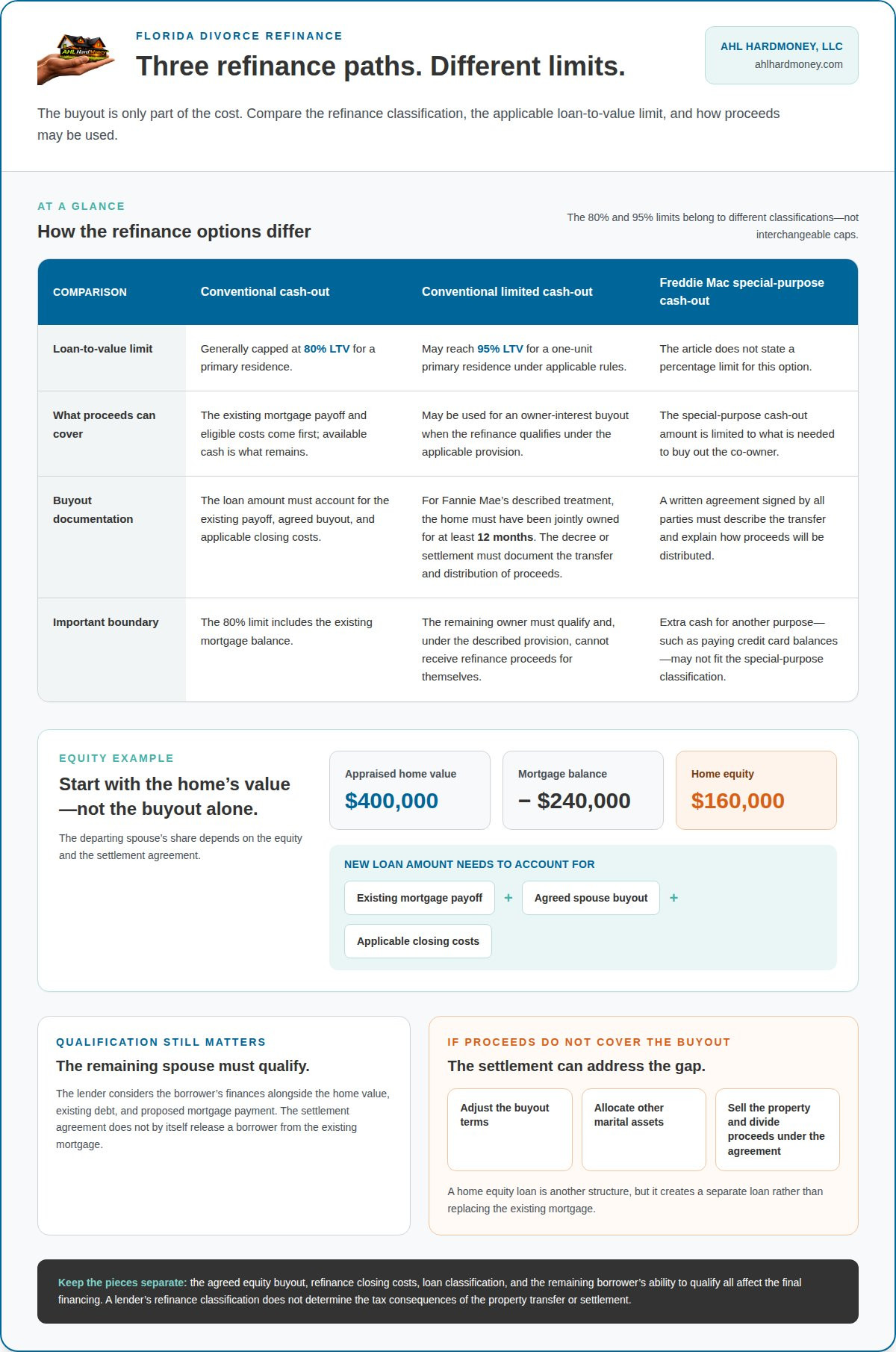
Refinance costs depend on the new loan and closing expenses, while the buyout depends on the home equity and settlement agreement. For a conventional cash-out refinance on a primary residence, the loan is generally capped at 80% loan-to-value. That limit includes the existing mortgage, so available cash is what remains after its payoff and eligible costs. A conventional limited cash-out refinance for a one-unit primary residence may reach 95% loan-to-value under applicable rules. These are different refinance classifications, not interchangeable limits.
Fannie Mae may treat a refinance used to buy out an owner’s interest as limited cash-out when the home has been jointly owned for at least 12 months. The divorce decree or settlement agreement must document the transfer and intended distribution of proceeds. The person keeping the property must qualify for the mortgage, and under this provision cannot receive the refinance proceeds for themselves. A written agreement clarifies the departing spouse’s buyout and helps the lender understand where the funds go.
Start the equity calculation with the home’s appraised value, then subtract the mortgage balance. For example, a $400,000 home with a $240,000 mortgage has $160,000 in equity. The departing spouse’s share depends on the home equity and the terms of the settlement. The new loan would need to cover the existing payoff and agreed buyout, plus applicable closing costs. For a cash-out refinance in Florida, the loan-to-value limit and the amount owed both affect how much cash can be released.
Freddie Mac also has a divorce-buyout option, but its special-purpose cash-out amount is limited to what’s needed to buy out the co-owner. A written agreement signed by all parties must describe the transfer and explain how refinance proceeds will be distributed. This matters if the spouse keeping the home also wants extra cash. For example, adding money to pay credit card balances goes beyond the buyout purpose and may not fit the special-purpose classification.
If refinance proceeds don’t cover the agreed buyout, the settlement can address the gap in other ways. The spouses might adjust the buyout terms, allocate other marital assets, or sell the property and divide the proceeds under their agreement. A home equity loan is another structure, but it creates a separate loan rather than replacing the existing mortgage. Compare the buyout amount, remaining debt, monthly payment, and settlement terms together.
Tax treatment is separate from a lender’s refinance classification. Fannie Mae or Freddie Mac’s treatment of the loan doesn’t determine the tax consequences of the property transfer or settlement. The decree, settlement agreement, and transaction details inform that analysis, so a tax professional can review them before the agreement is finalized.
What if I cannot qualify for the refinance on my income alone?
A lender assesses whether the spouse keeping the home can support the new mortgage using their income, debts, credit, and available equity. Conventional cash-out refinances commonly require a credit score of 580 to 620, while debt-to-income limits generally fall between 43% and 50%.
Qualifying on One Spouse’s Income
Qualifying on one spouse’s income means the lender evaluates that borrower’s finances without relying on the departing spouse’s earnings. The lender considers income, existing monthly debt, credit history, and the proposed mortgage payment together. Most conventional files have an automated-underwriting debt-to-income ceiling of 50%, though the applicable limit can be lower. If alimony or child support is counted, the borrower may need a payment history of 6 to 12 months, and the payments generally must continue for at least three years.
Funding a Spousal Settlement
A cash-out refinance can replace the existing mortgage and provide proceeds for an agreed spousal settlement. The lender evaluates the new loan against the home’s value, existing debt, and the amount allocated to the departing spouse. This connects the settlement terms to the borrower’s ability to qualify. If support income helps the remaining spouse meet the lender’s requirements, consistent payment records matter; generally, the former spouse must have paid support consistently for at least six months.
Buying Out a Spouse’s Home Interest
Buying out a spouse’s interest means the spouse keeping the property arranges payment for the other spouse’s agreed share while addressing ownership and mortgage responsibility. A divorce decree or settlement agreement can assign responsibility between former spouses, but it doesn’t by itself release a borrower from the mortgage. Refinancing can pay off the joint loan and put the replacement mortgage in the remaining spouse’s name, if that borrower qualifies.
If one income can’t support the new payment, alternatives include negotiating different settlement terms, delaying the refinance under the agreement, or selling the home and dividing the proceeds. A mortgage assumption may also be considered, but in Florida it requires lender approval and a release of liability to remove the departing spouse from responsibility for the loan. A decree alone doesn’t provide that lender release.
Protecting the departing spouse means resolving the old mortgage obligation, not only transferring ownership. Until the lender pays off the joint loan or formally releases a borrower, missed payments can still affect that person. The settlement timeline and the lender’s release process therefore need to work together. A review of refinance options can help clarify how loan qualification and settlement timing connect.
Does the Title-Seasoning Rule Block a Divorce Buyout?
No, a title-seasoning rule doesn’t automatically block a Florida divorce buyout. Florida Statute 61.075 governs marital property division, while refinance eligibility also depends on the loan program, ownership history, and mortgage documents.
Deed Transfers and Refinance Timing
A deed transfer changes ownership, while refinancing replaces the mortgage. Coordinating both matters because either step alone can leave an issue unresolved. A quitclaim deed may transfer one spouse’s interest, but it doesn’t remove that spouse from mortgage liability. Refinancing can pay off the existing loan as ownership changes, aligning the title transfer with the new mortgage rather than leaving the departing spouse responsible.
Timing can depend on how title was acquired. Fannie Mae generally requires six months of borrower title ownership for cash-out refinancing, but waives that wait when a home was legally awarded through divorce, separation, or dissolution of a domestic partnership. A separate conventional cash-out guideline generally requires the first mortgage being paid off to be at least 12 months old, subject to lender guidelines.
Appraisal and Settlement Documentation
An appraisal establishes the home’s fair market value, while a settlement agreement records the spouses’ agreed division and intended use of refinance proceeds. This valuation gives the lender a basis for assessing available equity and the buyout amount, rather than relying on an online estimate.
The lender may review the divorce judgment, settlement agreement, current mortgage statement, payoff information, and deed documents to connect the ownership transfer with the proposed loan. Florida law allows a judgment distributing assets to function as a transfer instrument once the judgment or a certified copy is recorded in the property’s county. The recorded judgment may therefore matter alongside deed paperwork.
Florida Divorce Rules Affecting Refinancing
Florida divorce rules shape how marital property is divided, but the lender separately evaluates the new mortgage and title. Under Florida Statute 61.075, courts divide marital property equitably and begin with an equal division. That starting point doesn’t establish every home buyout amount: the spouses’ settlement terms and property circumstances determine the agreed allocation.
While the marriage exists, a spouse must join in a new mortgage on Florida homestead property, even if that spouse isn’t on the title. After divorce, the recorded judgment or deed documents can show the ownership transfer, but a quitclaim deed alone doesn’t release mortgage liability. Fannie Mae’s divorce-related title exception may address ownership seasoning, while the loan’s other eligibility requirements still apply.
For a Tampa buyout, the appraisal, settlement agreement, recorded transfer documents, and mortgage payoff information should tell a consistent story. If the title transfer occurs before refinancing, the quitclaim deed doesn’t itself pay off the old mortgage. If refinancing closes alongside the transfer, the new loan can replace the existing mortgage as ownership changes. The sequence affects whether the departing spouse has transferred ownership, received payment, and been released from the old loan.
Documents a lender needs for a divorce-related refinance
A divorce refinance involves two reviews: the property and settlement terms, and the remaining borrower’s finances. In Florida, lenders may request records showing who receives the home, how the equity is divided, and what mortgage must be paid off.
Settlement and ownership records
The final divorce judgment and marital settlement agreement explain the agreed property division and the departing spouse’s interest. These documents help connect the requested loan with the transfer and planned use of proceeds. The lender may also request the deed or quitclaim deed to review ownership records. If a judgment distributes the property, its recorded form can document the transfer in the property’s county.
Consistency matters. If the settlement agreement awards the home to one spouse but the deed still shows joint ownership, the documents describe different stages of the transfer. The lender considers the judgment, agreement, and deed together to understand the borrower’s ownership and proposed refinance. This review also helps distinguish the agreed buyout from other assets divided in the settlement.
Mortgage, property, and closing records
A current mortgage statement and payoff information identify the existing loan the refinance is intended to address. Lenders may also request the homeowners insurance declaration page, along with tax and escrow information. These records identify property coverage and relevant carrying costs, helping the lender review the existing obligation and the new loan against the home.
- Mortgage statement and payoff details: show the current loan and amount needed to pay it off.
- Insurance declaration page: identifies the homeowners coverage for the property.
- Tax and escrow information: provides related property and payment details for review.
- Deed or quitclaim deed: documents title information and the ownership transfer.
Each record serves a different purpose. A deed shows ownership, while a mortgage statement concerns the debt secured by the property. A transfer document alone doesn’t establish that the old mortgage has been paid or that a borrower has been released from liability.
Borrower financial documentation
The spouse keeping the home must provide personal financial records for the lender’s qualification review. Requested materials may include income, assets, and credit documentation. These details help assess whether the borrower can support the new mortgage independently. The lender also considers settlement payment obligations alongside the borrower’s other debts and available resources.
For example, an agreement may assign the property to one spouse while dividing other assets separately. The lender needs the agreement and financial records to understand both the home transfer and the borrower’s financial position. If alimony or child support is part of the borrower’s income, payment-history documentation may support its consideration. The divorce judgment and agreement clarify the terms behind those payments.
A complete file gives the lender a connected record of the property, divorce terms, current mortgage, and borrower who will hold the new loan. In Tampa, keeping the judgment, settlement agreement, deed, payoff information, insurance, tax and escrow records, and financial documents aligned helps the lender assess the transaction without confusing ownership with mortgage responsibility.
Cash-out refinancing to fund a divorce settlement
For Tampa homeowners, a cash-out refinance for a divorce settlement can turn home equity into funds while replacing the existing mortgage. In Florida, proceeds first address the current mortgage payoff; remaining funds can support the agreed buyout and eligible closing items. The practical question is whether you can obtain enough financing while keeping the resulting payment manageable.
A Tampa example shows how equity shapes the calculation. A primary residence valued at $625,000 with a $380,000 mortgage has $245,000 in equity before settlement adjustments. That equity is not automatically the amount available as cash. The lender also considers the new loan’s terms and the property’s value, while the settlement agreement determines how the spouses divide assets and the buyout.
The process connects three amounts: the existing mortgage balance, the buyout set by the agreement, and the new loan proceeds. For example, if a settlement assigns a portion of the $245,000 equity to the departing spouse, the borrower’s financing must address that payment along with the old mortgage payoff. The lender reviews the requested loan and property together; the written agreement clarifies why funds are being borrowed and how they should be distributed.
Closing coordinates the debt replacement and the settlement payment. The existing mortgage is paid from the refinance proceeds, and the remaining funds are directed according to the transaction documents. The divorce-related refinance typically takes 30 to 45 days to close in Florida. A settlement timeline should account for lender review, property valuation, title work, and the closing itself, rather than treating the decree date as the only milestone.
Credit and income affect whether the spouse keeping the home can qualify for the new obligation. The lender also weighs property value, existing debt, the requested amount, and the borrower’s ability to make the resulting payment. If approved proceeds fall short of the agreed buyout, the spouses may need to revise the settlement terms, allocate other marital assets, or consider a sale. Each option changes how the home and remaining obligations are divided.
Extra cash can change how a conventional loan is classified. Fannie Mae’s limited cash-out treatment for a divorce buyout requires documented transfer and distribution terms, and the homeowner acquiring sole ownership cannot receive proceeds for themselves under that provision. Freddie Mac’s special-purpose divorce buyout limits proceeds to the amount needed to buy out the co-owner. Adding funds for unrelated expenses may therefore affect which refinance structure applies.
Before finalizing the property division, compare the settlement’s buyout amount with the expected payoff, available equity, closing costs, and new payment. A cash-out refinance for a divorce settlement in Tampa needs to align with both the agreement and the borrower’s mortgage obligations. If financing can’t cover the settlement while keeping the payment workable, a sale or revised asset allocation may fit better.
AHL HardMoney, llc: Cash Out Refinance
AHL HardMoney, llc offers Cash Out Refinance for homeowners considering using property equity to fund a divorce settlement. It can be a relevant next step when the settlement terms are clear and the spouse keeping the home needs to replace the existing mortgage while arranging the buyout. The loan review can consider borrowers regardless of credit history.
AHL HardMoney, llc often provides approvals within 30 minutes and can close loans in 5 to 15 days. Those timelines can help when a settlement creates a refinance deadline, while the lender still needs the property and borrower information to review the request. If replacing the mortgage isn’t the right fit, Home Equity Loans and Private Money Refinance are other available options.
Contact AHL HardMoney, llc about Cash Out Refinance
Choose a Path That Supports Your Next Chapter
The decision isn’t only whether the home can fund a settlement. Consider whether keeping the property fits your financial plans after divorce, including the new mortgage payment and your other commitments. A cash-out refinance for a divorce settlement in Tampa may be one route, but the right fit depends on how the property, your finances, and the settlement terms work together.
Bring those priorities into one conversation before finalizing the property division. AHLHardMoney™ can discuss whether Cash-Out Refinance or another available loan option aligns with your goals and circumstances. The next step is to get a clear picture of the financing path, without pressure to choose before you’re ready.
You can move forward thoughtfully, with a plan that respects both your settlement and the life you’re building next.
Frequently Asked Questions
Can I use alimony or child support to qualify for the refinance?
Yes, support payments may count as qualifying income when their amount and continuation are documented. For example, lenders generally require alimony or child support to continue for at least three years, with a consistent payment history for at least six months. A borrower may need records covering 6 to 12 months to show that history. Include the support terms in the divorce documents and provide evidence of payments received.
How is the home equity buyout calculated in a Florida divorce?
Calculate equity by subtracting the mortgage balance from the home’s appraised value, then apply the division agreed by the spouses. The departing spouse’s share depends on the home’s equity and the division agreed by the spouses. The agreement may allocate equity differently, so the appraisal and written division terms both matter.
Can I take extra cash out and still use the buyout treatment?
Extra cash for personal expenses may change whether a refinance fits a divorce-buyout classification. Fannie Mae’s limited cash-out provision requires documentation of the property transfer and intended proceeds distribution, and the spouse gaining sole ownership cannot receive proceeds for themselves under that provision. Freddie Mac’s special-purpose option limits the loan to the co-owner buyout. For example, adding funds for unrelated debts may require a different loan structure.
Can You Buy Out Your Spouse Without Paying Standard Cash-Out Refinance Rates?
Possibly, a divorce buyout may qualify for a limited cash-out or special-purpose refinance rather than standard cash-out treatment. That classification doesn’t itself promise a lower interest rate. Fannie Mae’s provision can apply when the property has been jointly owned for at least 12 months and its documentation rules are met. Freddie Mac’s special-purpose option limits proceeds to the amount needed for the co-owner buyout.
Divorce and Your Tampa Home: Sell, Buy Out, or Keep Living Together?
Selling, arranging a buyout, or temporarily sharing the home each leads to a different financial and living arrangement. A sale turns the property into proceeds for division, while a buyout lets one spouse retain the home if financing and settlement terms support it. If both remain in the home temporarily, the agreement can clarify payment responsibilities and a planned transition. In Tampa, compare these options with housing costs and the settlement timeline.
How does a cash-out refinance work for a divorce settlement in Florida?
The remaining spouse applies for a new mortgage that pays off the existing loan, with additional proceeds directed toward the agreed settlement buyout. The lender reviews the property, borrower’s finances, payoff information, and settlement documents. Closing coordinates the new loan with the property transfer and payment distribution. For example, if the refinance proceeds cover the payoff but not the full buyout, the spouses may need another settlement arrangement.
Can one spouse refinance the marital home and pay the other spouse their equity in Florida?
Yes. One spouse can refinance and use proceeds for the other spouse’s agreed share of the equity if the borrower qualifies and the loan supports the required amount. The settlement agreement should clearly state the payment and property transfer. The refinance also addresses the old mortgage, while a deed transfer alone doesn’t release a former spouse from loan liability. The lender’s payoff or formal release resolves that mortgage obligation.
What are current cash-out refinance rates and closing costs in Tampa, Florida?
Florida divorce refinance closing costs are typically estimated at 2% to 5% of the new loan amount. The available rate depends on the loan and borrower. As of June 2026, reported 30-year fixed refinance rates ranged from 6.38% to 6.79%; 15-year rates ranged from 5.81% to 6.20%. Those figures describe that June snapshot, not a guaranteed Tampa quote. Loan terms and closing costs shape the total expense.
Disclaimer:
While Dan is not a real estate attorney, he is a Full Time, Licensed Florida Mortgage and Real Estate Broker Professional coupled with 21+ years of successful strategies, methodologies and techniques that have proven effective to the benefit of Florida families.
While not every conversation is a deal, we promise to leave you better off then before you called. We serve everyone we come in contact, with the highest levels of integrity and dignity.
We invite you to make the call 📲


