


Article by
Dan Conneally - NMLS 339916, LO13164, BK3246524, CQ1072086
Dan Conneally has been successfully helping Florida families with thier real estate related situations for the last 21+ years, regardless of credit or past financial background.
While Dan is effective with institutional lending, he particuarly shines when matters require unique strategies involving noninstitutional resources.
Check out his legions of testimonials from real Florida families at Google, Facebook and the BBB to get a sense of the caliber and effectiveness he achieves. Dan has appeared on television speading the message of hope to good folks that need diligent, discrete, nonjudgy care.
The best Lima One Capital alternatives in Tampa aren’t chosen by name alone. Compare customer reviews alongside each lender’s fit for your project, then consider how the property’s location and nearby attractions may affect your investment plans. A useful comparison starts with what you’re financing and what matters most to you.
A lender’s headline offer is only one part of the decision. Reviews can offer insight into borrowers’ experiences, while Tampa’s neighborhood context may help you think through a property’s role in your investment strategy.
This article outlines how to compare financing options, read reviews critically, and consider local context without mistaking an appealing location for a sound financing decision. You’ll also learn how to assess loan type, process, and support for your next move.
Key Takeaways
- Compare lender options by how their loan structures, processes, and borrower feedback fit your investment plan, not by name alone.
- Understand how your experience, credit profile, and property details can shape investor-loan eligibility.
- Prepare the core property and financial documents early to help keep the application moving toward closing.
- Assess borrowing costs and repayment risks against your project’s timeline and exit plan, then explore whether cash-out refinancing fits your goals.
How do Lima One Capital, Kiavi, RCN Capital, and local Tampa lenders compare?
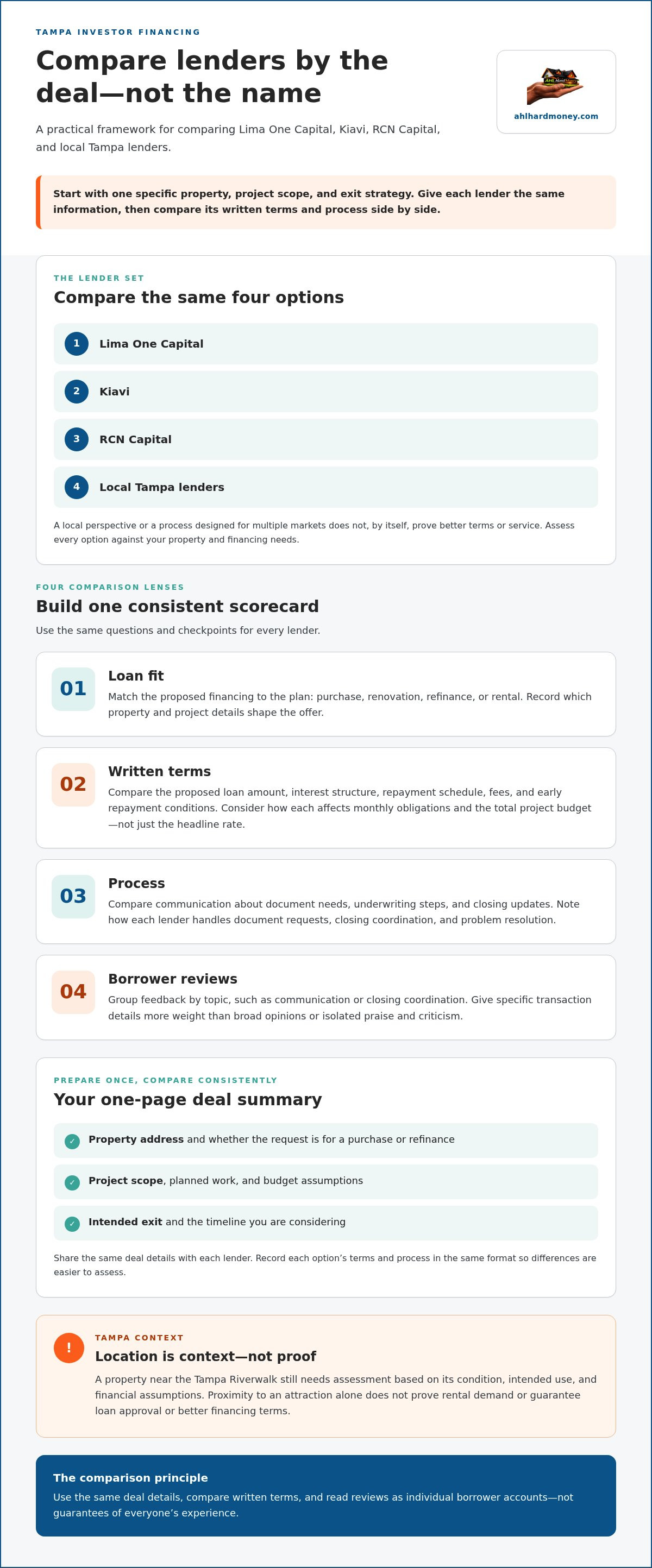
Lima One Capital, Kiavi, RCN Capital, and Tampa lenders can be compared against the same investment plan. Focus on the property, intended use, financing structure, timeline, and borrower experience. Brand recognition alone won’t tell you whether financing fits a Tampa purchase or refinance. Start with a specific example: the property, project scope, and exit strategy you’re considering.
Build a side-by-side comparison using written loan terms. Review the proposed loan amount, interest structure, repayment schedule, fees, and early repayment conditions. Put each item in the same row across the options. Note how differences affect monthly obligations or the total project budget instead of treating the headline rate as the whole decision.
Customer reviews offer a different kind of insight. Read reviews for Lima One Capital, Kiavi, and RCN Capital alongside feedback about Tampa-based lenders. Look for repeated, specific comments about communication, document handling, closing coordination, and problem resolution. One glowing or critical review offers limited context. Several detailed accounts describing the same part of the process can show what borrowers experienced.
Keep your review comparison consistent. Ask the same questions about each lender and distinguish firsthand details from broad opinions. For example, a report of delayed responses is more useful when it explains when they occurred and how they affected the process. Treat each review as one borrower’s account, not proof that everyone will have the same experience.
- Loan fit: Match the proposed financing to a purchase, renovation, refinance, or rental plan. Record which property and project details shape the offer.
- Terms: Compare the full repayment structure, fees, and payoff conditions. A lower advertised rate may not settle which option best matches your timeline.
- Process: Compare how each option communicates document needs, underwriting steps, and closing updates. Use the same checkpoints for all four.
- Reviews: Group feedback by topic, such as communication or closing coordination. Give specific transaction details more weight than general praise.
Tampa lenders can bring a local perspective, while national lenders may use processes designed for multiple markets. Neither description proves that a lender offers better terms or service. Assess each option against your property and financing needs. For example, compare how each proposed plan addresses a Tampa rental purchase and a refinance.
Location matters to your investment plan, but it does not guarantee loan approval. A property near the Tampa Riverwalk still needs to be assessed on its condition, intended use, and financial assumptions. Proximity to an attraction alone does not prove rental demand or guarantee better financing terms. Compare the property details and written terms directly.
Prepare a one-page deal summary and share the same details with each lender. Include the property address, purchase or refinance purpose, planned work, budget assumptions, and intended exit. Record each lender’s terms and process in the same format. This gives Tampa borrowers a clearer basis for assessing Lima One Capital alternatives in Tampa, without relying on brand names or isolated reviews.
What are the eligibility, credit, experience, and property requirements for investor loans in Tampa?
Investor-loan requirements in Tampa depend on the program and deal, not one universal checklist. Lenders commonly consider the borrower, property, project plan, and repayment strategy together. A first-time investor buying a rental in Seminole Heights may present a different profile from an experienced owner refinancing a renovated property. Be ready to explain how the financing supports your investment.
Credit is one part of the assessment. A lender may consider payment history, existing obligations, available funds, and the borrower’s broader financial picture. Criteria vary by lender and program, so one score doesn’t describe every Tampa borrower’s options. Organize an accurate account of current debts and explain any credit events relevant to the application. Clear context helps distinguish a past issue from your current capacity.
Your experience can affect how a lender views the project. If you’ve completed renovations, be ready to describe budgets, contractors, and prior exits. Newer borrowers can also present a detailed plan covering the work, expected timeline, and intended repayment or refinance strategy. For a first Tampa rental purchase, specify whether the plan depends on leasing, renovation, or resale. Keep the explanation consistent with the property and requested financing.
Property details matter because the asset is part of the financing decision. Be ready to identify the property type, condition, purchase or refinance purpose, and planned improvements. A single-family rental in West Tampa differs from a multifamily building that needs substantial work. A lender may consider value, condition, marketability, and project scope. Provide accurate details rather than relying on a neighborhood name to explain the deal.
Make the ownership and project structure clear, too. Explain who will own the property, manage the work, and generate repayment through the investment. If an entity is involved, provide relevant ownership and financial information as requested. Naming the decision-makers and explaining their roles gives the lender a clearer view of the transaction.
- Borrower profile: Summarize your investment purpose, financial position, and relevant credit history.
- Experience: Describe completed projects or explain your specific plan for a first investment.
- Property: Identify the asset, its condition, intended use, and planned work.
- Repayment: Show how the project’s exit strategy relates to the requested financing.
Use these four areas to spot gaps before applying. For a Tampa home improvement project, align the property condition, renovation scope, borrower capacity, and repayment plan. For an equity-based transaction, explain the property’s role and how you plan to use the funds. These distinctions can help when comparing investor financing with related options, such as home equity loans or home improvement hard money loans.
Keep the application narrative consistent. If you plan to renovate a rental, the property details, project budget, and repayment plan should all support that purpose. Lenders assess the complete proposal, not one feature in isolation. Mapping your borrower profile and Tampa property against these factors helps identify what to address before moving forward.
How quickly can Tampa investment-property lenders close, and what documents are required?
Closing speed in Tampa depends on the lender’s review, property, title work, and complete paperwork. One hard-money financing option reports approvals often within 30 minutes and closings in 5 to 15 days, regardless of credit history. That timing describes a particular program, not every investment-property lender. A complex renovation or title issue can add steps before closing.
When comparing lender timelines, distinguish an initial review from approval and closing. An early decision may follow a review of the borrower and basic deal details, but the lender still needs to assess the property, confirm transaction information, and coordinate closing requirements. A Tampa purchase with a clear contract, for example, differs from a refinance involving existing liens and payoff figures.
Prepare an organized document package before applying. The checklist depends on the lender and transaction, but these records help explain the borrower, property, and plan:
- Borrower identification: Gather government-issued identification and contact details for each applicant.
- Ownership records: Provide entity formation and ownership documents when an LLC or other entity will hold the Tampa property.
- Financial information: Organize recent bank statements, asset details, and records of existing property debts.
- Property and transaction records: Include the purchase contract or refinance details, property address, and current mortgage or lien statements.
- Project information: For a renovation, prepare the work scope, contractor estimates, and a clear description of planned improvements.
- Rental records: If the property is leased, gather the lease and details about current rental income.
These records give the lender a consistent picture of the deal. For example, property details for a Tampa duplex purchase should match across the contract, loan application, and project plan. If the borrower’s entity name differs between records, resolve the discrepancy early. For a refinance, current payoff information clarifies which existing obligations the transaction must address.
Use an orderly submission process to reduce avoidable back-and-forth:
- Send the deal summary: State whether the request concerns a purchase, refinance, or renovation.
- Submit matching records: Check names, addresses, ownership, and figures across the application documents.
- Answer follow-up requests: Return requested explanations or missing records promptly and keep copies together.
- Coordinate closing details: Track outstanding title, payoff, insurance, and signing items with the parties handling them.
For example, an investor buying a Tampa rental can submit the signed contract, borrower details, and property records as one organized package. If the property needs repairs, explain the proposed work as well. Clear, consistent documents help the lender assess the actual transaction without pausing to reconcile conflicting details.
Ask each lender to distinguish expected approval timing from the full closing timeline. Identify outstanding documents and who is responsible for each step. This makes timelines more useful than a single fast-approval claim and helps you plan around a purchase contract, renovation schedule, or refinance payoff without assuming every Tampa transaction follows the same path.
What risks and costs should Tampa investors consider when choosing a hard-money or rental-property lender
A Tampa investment can lose flexibility when financing terms don’t match its timeline. Hard-money and rental-property loans may have different repayment structures, fees, and payoff conditions. Review the written terms before committing to a purchase or renovation. For a Ybor City property that needs repairs, compare the full project budget with borrowing costs.
Start with the total cost, not just the interest rate. Ask for an itemized explanation of charges for the proposed transaction. Compare lender fees, third-party expenses, payment obligations, and any charges tied to payoff or extensions. Loan pricing depends on the specific case and is provided after a quote request; factors include the property, financing purpose, project scope, and borrower profile.
Test your repayment plan against realistic project outcomes. A rental strategy depends on completing the work, attracting tenants, and generating enough income to meet obligations. A resale plan depends on finishing the work and selling on schedule. A renovation near downtown Tampa, for example, could take longer if the scope changes. Allow for delays instead of assuming rental income will begin immediately.
Pay close attention to the loan’s term and exit requirements. A short repayment window can create pressure if a renovation, lease-up, sale, or refinance takes longer than expected. Identify the maturity date, payment schedule, payoff process, and extension terms in the written documents. If repayment depends on refinancing, consider how the project’s condition and financial performance support that future step.
- Upfront and ongoing costs: Record each disclosed charge and payment obligation in one budget.
- Payoff terms: Identify how early repayment is handled and whether charges apply.
- Extension conditions: Understand the process and requirements if the project runs late.
- Default consequences: Read the agreement’s remedies and understand the effect of missed payments.
- Property risks: Include repair needs, vacancy, and operating expenses in the Tampa project plan.
Property condition can quickly affect the budget. For a home improvement project in Seminole Heights, separate necessary work from optional upgrades. Compare contractor estimates with available project funds and decide how you’ll handle changes. A budget with no room for surprises can put repayment under pressure if the work expands.
Rental-property investors should examine the gap between expected income and obligations. Include vacancy, maintenance, insurance, taxes, and routine management costs in the cash-flow plan. Don’t base repayment on full occupancy alone. For a Tampa rental, compare planned income with expenses under a more cautious operating scenario.
Before choosing a lender, collect each written offer, compare the same cost and repayment categories, and flag every term that could affect your exit. Then test the loan against a delayed renovation or slower rental start. This turns the comparison into a practical risk review, helping you choose financing that supports your property plan rather than relying on optimistic assumptions.
AHL HardMoney: Cash Out Refinance
AHL HardMoney, llc may be a relevant next step if you own property and are considering using its equity toward another financial goal. Its Cash-Out Refinance program can help Tampa borrowers explore refinancing that releases equity. It may suit an investor looking to restructure property financing or access funds for a planned need. The right fit depends on the property, purpose, and repayment plan.
Other situations may call for a different approach. Home Equity Loans, Private Money Loans, and Foreclosure Refinance Loans address distinct financing needs. Consider how your goal relates to the property and repayment strategy before choosing a direction.
Contact AHL HardMoney, llc to discuss whether Cash-Out Refinance fits your Tampa property plans.
Choose a Financing Path That Fits Your Next Move
Comparing Lima One Capital alternatives in Tampa is useful when it helps you make a clear decision about your property and plans. Consider what the financing needs to accomplish, how the property supports that goal, and which repayment approach fits your broader investment strategy. A focused discussion can turn those priorities into a practical next step.
AHL HardMoney, llc offers Cash Out Refinance, Home Equity Loans, and Private Money Refinance. These options serve different financing needs, so the right starting point depends on whether you’re exploring property equity or refinancing. Bring your property details and intended use of funds into the conversation to keep it specific to your situation.
Move forward with a clear purpose and a plan you can assess. The right financing conversation starts with your goals.
Your next property decision can start with a thoughtful, informed step.
Disclaimer:
While Dan is not a real estate attorney, he is a Full Time, Licensed Florida Mortgage and Real Estate Broker Professional coupled with 21+ years of successful strategies, methodologies and techniques that have proven effective to the benefit of Florida families.
While not every conversation is a deal, we promise to leave you better off then before you called. We serve everyone we come in contact, with the highest levels of integrity and dignity.
We invite you to make the call 📲


