


Article by
Dan Conneally - NMLS 339916, LO13164, BK3246524, CQ1072086
Dan Conneally has been successfully helping Florida families with thier real estate related situations for the last 21+ years, regardless of credit or past financial background.
While Dan is effective with institutional lending, he particuarly shines when matters require unique strategies involving noninstitutional resources.
Check out his legions of testimonials from real Florida families at Google, Facebook and the BBB to get a sense of the caliber and effectiveness he achieves. Dan has appeared on television speading the message of hope to good folks that need diligent, discrete, nonjudgy care.
The lender with the biggest footprint isn’t automatically the best fit for your Florida deal. Private-money financing can close in as fast as 7 days, so choosing between Kiavi and local private money lenders in Florida comes down to which lender’s speed, borrower requirements, state coverage, reputation, and deal flexibility fit your investment.
When a property is moving quickly, closing speed matters. But a fast timeline only helps if the lender’s process and terms fit your experience, property, and investment plan.
This comparison explains what to weigh when choosing between Kiavi and a Florida-focused private lender, including borrower review, property fit, and loan terms. Use the practical steps below to compare offers for the same deal instead of choosing by name alone.
Key Takeaways
- Compare the full path to funding, from initial review through underwriting and closing, not just a lender’s headline timeline.
- Look at how each lender weighs your credit profile, investing experience, property, and overall deal.
- Confirm that the lender’s Florida coverage fits the property’s location and the type of financing you need.
- Assess reputation through clear communication and transparent loan terms, then match the financing structure to your project and exit plan.
- For an existing property, explore whether cash-out refinancing could support your next investment or financial goal.
Closing speed and underwriting
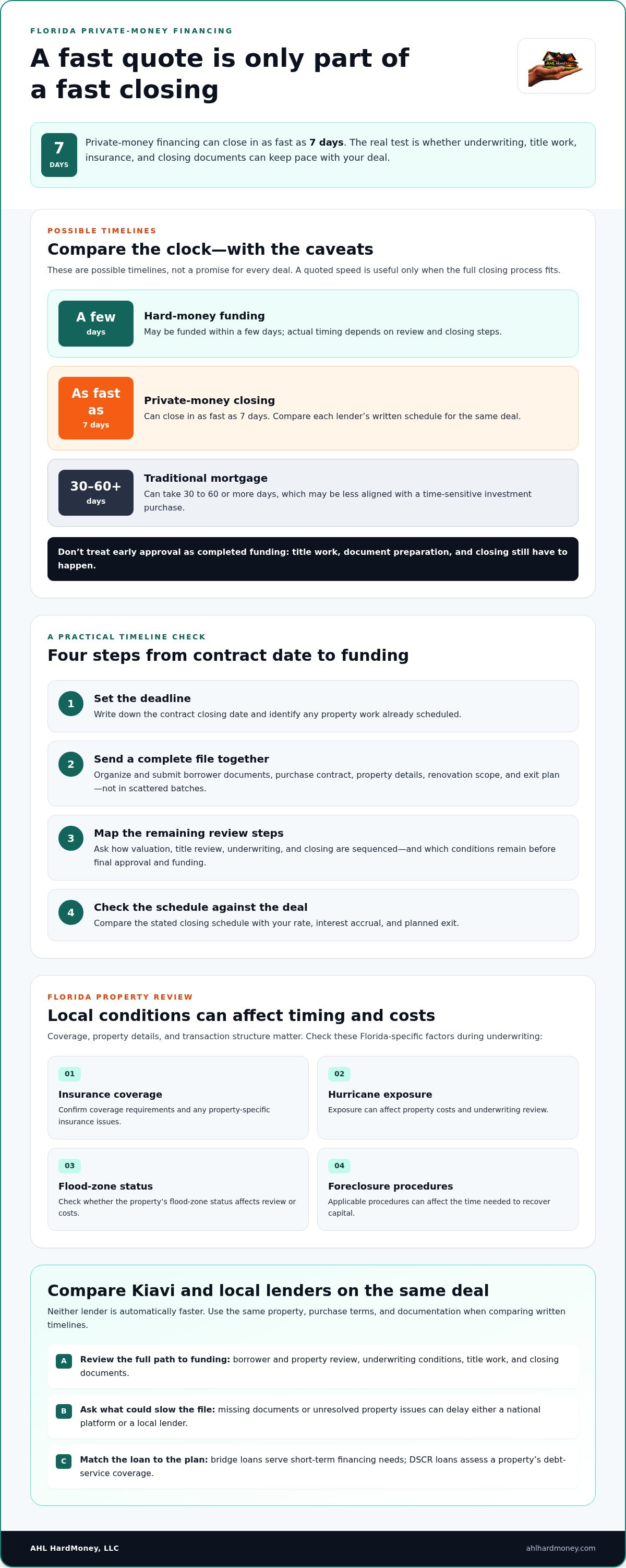
Hard-money and private-money real estate loans can close in as fast as 7 days. In a Kiavi-versus-local comparison, the practical difference is how quickly each lender reviews the property, borrower, and requested capital. A quoted timeline matters only when underwriting, title work, insurance, and closing documents keep pace.
Private- and hard-money real estate loans in Florida are subject to applicable lending, contract, mortgage-document, and foreclosure rules. Requirements depend on the transaction structure and how the borrower uses the property.
Florida investors should account for insurance coverage, hurricane exposure, flood-zone status, and foreclosure procedures. These factors can affect property costs, underwriting review, and the time needed to recover capital.
Speed starts with a complete file. Before comparing a term sheet, organize the purchase contract, property details, renovation scope, and exit plan. Then ask how the lender sequences valuation, title review, underwriting, and closing. A missing document or unresolved property issue can slow either a national platform or a local lender.
Hard-money loans may be funded within a few days, while private-money closings can take as fast as 7 days. These are possible timelines, not a promise for every deal. A traditional mortgage can take 30 to 60 or more days, making it less aligned with some time-sensitive investment purchases. Bridge loans also serve short-term financing needs, while DSCR loans assess a property's debt-service coverage. Compare the product's purpose with your planned hold and exit.
| Option | Speed factors | Underwriting focus | Best comparison step |
|---|---|---|---|
| Kiavi | File completeness and review sequence | Borrower, property, and deal details | Map each review step to your closing date |
| Local Florida lender | File completeness and review sequence | Borrower, property, and deal details | Ask for the process and required documents |
Do not assume one lender is automatically faster. Compare written timelines for the same property, purchase terms, and documentation. Separate approval from closing: an early decision does not complete title work, document preparation, or funding.
Use this sequence to test the timeline:
- Set the contract closing date and identify any scheduled property work.
- Submit requested borrower and property documents together, not in scattered batches.
- Ask which underwriting conditions remain before final approval and funding.
- Compare the stated closing schedule with your rate, interest accrual, and exit plan.
Choose a lender whose documented process fits your contract deadline and deal structure. A faster timeline matters only when the underwriting terms and closing steps also support your investment.
Credit score and borrower requirements
A credit score is only one part of a real estate loan review. Hard money lenders may begin pre-qualifying a borrower with a soft credit pull, while also assessing the property, available equity, experience, and exit plan. Some lenders require 1-2 completed flips, so an investor’s track record can matter alongside credit history.
Conventional mortgage benchmarks offer context, but don’t automatically determine private-money approval. A credit score of 740 or above is described as ideal for a lower mortgage down payment and a more attractive interest rate. For mortgage qualification, a debt-to-income ratio of 50% or less gives borrowers the most options. A borrower paying $2,000 in monthly debt with $6,000 in gross monthly income has a 33% ratio.
Private lenders may weigh collateral and leverage differently from mortgage lenders. A hard-money loan may require a down payment of 20% to 35%, based on the property’s current value or after-repair value. Compare Kiavi vs local private money lenders in Florida by reviewing how each evaluates credit, investing experience, property condition, and funds for purchase or renovation. Don’t assume one credit score tells the whole story.
To compare offers, review the interest rate, how interest accrues, lender charges, cash due at closing, and repayment terms. Estimate borrowing costs over your expected hold period, then compare them with your exit plan and available capital. A Kiavi vs local private money lenders Florida comparison is most useful when both offers use the same deal assumptions.
Application steps can differ, but an organized file helps a borrower move through review. Prepare a credit and financial summary, purchase contract or refinance details, property information, renovation scope, and a clear exit plan. Submit requested materials together, then respond promptly to underwriting questions. For a purchase, connect the contract terms to the leverage requested; for a refinance, outline existing property debt and the intended use of funds.
- Communication: Track who answers questions, how clearly they explain conditions, and whether updates arrive at each review step.
- Reviews and complaints: Look for repeated themes about communication, closing coordination, or unresolved concerns. Consider how the lender responds, rather than treating one review as the full picture.
- Borrower support: Note whether you have a clear point of contact and understand which documents or decisions are needed next.
For example, if two offers use similar collateral but require different borrower contributions or repayment structures, compare the cash needed upfront and total cost over your planned hold. Reviewing terms, support, and borrower feedback side by side can clarify the choice. Florida investors can also discuss their financing needs with AHL HardMoney, llc.
Geographic availability and state coverage
For a Florida investment, start with the property address, not a lender’s general state list. Kiavi and a local private lender may differ in geographic reach, property types, and financing programs. A lender serving Florida may still have different terms for a rental, renovation, or construction project.
Compare coverage at the property level. Identify the Florida city and county, then match the address to the lender’s eligible markets and loan purpose. A rental in one part of Florida may be assessed differently from a construction project elsewhere. The address is a first filter, not proof of approval.
State coverage matters to investors working across state lines. If you own properties in Florida and another state, compare whether each lender can handle both locations and the loan programs you need. “Available” may refer to a state, a property type, or a specific product. Compare the exact combination instead of relying on a broad coverage statement.
Ask how servicing works after closing. A lender’s geographic reach may differ from the team that handles payments and loan administration. For a Florida rental, clarify how to access payment instructions, account support, and loan documents. Understanding the servicing process helps you know what support to expect after funding.
Use the same property details to compare Kiavi with a local option. Record the address, occupancy plan, property type, requested financing, and whether the project involves repairs or construction. Then compare each lender’s response to those details. This prevents differences in project assumptions from being mistaken for differences in state coverage.
- Property location: Match the full Florida address to the lender’s coverage and eligible counties.
- Loan purpose: Compare rental, purchase, refinance, and construction needs separately.
- Property type: Identify whether the asset is a single-family rental, multifamily property, or another investment type.
- Servicing: Understand who handles payments and account administration after closing.
For example, an investor considering a Florida rental and an out-of-state property should compare coverage for each address, rather than assume one lender handles both. Apply the same check if a rental plan changes to renovation or construction. A change in use can affect the relevant program even if the property stays in the same state.
Build a simple coverage matrix with one row per property and columns for location, loan purpose, property type, and servicing contact. Record each lender’s response against the same facts. Choose the option whose geographic reach and program fit the actual Florida property and investment plan, not simply the broadest map.
Choosing a reputable lender
Reputation matters because a real estate loan involves more than approval. Before choosing Kiavi or a Florida lender, review the written terms, communication, and funding process. A bridge loan can support a short-term investment, but repayment must fit your exit plan. Clear answers are a practical sign of a well-managed lending relationship.
Start with the documents. Compare the term sheet with the final loan documents, checking that the interest, repayment, extension options, and funding conditions are consistent. If approval depends on outstanding requirements, get each condition in writing. For example, a borrower planning renovations should understand which project details are required before closing.
Reviews can reveal patterns, but read them carefully. A single complaint about a delayed response offers limited context; repeated reports of the same communication problem deserve closer attention. See whether the lender responds clearly and explains how concerns were handled. Apply the same standard to positive reviews: specific details about a completed purchase or bridge loan are more useful than general praise.
Use the same process to assess support from Kiavi and local lenders. Note who handles questions, how updates arrive, and whether the next step is clearly explained. A Florida investor facing a contract deadline needs to know which documents remain outstanding and how they affect approval. Helpful communication is specific, timely, and tied to the deal.
- Review the terms: Match the term sheet to the loan documents and identify conditions before funding.
- Test clarity: Ask for an explanation of an unfamiliar term, then assess whether the answer addresses it directly.
- Read reviews for patterns: Compare repeated comments about communication, document handling, and closing coordination.
- Map the process: Record the person responsible for each step from application through servicing.
- Connect the loan to the plan: Check that repayment timing aligns with the purchase, renovation, or sale strategy.
A credible lender should explain how the loan fits the property and planned exit without relying on vague assurances. If you expect to repay a bridge loan through a property sale, for example, the projected sale timeline and repayment terms should make sense together. If answers conflict across conversations or documents, resolve the discrepancy before relying on the approval.
Keep a simple comparison record for each lender: written terms, open conditions, contact person, review themes, and planned funding path. This gives you a fair basis for comparing the relationship, not just the speed of initial approval. Choose a lender whose documents and process you understand and whose terms fit the realities of your Florida investment.
Deal flexibility and underwriting
Compare the financing structure with the property and exit plan, not the lender’s name alone. For a fix-and-flip or rental, assess underwriting, renovation draws, repayment terms, and support using the same deal details.
Kiavi Deal Flexibility and Underwriting
Review Kiavi’s written offer to see whether its financing fits your fix-and-flip or rental investment. Compare underwriting conditions, required borrower contribution, and renovation draw schedule with your project plan. Track how clearly the lender explains each condition and draw step. The documents show how the terms apply to your deal, beyond a general product label.
Local Lender Deal Flexibility and Underwriting
Apply the same test to a local Florida lender’s written offer. Confirm whether its financing covers your intended flip or rental, then compare its underwriting criteria and draw process with Kiavi’s. A local relationship can help with property-specific discussions, but judge support by clear answers, documented conditions, and a path from approval to each draw that you can understand.
For comparable fix-and-flip or rental financing, the written programs must cover the same investment purpose. Compare Kiavi with Florida private lenders on that basis, then evaluate the terms and process instead of assuming every lender structures a deal the same way.
Underwriting can weigh collateral and project costs alongside borrower income. A hard money loan may require a down payment of 20% to 35%, based on the property’s current value or after-repair value. By contrast, a traditional mortgage’s minimum down payment is 3%. These figures describe different financing approaches, so compare each lender’s actual structure and how it affects your cash contribution.
Loan-to-value and loan-to-cost measure different things. Ask which basis applies, what costs count, and how the remaining cash requirement fits your budget.
Pay close attention to renovation draws. Compare the work required before funds are released, the documents needed for a draw request, and the schedule against contractor payments. For example, a project that needs materials funded early could face a cash-flow gap if funds are released only after work is complete.
Compare offers using the same property, renovation budget, and exit plan. Review borrower contribution, underwriting conditions, draw timing, repayment period, and the contact for questions. Hard-money repayment periods can range from six months to several years, so match the term to your project timeline. Choose the offer whose written terms best fit the investment and your available capital.
AHL HardMoney, LLC: Cash Out Refinance
AHL HardMoney, LLC offers Cash-Out Refinance for Florida property owners who want to access equity through refinancing. It may suit an investor who owns a property and wants to put available equity toward a financial goal or another investment. Consider the property, existing mortgage, intended use of funds, and repayment plan.
For other financing needs, AHL HardMoney, LLC also offers Home Equity Loans, Private Money Refinance, and Foreclosure Refinance Loans. Match the option to your property and situation rather than treating these offerings as interchangeable. Review the Cash Out Refinance details as you consider your next step.
To discuss your financing needs, contact AHL HardMoney, LLC or visit ahlhardmoney.com.
Choose a financing path that fits your next move
Connect your financing choice to a clear property plan. Set out how you intend to use the funds, how you plan to repay, and what matters most. Those details can make a lender conversation more focused and help ground your decision in your investment goals.
In your comparison of Kiavi with local private money lenders in Florida, look beyond the initial offer. Consider whether the proposed terms and process make sense for the property and your next move. If you’re exploring financing options, AHL HardMoney, LLC can discuss how your deal fits its available loan solutions.
Take the next step with a clear picture of your goals. Contact AHLHardMoney™ to discuss your property, financing needs, and repayment plan.
Frequently Asked Questions
Which Real Estate Investment Lender Should You Choose?
Choose the lender whose written terms fit your property, investment plan, and repayment strategy. For example, an investor buying a rental can compare offers using the same purchase details and intended use, then see which structure better fits the project. Before deciding, write down your priorities, such as predictable draw procedures or a particular exit plan. Use that list to assess the complete offer, not only the initial approval.
What is hard money lending?
Hard money lending is non-institutional financing secured by real estate equity. The property and its equity are central to the loan, along with the borrower’s plans for the funds. A property owner might consider this financing when a project or financial situation calls for an option outside conventional bank criteria. Review the loan documents carefully to understand repayment terms and how the property secures the financing.
Disclaimer:
While Dan is not a real estate attorney, he is a Full Time, Licensed Florida Mortgage and Real Estate Broker Professional coupled with 21+ years of successful strategies, methodologies and techniques that have proven effective to the benefit of Florida families.
While not every conversation is a deal, we promise to leave you better off then before you called. We serve everyone we come in contact, with the highest levels of integrity and dignity.
We invite you to make the call 📲


