


Article by
Dan Conneally - NMLS 339916, LO13164, BK3246524, CQ1072086
Dan Conneally has been successfully helping Florida families with thier real estate related situations for the last 21+ years, regardless of credit or past financial background.
While Dan is effective with institutional lending, he particuarly shines when matters require unique strategies involving noninstitutional resources.
Check out his legions of testimonials from real Florida families at Google, Facebook and the BBB to get a sense of the caliber and effectiveness he achieves. Dan has appeared on television speading the message of hope to good folks that need diligent, discrete, nonjudgy care.
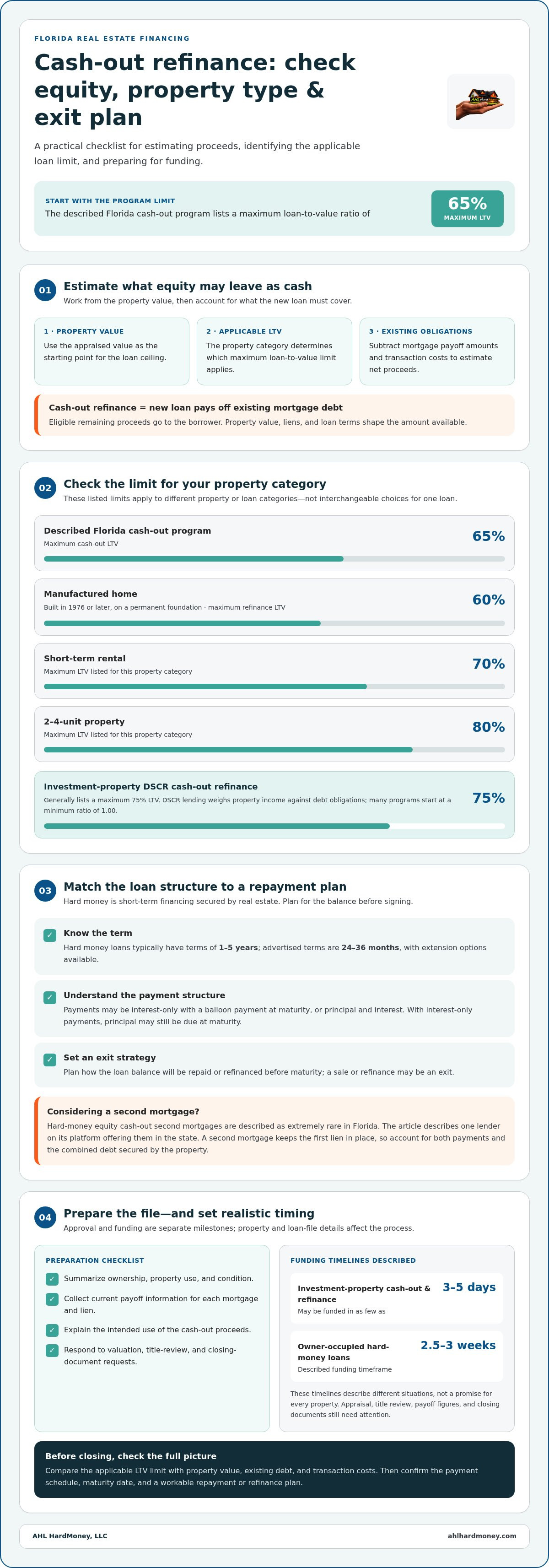
Equity can matter more than a traditional credit profile in a hard money cash-out refinance in Florida. The loan is secured by real estate, and the Florida program described sets a maximum cash-out loan-to-value ratio of 65%, so the property’s value and existing debt help determine how much cash may be available. It’s a short-term financing route, not a one-size-fits-all answer.
Before using property equity, get clear on how the loan works, what the lender considers, and when funds may be available. This guide explains hard money cash out refinance in Florida, how property value and existing debt affect proceeds, and what to expect from the process. It also compares cash-out refinancing with other financing structures to help you decide what fits your property and investment plan.
Key Takeaways
- Hard money financing is secured by real estate, with property equity playing a central role in evaluating a cash-out refinance.
- Compare the maximum loan amount with your existing payoff and closing costs to estimate whether enough equity may be available for your plans.
- Approval and closing speed depend on the property and loan file; prepare clear details about the property, current debt, and intended use of funds.
- Weigh a short-term hard money loan against conventional refinancing or a HELOC by considering the payment structure, timeline, and financing purpose.
- Match the financing route to your investment goal, whether you need cash from equity, a refinance, or help addressing foreclosure pressure.
What is Hard Money?
A hard money loan is private real estate financing secured by the property. In Florida, lending decisions can focus on equity and collateral rather than credit alone. For a cash-out refinance, the new loan pays off existing mortgage debt, and eligible remaining proceeds go to the borrower. The property’s appraised value, current liens, and loan terms shape the available cash.
Residential mortgage amounts are tied to the home’s value and the lender’s loan-to-value limit. The described Florida program lists a maximum 65% loan-to-value ratio for cash-out refinancing. For example, a property’s value sets the ceiling before existing debt and transaction costs are subtracted. Hard money loans typically have terms of 1 to 5 years; advertised terms are 24-36 months, with extension options available. Payment structures may be interest-only with a balloon payment at maturity, or principal and interest. Investors should plan how the balance will be repaid or refinanced before signing.
For commercial properties, the property also serves as collateral, and the requested financing is assessed in light of its value and existing obligations. Start with the mortgage payoff, then account for transaction costs to estimate net proceeds. This shows whether the cash could support renovations, debt repayment, or another investment. Property use and condition also help clarify the financing request.
Property type can change the permitted leverage. The described program lists a 60% maximum refinance loan-to-value ratio for manufactured homes built in 1976 or later on permanent foundations. Short-term rentals have a 70% maximum, while 2-4-unit properties list an 80% maximum. These figures apply to different property categories, not interchangeable choices for one loan. A cash-out applicant should identify the property type, confirm the appraisal basis, and compare the applicable limit with the mortgage payoff.
A second mortgage lets a borrower seek equity without replacing the first lien, but hard-money equity cash-out second mortgages are extremely rare in Florida. The described market has one lender on its platform offering them in the state. Investors considering this structure should account for both loan payments and the combined debt secured by the property. For an investment property, a DSCR cash-out refinance generally has a maximum 75% loan-to-value ratio. DSCR lending weighs property income against debt obligations; many programs start with a minimum ratio of 1.00. A Florida cash-out refinance starts with understanding the property value, liens, and intended proceeds.
Approval and closing timelines
Approval and funding are separate milestones in a Florida refinance. Investment-property cash-out and refinance loans may be funded in as few as 3-5 days, while owner-occupied Florida hard-money loans take 2.5-3 weeks to fund. The difference reflects the borrower and property situation. A quick initial decision doesn’t mean appraisal, title review, payoff figures, and closing documents are finished.
To apply for a hard money cash out refinance in Florida, prepare property ownership details, current mortgage payoff information, and financial records relevant to your request. The process includes reviewing the property, title and liens, preparing loan documents, and closing. If the property is a rental or under construction, explain its use and how you plan to use the proceeds.
How long does a hard money cash out refinance in Florida take to close? Investment-property loans may fund in as few as 3-5 days, while owner-occupied loans take 2.5-3 weeks to fund. These are different timelines for different situations, not interchangeable estimates for every property.
A few practical steps can help keep your application organized. Gather current payoff information for each mortgage or lien, then collect ownership and property records. Respond promptly to requests related to valuation, title review, or closing documents. Missing payoff figures can make it harder to calculate net proceeds, while title issues may need to be resolved before closing.
Use this preparation checklist:
- Summarize the property’s ownership, use, and condition.
- Collect current payoff information for existing mortgages and liens.
- Explain the intended use of the cash-out proceeds.
- Keep appraisal, title, and closing requests moving with prompt responses.
For a hard money cash out refinance in Florida, match the expected funding date to your next project milestone. If you plan to use proceeds for construction, consider how the closing timeline fits planned work. For a rental property, account for leasing and operating plans when deciding when you need the funds.
Before signing, understand the payment schedule and loan maturity. With interest-only payments, the principal may still be due at maturity, so make sure your repayment plan fits the loan term. A fast closing can help with timing, but you also need a workable exit, such as a sale or refinance, before the balance comes due.
Florida private money loans for real estate investors
Private money financing gives Florida investors another way to fund property transactions. A bridge loan can cover a temporary gap, such as buying or improving a property before a longer-term mortgage is ready. In the described Florida programs, bridge loans commonly run from 6 to 18 months and use interest-only payments. That short structure makes the planned exit important from the start.
For bridge financing, connect each financing step to the property’s next milestone. An investor renovating a property, for example, can plan around acquisition, construction, and the eventual sale or refinance. Because the loan is short term, clarify the repayment strategy before committing funds. Consider project timing, existing debt, property condition, and the income or sale proceeds intended to repay the balance.
Investment-property refinancing can serve a different purpose: replacing current mortgage debt, changing financing terms, or drawing equity for another investment. A lender reviews the property, its liens, and the requested loan structure. For a DSCR cash-out refinance, Florida programs commonly require about 6 months of ownership, measured from title recording. That timing can affect an investor who recently acquired a property and wants to refinance before completing the ownership period.
Cash-out proceeds depend on the property’s value, outstanding mortgage payoff, and other obligations secured against it. Compare the requested refinance amount with current debt, then consider how the net proceeds would support your next transaction. For an investment property, rental income may help explain the financing request, while the property’s condition and use provide relevant context. A clear account of your investment plan makes the request easier to assess.
Florida’s short-term investment real estate market recorded an estimated $3.0B in loan volume across 2,805 loans in Q2 2026. That market figure offers context, not a prediction for an individual property. Each investor still needs to connect the loan structure with a specific project, repayment route, and timing. Bridge financing fits a temporary need; a refinance addresses existing property debt or equity access.
Before choosing a structure, write down these project details:
- Property purpose: Identify whether the asset is a rental, renovation, or another investment property.
- Current obligations: List mortgage balances and other property liens that affect available equity.
- Exit plan: State whether repayment depends on a sale, refinance, or property income.
- Timing: Compare construction or leasing milestones with the loan’s term and maturity.
This comparison helps distinguish short-term bridge financing from a longer-term investment-property refinance, keeping the requested capital tied to a defined real estate plan.
Florida hard money cash-out refinancing
A hard money cash-out refinance in Florida can convert eligible property equity into proceeds after existing debt is paid. Before comparing lenders, account for state taxes, closing charges, payment terms, and the property’s intended use.
Florida Rules, Taxes, and Closing Costs
Florida documentary stamp tax on promissory notes is 35 cents per $100 or portion of the obligation. The nonrecurring intangible tax on obligations secured by Florida real property is 2 mills, or $2 per $1,000. Include these taxes alongside title, recording, and other transaction charges when estimating the cash available after closing.
The $2,450 documentary stamp tax maximum applies to a promissory note, but not to a mortgage or lien recorded in Florida. After full repayment, Florida Statute 701.04 sets the period for recording mortgage satisfaction and sending the borrower a recorded copy. Include payoff amounts and recorded liens in your proceeds calculation.
Refinancing Risks and Common Fees
A hard money cash-out refinance in Florida adds debt secured by your property. Review the payment schedule, maturity date, and written charges, then estimate net proceeds after existing debt and closing costs. With interest-only payments, the principal may be due at maturity, so plan how you will repay it, whether through a sale, refinance, or another defined source.
A short loan term can create pressure if a sale or project takes longer than expected. Construction delays, for example, may push back a sale or refinance while payments continue under the loan terms. Compare the project timeline with the maturity date before relying on future proceeds to repay the balance.
Florida is the state market for these loans. Local property examples include Tampa, Clearwater, Largo, Orlando, and Lakeland, but a city name alone doesn’t establish that every lender offers cash-out refinancing there. The property’s location, value, title, and transaction details shape which financing terms apply.
For a purchase or refinance, begin with the current mortgage payoff and any recorded liens. Account for taxes and closing charges before comparing the requested loan with available equity. If you’re a commercial borrower, connect the requested capital to a defined property plan, such as renovations or debt repayment. This clarifies how you’ll use the proceeds and plan to repay the loan.
Before signing, review the interest rate, payment schedule, maturity date, extension terms, and prepayment conditions in the loan documents. Compare the complete written terms rather than focusing on the rate alone. This helps you weigh repayment obligations against the cash available at closing.
How does a hard money cash-out refinance compare with a conventional cash-out refinance or HELOC in Florida?
These options differ in how they access home equity, structure debt, and assess a borrower. A hard money refinance is secured by real estate, and its review can emphasize the property’s value and available equity. The Florida program described sets a 65% maximum loan-to-value ratio for cash-out refinancing. That limit helps frame a request, but existing debt and closing costs also affect net proceeds.
A conventional cash-out refinance replaces the existing mortgage with a new one, then provides eligible proceeds to the borrower. Compare the new payment and full repayment terms with your current mortgage. A conventional loan may place more weight on credit and income than a property-focused private loan. Compare the full qualification process and loan terms, not just the cash available at closing.
A HELOC provides access to a credit line secured by property, rather than replacing the first mortgage as a refinance does. You draw funds as needed under the line’s terms. This structure may suit staged expenses, such as renovation work completed in phases. Compare how payments are calculated, how you access funds, and whether the HELOC’s lien position fits the property’s existing financing.
Term length matters. Florida hard money loans typically have terms of 1 to 5 years, and payment structures can include interest-only payments with principal due at maturity. A conventional refinance or HELOC follows its own repayment terms, which should be reviewed in the loan documents. For an investor, a short-term hard money loan fits best with a defined plan, such as selling after construction or refinancing into longer-term financing—a process where learning resources from Mortgage Suite Ltd can provide helpful guidance on broader property lending fundamentals.
Use these questions to compare the three paths:
- Purpose: Does the transaction replace a mortgage, provide a credit line, or release equity for a defined investment?
- Underwriting: How do property value, credit, income, and existing liens factor into approval?
- Repayment: What payment schedule and maturity terms apply, and what is the plan for the remaining balance?
- Proceeds: After paying existing debt and closing costs, how much cash remains for the intended use?
An investor funding a time-sensitive renovation might prioritize a property-based review and short-term loan structure. Someone who needs funds gradually could compare a HELOC’s draw structure, while a borrower looking to replace an existing mortgage could consider a conventional refinance. Match the financing to the project, then compare the written terms side by side.
Explore cash-out refinance options
AHL HardMoney: Cash Out Refinance
AHL HardMoney, llc offers Cash-Out Refinance in major Florida cities for property owners seeking to access real estate equity. Investors can explore this option to meet a defined property or debt goal. The company also offers Home Equity Loans and Refinance Loans for other financing needs.
AHL HardMoney, llc reports “30 Min Approvals” and closing in 5 to 15 days, regardless of credit history. Organize property details, the current mortgage payoff, and your intended use of proceeds to clarify your financing request.
To discuss your property and financing goals, contact AHL HardMoney, llc or visit ahlhardmoney.com.
Make your next financing move with purpose
Before using property equity, turn your investment goal into a clear decision brief. Write down what the funds need to accomplish, when you need access to capital, and what outcome would make the transaction worthwhile. This keeps the financing decision connected to your project instead of urgency alone.
A hard money cash-out refinance in Florida should fit the property’s role in your broader plan. Consider how it affects your next investment step, your financial flexibility, and the priorities you may need to revisit if the project changes. A focused conversation can help you organize your considerations and identify the questions that matter most to your situation.
Bring your goals and property details to the conversation. A thoughtful next step can make a complex financing decision easier to manage.
Your investment plans deserve a clear, confident path forward.
Frequently Asked Questions
What Does the Exit Actually Look Like?
Your exit strategy is the repayment plan that clears the loan balance. It may involve selling the property, refinancing into longer-term financing, or using property income to support repayment. If you’re borrowing for renovations, align the expected work and sale or refinance plan with the loan’s maturity. Map out the next financing step before closing instead of relying on future equity alone.
What is a hard money cash-out refinance in Florida?
A cash-out refinance replaces existing real estate debt with a new loan secured by the property. After the old debt and transaction costs are paid, eligible proceeds go to the borrower. Investors may use the cash for a property-related goal, such as repairs or another investment. The amount available depends on property value, current liens, and loan terms. Unlike a credit line, a refinance provides proceeds through a new loan rather than allowing funds to be drawn as needed.
What are current Florida hard money cash-out refinance rates, fees, and loan terms?
Rates, charges, and repayment terms depend on the property, loan structure, and transaction details. Don’t compare options by interest rate alone: review the payment schedule, maturity date, extension provisions, and all charges in the written terms. Also estimate net proceeds after existing debt and closing costs. That figure, rather than the gross loan amount, shows how much cash could support your investment plan.
What maximum loan-to-value ratios do Florida hard money lenders allow for cash-out refinances?
The described Florida cash-out program lists a maximum loan-to-value ratio of 65%. A DSCR cash-out refinance on an investment property generally has a maximum of 75%, under a different program structure. Loan-to-value compares the proposed loan with the property’s appraised value. For a useful estimate, apply the relevant cap, then account for mortgage payoffs and transaction costs that reduce cash available to you.
What are the Florida eligibility requirements for a hard money cash-out refinance?
Start with a Florida property that has enough usable equity for the requested refinance after existing liens are considered. The review can weigh the property’s appraised value, ownership and use, title, payoff figures, and the borrower’s plan for the proceeds. For investor properties using DSCR financing, rental income is relevant to the property’s ability to support debt. Organize ownership, property, and mortgage records to clarify the request.
How much equity or cash can I take out with a Florida hard money refinance?
Estimate available cash by multiplying the appraised value by the applicable loan-to-value limit, then subtracting existing mortgage payoffs and transaction costs. That estimate is not the cash you receive: liens and closing charges reduce net proceeds, and the loan terms determine the final structure.
Disclaimer:
While Dan is not a real estate attorney, he is a Full Time, Licensed Florida Mortgage and Real Estate Broker Professional coupled with 21+ years of successful strategies, methodologies and techniques that have proven effective to the benefit of Florida families.
While not every conversation is a deal, we promise to leave you better off then before you called. We serve everyone we come in contact, with the highest levels of integrity and dignity.
We invite you to make the call 📲


